
A winter road trip in Iceland promises frost-covered waterfalls, icebergs on black sand, and—with a little luck—the Northern Lights above the road. But it’s also a trip that’s much less forgiving of mistakes than in the summer.
After driving around the island in the snow, here are the mistakes we saw (and sometimes made!)—so your road trip will be a magical memory, not a nightmare.
This opinion is completely independent, based on our experiences. We visited the region anonymously, making our own choices and paying our bills in full.
1. Underestimating the wind
We worry about snow, ice… and we forget the real ruler of the Icelandic winter: the wind.
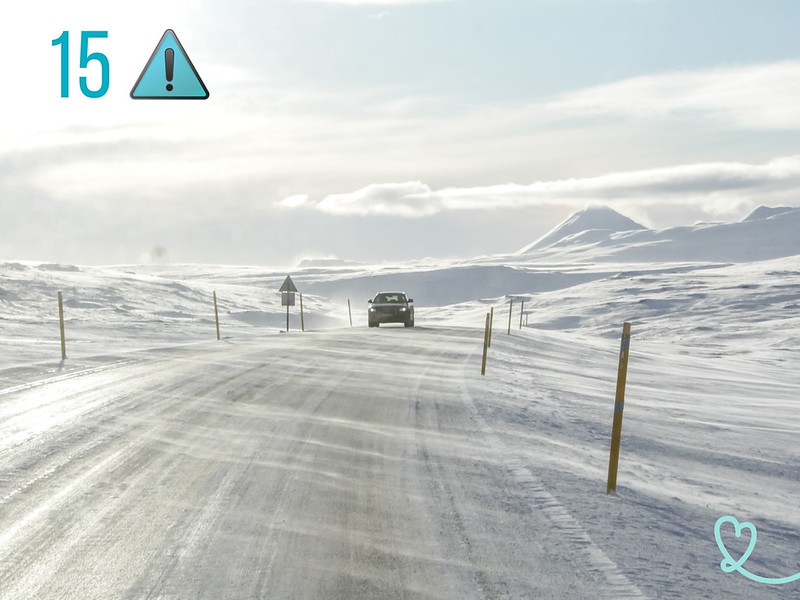
Gusts of wind come without warning, often right after a turn or when coming down from a mountain pass, and can cause the car to veer off course. They also push the snow onto the road, and drifts form within minutes.

Wind can be dangerous even when the car is stopped: a door that opens suddenly can be twisted off its hinges. Park facing the wind and always hold the door with both hands. This type of damage is one of the most common in Iceland and is rarely covered by basic insurance.
And if an orange or red alert is issued, there’s no room for negotiation: stay indoors and wait.
Learn more in our article on winter driving.
2. Driving without checking the road conditions

In winter, yesterday’s weather says nothing about today’s road conditions. Every morning, before we get started, we have our little ritual:
- Umferdin on road closures and road conditions
- vedur.is for weather and, especially, wind alerts (yellow, orange, red)
- Safetravel.is and the 112 Iceland app: useful in case of an emergency
And feel free to ask the staff at your hotel for advice. Icelanders know their roads, and their “I wouldn’t go out today” is worth more than any website.
3. Trying to tour the island in too few days
On the map, Route 1 looks like a good choice. In winter, it’s a whole different story: short days, slower driving, photo stops everywhere… and a storm that can tie you up for an entire day.
To complete the entire tour, plan on at least 7 days; 10 days would be more comfortable. If you’re short on time, focus on the Golden Circle, the southern coast, and perhaps Snaefellsnes.

Always leave a day of leeway in your schedule. If all goes well, we’ll have an extra day to spend at a hot spring or a glacier.
Get inspired by our itineraries: a week or 10 days in Iceland this winter.
4. Forget that night falls (very) early
In December and January, you only get 4 to 5 hours of daylight. If you don’t factor this into your schedule, you’ll inevitably end up driving at night on unlit rural roads, where it becomes difficult to judge distances and the condition of the road surface.

Our tip: Drive at dawn or dusk and save the daylight hours for sightseeing.
And if you can choose your dates, late February and early March offer a much better balance, with 10 to 13 hours of daylight. Check out our articles on Iceland in February and March.
5. Renting the wrong car

The smallest city car in the lineup is tempting for those on a budget… but much less so when the wind picks up. Small cars don’t handle as well.
A 4WD isn’t required on Route 1, but it offers real comfort and added safety. Cars are usually equipped with snow tires, but check them before you leave, and then every morning.
Our first instinct is to compare offers on DiscoverCars (major brands and a few local rental companies) or on GuidetoIceland for more Icelandic agencies.
View the latest car rental deals
And check out all our tips for renting a car in Iceland.
6. Skipping out on good insurance
The basic insurance included in the rental often has a high deductible and specifically excludes the most common types of damage in Iceland: gravel on the windshield, sand and ash blown by the wind, and doors damaged by a gust of wind.
Be sure to read the exclusions carefully, and don’t blindly rely on your credit card’s insurance: check what it actually covers before you leave.

Another change to be aware of: As of January 1, 2026, Iceland charges for road use based on the number of kilometers traveled, including for rental cars. Ask your rental company how this affects your contract.
WHERE TO STAY IN Iceland
Our independent picks for the accommodation of your dreams:

7. Driving too fast and braking suddenly
Now is not the time to test your driving skills. The speed limits are already low (90 km/h on paved roads, 80 km/h on gravel roads, 50 km/h in town), and in winter you often have to drive even slower than that.
The main hazard is black ice, especially the kind that’s almost invisible. It forms at night or after it rains, and it’s most noticeable early in the morning, before traffic has melted it away.

Best practices: drive at a slow, steady pace; avoid sudden steering or braking; and maintain a much greater following distance. On Route 1, you can go from dry pavement to a thin layer of snow in just a few kilometers. Be prepared for anything.
And if the ice or wind gets worse, pull over at a gas station, grab a coffee, and wait.
8. Pull over on the road to take a photo

We get it: every 2 kilometers, the scenery begs you to take a picture. But stopping on the road or on a shoulder that is hidden under the snow is a classic mistake—and one of the most dangerous. A car approaching from behind on a patch of black ice won’t be able to brake.
Wait for a parking area or access to a site. The yellow posts along the side of the road show you where the road ends: beyond that, there’s often a ditch.
UNFORGETTABLE ACTIVITIES IN winter
- Visit an ice cave
- Glacier hiking
- Whale watching (from Reykjavik, Husavik or Akureyri)

9. Forget about single-lane bridges and reindeer
Even on Route 1, many bridges are reduced to a single lane. Signs warn of them well in advance: slow down early and let the vehicle closest to the bridge pass.

There are no sheep in the winter, but in the eastern fjords, reindeer come down from the highlands and regularly cross the area. We ran into a lot of them! As soon as you see one near the road, slow down.
More rarely, an arctic fox may also appear, and with its white fur, it is almost invisible against the snow.
10. Venture off the main roads
Does your GPS suggest a shortcut? Be wary. In winter, the F roads are closed and not maintained (they are generally open from mid-June through September). The Highlands and much of the Westfjords become virtually inaccessible.
Stay on Route 1 and the paved side roads that lead to tourist attractions: they are plowed regularly. And remember that off-road driving is prohibited throughout Iceland.

At lesser-known sites, the gravel access roads are often covered with snow. If it doesn’t seem feasible, give it up: there’s always another wonder just a little further on.

It’s time to book!
Compare everything: companies, prices, schedules and availability.
11. Wait until the fuel gauge hits the reserve before refueling
Outside of cities, gas stations are few and far between, and many are self-service. Our rule: We never let the fuel level drop below half the tank.

Another pitfall: ATMs require a bank card with a 4-digit PIN. If your card isn’t working properly, buy a prepaid card at a staffed gas station (N1, Olís, Orkan) during business hours.
And be sure to check the fuel type before filling up—the colors of the nozzles may not be the ones you’re used to.
12. Driving without an emergency kit in the car
Getting stuck for a few hours while waiting for the snowplow is rare… but it happens. And when you’re far away from everything, it’s best to be prepared. In our trunk, there’s always:
- some water and a snack
- a flashlight
- a charger or a portable battery for the phone
- survival blankets: they take up very little space and provide excellent warmth
- a small first-aid kit
- In case of an emergency, dial 112.

13. Not wearing the right gear when getting out of the car
A road trip isn’t just about driving. Between trips, you can take a walk to a waterfall, along a windswept beach, or across parking lots that have been turned into ice rinks.
Follow the three-layer principle (base layer, insulating layer, waterproof and windproof layer), and wear a hat, waterproof gloves, and non-slip shoes. And above all, don’t forget the cleats to attach to your shoes: they saved us from more than one fall, even on the streets of Reykjavik!
Read our full article on what to pack for a winter trip to Iceland.

UNFORGETTABLE ACTIVITIES IN winter
- Visit an ice cave
- Glacier hiking
- Whale watching (from Reykjavik, Husavik or Akureyri)
14. Don’t make any reservations in advance

Going with the flow as you go along is lovely in the summer. In winter, it’s risky.
Ice caves can only be visited with a guide, from mid-November through early March, and slots fill up quickly. See our article on ice caves or check out the different tour options directly.
As for accommodations, not all B&Bs and guesthouses are open in the winter, and in some areas, the selection is limited. Book your stops along the way—ideally with free cancellation—to stay flexible in case a road closes.
Our favorite spots along the way:
- South Coast: Kria Hotel in Vik – check photos and availability
- Near Jökulsárlón: Fosshotel Glacier Lagoon – check photos and availability
- Eastern Fjords: Lake Hotel Egilsstaðir – check photos and availability
- Lake Myvatn: Fosshotel Myvatn – check photos and availability
- Akureyri: Akureyri Berjaya – check photos and availability
- Snaefellsnes: Hamar Hotel in Borgarnes – check photos and availability
- See our full article on where to stay in Iceland in the winter.
15. Chasing the Northern Lights by Car

One of the great things about a road trip is sleeping far from the lights of Reykjavik, which means you have a better chance of seeing the Northern Lights. But nothing is guaranteed: you need a clear sky and high solar activity.
The mistake is spending your nights driving on icy roads in pursuit of them, after a long day behind the wheel. Fatigue + darkness + ice = a bad combination.
Instead, choose accommodations in the countryside—many of which offer a wake-up call if the aurora is visible—and simply step outside, just a few steps from your room. And if you really want to chase them, let someone who does this for a living take the wheel: check out the different tour options.
What if you’re afraid of driving in the winter?
It’s not a mistake to give up driving! If you’ve never driven in the snow, we don’t recommend starting in Iceland. There are two ways to see a lot of things:
- Stay in Reykjavik and book day trips— check out our favorites
- Book a multi-day guided tour, such as this 8-day small-group tour, to enjoy the scenery at a leisurely pace

Our checklist before hitting the road
- Check Umferdin and vedur.is every morning
- Check your tires and fill up your tank as soon as it’s half empty
- Plan your trips during daylight hours
- Allow for an extra day in the itinerary
- Always hold the door open!
With these helpful tips, a winter road trip in Iceland becomes an unforgettable experience. To plan the rest of your trip, check out Iceland’s winter attractions and our guide to Route 1 in winter.
PLAN YOUR TRIP TO iceland IN WINTER

- Practical advice
How to rent a car in Iceland
Winter driving tips
Where to stay in Iceland in winter
Itineraries: 3 days – 4 days – 5 days – 1 week – 10 days