
Iceland in summer is a destination like no other. Between volcanoes, glaciers, waterfalls, lava fields and hot springs, this North Atlantic island boasts an extraordinary diversity of landscapes.
Here’s our selection of must-do activities and places to discover in Iceland during the summer, to help you plan your stay.
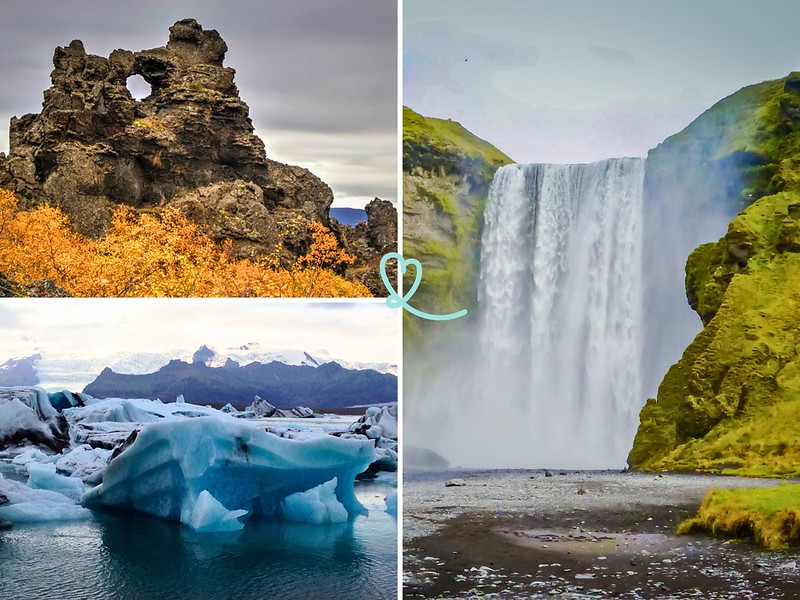
This opinion is completely independent, based on our experiences. We visited the region anonymously, making our own choices and paying our bills in full.
Content
1. Take a road trip: admire the scenery as you drive

Why it’s a must
In Iceland, the road is an integral part of the journey. Route 1, which circumnavigates the island for around 1,322km, passes through landscapes of rare variety: moss-covered lava plains, ash deserts, deep fjords, snow-capped mountains and jagged coastlines.
Take your time, stop often and let yourself be surprised. We advise you to allow more time than necessary between stages, as every bend and detour road can offer breathtaking views. In summer, the almost constant daylight means you can ride at any time of day without losing visibility.

Practical advice
- Route 1 (Ring Road) goes all the way around the island. Allow a minimum of 7 to 10 days to enjoy it, more if you want to explore the detours.
- Some secondary roads (F roads) require a 4WD vehicle and are only open in summer, generally between June and September, depending on conditions.
- The umferdin.is website lets you check road conditions in real time before setting off.
- Service stations are sparse in some areas, notably the East Fjords and the North. Fill up as soon as possible.
- Beware of the wind: car doors can be blown off by gusts of wind. Always open with care.
RENTING A CAR IN Iceland
Discover the best offers on Discovercars, our preferred platform!
On Route 1, no 4WD required, off Route 1, it depends on your plans.

2. Collect waterfalls (Seljalandsfoss, Gullfoss…)

Why it’s a must
Iceland has hundreds of waterfalls, each with its own character. Some impress with their raw power, plunging into deep canyons on several levels; others seduce with their grace and accessibility, offering unusual perspectives that few waterfalls in the world allow. On sunny days, the spray regularly creates rainbows suspended in the air.
In addition to the emblematic waterfalls of the south coast, the entire region is full of them: some rise up from the heart of lava fields, others flow through brightly colored landscapes of moss and greenery, and still others nestle in remote valleys that only hikers can discover. Whatever the season, they are part of the island’s sound and visual landscape, omnipresent, always renewed by rain and snowmelt.

Our top 3 and tips
- Seljalandsfoss: you can walk behind the waterfall on a specially prepared path. Make sure you wear waterproof clothing, as you’ll get wet.
- Gullfoss: free admission. Two levels of observation platform. The lower parking lot is closer to the falls.
- Skogafoss: free access. A 527-step staircase leads to the top for a bird’s-eye view.
- Wear non-slip shoes: the rocks around waterfalls are often slippery.
3. Search for trolls in the lava fields (Dimmuborgir, Lóndrangar, Arnarstapi…).

Why it’s a must
Iceland’s lava fields are home to rock formations with strange silhouettes, and local mythology sees trolls petrified by sunlight. Walking through these natural labyrinths of lava columns and arches is a singular experience, between silence and improbable shapes.
Some of these fields extend inland, often close to volcanic lakes, while others reach the ocean coasts, where waves have sculpted natural arches and sheer cliffs over the millennia. Basalt pillars sometimes rise above the water, the remains of ancient craters gradually eroded by the sea. These black rock coastlines are home to an abundance of marine fauna, including many species of nesting birds.
What’s most striking about these landscapes is the striking contrast between the harshness of the volcanic rock and the delicacy of the moss that covers it: a fragile balance between the brutality of geological forces and the slow reclamation of life.

Our top 3 and tips
- Dimmuborgir: several marked trails of varying lengths (from 20min to 1h). Access free of charge. On-site parking. The “Kirkjan” trail leads to a church-shaped cave.
- Lóndrangar: a short path from the parking lot leads to the viewpoint. Access free of charge. Allow around 30min round trip.
- Arnarstapi: the coastal walk between Arnarstapi and Hellnar takes about 1h (2.5km). The trail skirts spectacular cliffs. Access free of charge. Coffee in Hellnar.
- Stay on the marked trails: lava is fragile and moss takes decades to regenerate.
WHERE TO STAY IN Iceland
Our independent picks for the accommodation of your dreams:

4. Feel the power of the earth in geothermal zones (Haukadalur, Hverir…)

Why it’s a must
Iceland lies on the Mid-Atlantic Ridge, at the junction of the Eurasian and North American tectonic plates. This unique geological position manifests itself spectacularly in the geothermal zones that dot the island, and you’re gripped by the raw energy of these places where the earth smokes, bubbles and shoots hot water skywards.
Some of these areas are dominated by active geysers, whose regular eruptions propel high columns of boiling water with almost mechanical punctuality. Others offer a more total sensory immersion: boiling mud pots, sulfurous fumaroles, hot ground underfoot and earth tinged with ochre, yellow and white. The ever-present smell of sulfur becomes part of the scenery.
These lunar landscapes can be found both in the major tourist valleys and in more remote areas, often at the foot of active volcanoes. They are a constant reminder that Iceland is a living island, in perpetual formation.

Our top 2 and tips
- Haukadalur: on the Golden Circle with its 2 geysers: Geysir (dormant) and Strokkur, which erupts regularly.
- Hverir (Námaskard): Located about 5km east of Lake Mývatn, on Route 1. An incredible ochre color
- Never walk off the beaten track: the earth’s crust can be very thin and groundwater can exceed 100°C.
- The smell of sulfur (rotten egg) is normal and harmless, but can be surprising. Don’t stay longer than 1 hour (or less if you suffer from asthma).
5. Admire the icebergs (Jökulsárlón, Diamond Beach, Fjallsárlón)

Why it’s a must
The glacial lagoons of southeast Iceland are among the country’s most breathtaking natural sites. Blocks of translucent, bluish ice slowly break away from the glaciers and drift silently across a landscape where the only sound is the cracking of the ice and the occasional cry of Arctic terns.
Some of these lagoons are vast and spectacular; others, smaller and less frequented, offer a more intimate observation of the same phenomenon. Nearby black sand beaches provide a striking backdrop: the fragments of ice that wash up on them sparkle in the light like precious stones, creating an unforgettable visual contrast between the black of the volcanic sand and the transparency of the ice.

Our top 3 and tips
- Jökulsárlón: Jökulsárlón, the largest, is home to bluish-tinted, translucent blocks of ice that rise from the Breiðamerkurjökull glacier. You can take an amphibious boat or zodiac tour of the lagoon to get closer to the icebergs.
- Diamond Beach: just across Route 1 from Jökulsárlón. icebergs washed up on the black sand sparkle like precious stones.
- Fjallsárlón: about 10km west of Jökulsárlón. A smaller, less-frequented lagoon nearby offers a more intimate setting for iceberg watching.
- Summer is the best season for observing icebergs, as calving (the detachment of ice blocks) is more active.
- Please note that the ice caves are only accessible in winter.

It’s time to book!
Compare everything: companies, prices, schedules and availability.
6. Experience a glacier

Why it’s a must
Walking on a glacier is an experience that leaves a lasting impression. Iceland is home to Vatnajökull, Europe’s largest ice cap, as well as several other glaciers accessible in summer. We were struck by the textures and colors of the ice, ranging from deep blue and brilliant white to streaks of black volcanic ash.
Guided excursions, mandatory for safety reasons, equip you with crampons and take you to glacier tongues such as Sólheimajökull or Skaftafellsjökull. Some tours include exploration of ice caves, whose filtered light creates unreal atmospheres. We opted for a hike on Sólheimajökull and the intensity of this walk, between crevasses and glacial mills, remains a strong memory.
Practical advice
- It is forbidden to venture onto a glacier without a certified guide. Invisible cracks are a real danger.
- Glacier hikes generally last between 2 and 5 hours, depending on level. Some are accessible from the age of 8.
- The natural ice caves are mainly open to visitors in winter. In summer, some operators offer access to caves dug artificially into the glacier.
- Bring warm, waterproof clothing and hiking boots. Crampons and safety equipment are provided by the operators.
- Book your glacier excursion!
OUR GUIDE TO PLANNING A Dream trip
- 8 maps that make planning easier
- + 100 pre-selected locations
- Practical advice
- + 130 photos to help you choose
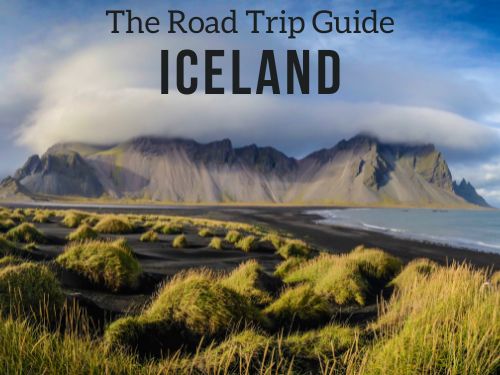
7. Relax in the hot springs (Blue Lagoon, Mývatn Earth Lagoon, Secret Lagoon…)

Why it’s a must
Bathing in a natural hot spring is part of Icelandic culture. Everywhere on the island, geothermal water rises to the surface and offers open-air bathing at pleasant temperatures, generally between 36°C and 42°C. We particularly appreciated the contrast between the cool Icelandic air and the enveloping warmth of the water, a deeply relaxing moment after a day’s driving or hiking.
There’s a wide range to choose from, with pools of varying degrees of sophistication. But in addition to these fee-paying sites, Iceland also has wild hot pots, accessible free of charge in the wild. We recommend you try both, as the atmospheres are very different.

Our top 3 and tips
- Blue Lagoon: booking essential, often several weeks in advance in summer. Located on the Reykjanes peninsula, 20 minutes from Keflavík airport. Several price formulas. Towel and silica mask included. Book your experience
- Earth Lagoon (Myvatn Nature Bath): reservation recommended. Cheaper and less crowded than the Blue Lagoon. View of the surrounding volcanic landscape. Open all year round. Book your ticket now to save time!
- Secret Lagoon (Flúðir): dates back to 1891. More authentic atmosphere. Close to the Golden Circle. Reservations recommended.
- For wild hot springs: find out the local water temperature before taking a dip. Some springs are too hot. Don’t leave any garbage behind.
- In Iceland, it’s compulsory to shower naked before entering the pool, whether in a municipal pool or a spa.
8. Unique experiences: Icelandic horses, Silfra fissure, recent eruption

Some experiences are only possible in Iceland, and summer is the ideal time to enjoy them. Icelandic horses, a pure breed that has been preserved for over a thousand years, have a unique extra gait called the tölt, which is particularly comfortable for the rider. We gave it a try, and the gentleness of the animals, combined with the landscapes we crossed, made it an unforgettable experience. Book your horseback ride!
The Silfra fissure, in Þingvellir National Park, offers snorkeling and diving between two tectonic plates, in water of rare clarity (visibility in excess of 100m). The water is cold (2°C to 4°C), but the wetsuit provided by the operators protects you. Book your excursion to Silfra!
In addition, the Reykjanes peninsula has been experiencing recurrent volcanic activity since 2021. Depending on the conditions at the time, it is sometimes possible to observe recent lava flows or still-smoldering lava fields. We recommend that you check safety information with local authorities before approaching the site. See the options
9. Climb a volcanic crater (Hverfjall, pseudocraters, Grábrók…)

Why it’s a must
Iceland is a volcanic land, and to climb a crater is to measure the power of the forces that have shaped the island. Some reach impressive dimensions, almost perfectly circular, and offer 360° panoramic views of lava fields, lakes and surrounding valleys from their crests. Others are more modest, accessible by a twenty-minute walk, and suitable for all levels.
The island also has a particular geological curiosity: pseudocraters, formed not by a classic eruption but by the contact of molten lava with wet or marshy areas. They have all the appearance of it without ever having had the origin, and their exploration is often as surprising as it is instructive.
Whether monumental or discreet, these craters are privileged vantage points for observing Iceland’s volcanic landscapes, and a concrete way of taking the measure of an island that continues to build itself beneath our feet.

Our top 3
- Hverfjall: An almost perfectly circular tephra crater 1km in diameter. We were impressed by its size and by the panoramic view from its crest.
- Pseudocraters of Skutustadagigar: Formed when molten lava covered a swamp, they look like small volcanoes without ever having been one.
- A tough choice for the 3rd… Pictured above, Krafla Viti with its lake and colorful surrounding mountains.
- Wear closed shoes: volcanic terrain is uneven and sometimes sharp.
- See our selection of the best craters to explore.
10. Go 4WD (Thórsmörk, Landmannalaugar…)

Why it’s a must
Iceland’s Highlands are a world apart, accessible only in summer and exclusively by off-road vehicle. These inland regions, uninhabited and devoid of infrastructure, are home to some of the island’s most spectacular scenery. We were dazzled by Landmannalaugar, where rhyolite mountains come in shades of pink, orange, green and purple. The contrast between these colors and the surrounding black lava fields creates a picture found nowhere else.

Practical advice
- F roads (mountain roads) are only accessible by 4WD and are generally open from late June to early September. See road.is for opening dates.
- Landmannalaugar: accessible via F225 or F208. The route involves some fording. If you don’t drive a 4WD, many companies offer tours from Reykjavik in summer. See excursion options
- Thorsmörk: accessible by road from Hella, with major fords.
- Never attempt a ford without experience: current and depth can be deceptive. Many vehicles get stuck every year.
- No service stations or telephone networks in the Highlands. Bring plenty of fuel, food and water.
- Huts and campsites available in Landmannalaugar and Thórsmörk. Reservations recommended in high season.
11. Discover Icelandic culture in Reykjavik

Why it’s a must
Reykjavik is the world’s most northerly capital and, despite its modest size (around 140,000 inhabitants), has a vibrant cultural life. We enjoyed the diversity of its museums, art galleries and contemporary architecture, starting with the Hallgrímskirkja church, whose silhouette dominates the city center.
The historic center is easily accessible on foot. The Laugavegur shopping street, the colorful facades of the Old Quarter and the Old Harbour create a relaxed yet lively atmosphere. We also recommend the National Museum of Iceland for an insight into Viking history and the culture of the sagas, as well as Harpa, the concert hall whose glass façade reflects the light in changing ways throughout the day. In summer, the city hosts numerous outdoor festivals and events.

Practical advice
- The city center can easily be visited on foot in half a day to a full day.
- Hallgrímskirkja: the main church
- Harpa: concert hall and interesting architecture
- National Museum of Iceland: Allow around 2 hours for the visit.
- The waterfront
- And many other museums on different subjects related to Iceland: geology, history, nature…
12. Diving into the bowels of the earth: lava caves

Why it’s a must
Beneath Iceland’s surface lies a network of tunnels carved out by ancient lava flows. To explore these caves is to discover the island from a different angle, sheltered from the wind and in an unusual silence. The interior formations are fascinating: lava stalactites, walls with colored reflections, vaults sculpted by the passage of magma thousands of years ago.
Some of these caves have been set up for guided tours, with careful lighting and geological explanations to help visitors understand how these structures were formed. Others can be explored more adventurously, headlamp in hand, with no facilities or markers.
These lava tunnels can be found in various parts of the island and are accessible to a wide range of abilities, from families with children to thrill-seeking explorers.

Our top 3 and tips
- Vídgelmir is one of the country’s largest lava caves.
- Raufarhólshellir (The Lava Tunnel) offers a guided tour on a footbridge through a tunnel some 1.4km long.
- Grjotagja, wilder and filled with scalding water.
- Bring warm clothing even in summer: temperatures in the caves remain low all year round.
- Hiking boots essential: the ground is uneven and sometimes wet.
- See our selection of the best lava caves
13. Admire the contrasts on black sand beaches

Why it’s a must
Iceland’s black sand beaches are like no other. Formed by the erosion of basaltic lava, they offer striking visual contrasts between the deep black of the sand, the white of the foam and, on a clear day, the intense blue of the sky. Some are lined with hexagonal basalt columns, testimony to the slow, steady cooling of the lava; others open onto rocky spires that emerge from the ocean, composing powerful scenery.
The changing light plays an essential role: depending on the weather and the time of day, these beaches change radically, from dramatic to almost gentle.

Our top 3 and tips
- Reynisfjara: free parking. the most famous: its hexagonal basalt columns and the Reynisdrangar rock spires, which emerge from the ocean, create a powerful natural backdrop.
- Diamond beach, with its icebergs running aground and contrasting with the black sand
- Stokksnes/Vestrahorn: with a mountain in the background and small black sand dunes
- BEWARE of sneaker waves: they are powerful, unpredictable and have caused several fatal accidents. Never turn your back on the ocean, and keep a safe distance from the shore.
- These beaches are not suitable for swimming: the water is cold (around 5-10°C in summer) and the currents are dangerous.
14. Hiking

Why it’s a must
Iceland is a hiker’s paradise, and summer opens up access to the vast majority of trails. The variety of terrain is remarkable: in the space of a week, you can hike over lava fields, cross glacial rivers, skirt coastal cliffs and tread the thick moss of verdant valleys. We were surprised by the diversity of atmospheres, sometimes within the same hike.
The famous Laugavegur trek, between Landmannalaugar and Þórsmörk (55km, 3 to 4 days), is often cited as one of the most beautiful long-distance trails in the world. But the island also offers excellent day hikes.

Practical advice
- Short hikes above Skogafoss, around Myvatn, Glymur hike, and also in Skaftafell park…
- Laugavegur: 55km, 3 to 4 days. Mountain huts to be booked well in advance (places sell out fast). Generally open from late June to early September. Camping possible along the route.
- Fimmvörduháls: approx. 25km, 8 to 10h. Challenging day hike between two glaciers and down to Þórsmörk. Shuttles available for the return journey.
- Weather changes rapidly: always pack waterproof layers, a windbreaker and warm clothing, even in fine weather at the start.
- No standardized markers on all trails. A topographical map and GPS are recommended for hikes outside busy areas.
- Follow the signs and avoid walking off-trail: Iceland’s ecosystem is fragile and vegetation regenerates very slowly.
15. Focus on a single region (Golden Circle, Snæfellsnes…)

Why it’s a must
If you don’t have a lot of time, or if you prefer to explore in depth rather than multiply the kilometers, concentrating your stay on a single region is an excellent approach.
The Golden Circle, the most classic itinerary, brings together three major sites in a 300km loop: Þingvellir National Park (historical and geological site), the Haukadalur geothermal zone (with the Strokkur geyser) and the Gullfoss waterfall.
The Snæfellsnes peninsula, often referred to as “miniature Iceland”, concentrates volcanoes, glaciers, black sand beaches, cliffs, lava fields and fishing villages in a small area. We particularly enjoyed it, as it offers a condensed version of what the island has to offer in just two or three days.
Other regions are also well worth a prolonged immersion: the Lake Mývatn area in the north, Vatnajökull National Park in the southeast, or the Western Fjords for travelers in search of isolation.

Practical advice
- Golden Circle: doable in a day from Reykjavik, but we recommend 2 days to avoid the rush and take advantage of detours (Kerið crater, Friðheimar tomato farm, Secret Lagoon).
- Snæfellsnes: allow 2 to 3 days. Possible base in Stykkishólmur or Grundarfjörður. Kirkjufell, one of Iceland’s most photographed mountains, is located here.
- Mývatn and surroundings: 2-3 days to explore the lake, Dimmuborgir, Hverir, Hverfjall crater, Goðafoss waterfall and Mývatn Nature Baths.
- Western Fjords: isolated region, little tourist infrastructure, unpaved roads. Allow at least 4 to 5 days. The cliffs of Látrabjarg, Europe’s most westerly point, are well worth a visit.
16. Aurora borealis or midnight sun

Iceland in summer is all about the midnight sun. From mid-May to late July, the sun hardly sets at all, creating golden hours that stretch through the night. We were struck by this very special light: the landscapes take on warm, soft hues at 11pm as well as at 3am, offering total freedom to explore without time constraints.
On the other hand, the Northern Lights are not visible in midsummer due to the permanent brightness. To observe them, you need to come at the end of summer: late August and September, when it gets dark again. We were able to see auroras in September.
17. Wildlife watching: whales and puffins

Why it’s a must
Summer is the ideal season for observing Icelandic wildlife.
- Whales frequent the nutrient-rich waters around the island, and boat trips offer excellent chances of spotting them: humpbacks, minke whales and, with luck, blue whales. Book your whale-watching excursion!
- Puffins, those little birds with the colorful beaks, nest in Iceland from mid-April to mid-August. The largest colonies are on the Vestmann Islands (Westman Islands), Látrabjarg in the West Fjords, and Borgarfjörður Eystri in the east. We recommend the latter site for its proximity to the birds, visible from an observation platform just a few meters from their burrows. See options and availability
- Foxes can also be more visible, because in winter they’re all white in the snow!

Practical advice
- Dress warmly for sea outings: the temperature is much lower than on land. Most operators provide combinations.
- Bring your binoculars!
18. Relive your favorite movies (Walter Mitty, Game of Throne…)

Iceland has been the setting for numerous film and TV productions, and with good reason: its landscapes seem to have emerged from another world.
Seyðisfjörður, a charming port town in the East Fjords, became famous thanks to the film “The Dream Life of Walter Mitty” (2013). Its rainbow path leading to the blue church has become a symbol. We found this small town full of character, with its colorful wooden houses, art scene and natural setting surrounded by mountains and waterfalls.
Thingvellir National Park was used in Game of Thrones.
The Svínafellsjökull glacier appeared in Interstellar and Batman Begins.
Reynisfjara beach was the setting for several scenes in the Vikings series.
Skógafoss, Dettifoss and Jökulsárlón also feature in numerous productions.
Most of the filming locations are free, public natural sites. None are specifically designed as “cinema attractions”.
RENTING A CAR IN Iceland
Discover the best offers on Discovercars, our preferred platform!
On Route 1, no 4WD required, off Route 1, it depends on your plans.
19. Feeling small in the fjords

Why it’s a must
Iceland’s fjords, sculpted by glaciers over the millennia, offer landscapes of rare magnitude. The Westfjords, the least-visited region of the country, are also among the most spectacular. Winding roads skirt steep mountain walls that plunge into deep, calm waters. We were struck by the sense of isolation and immensity that this region exudes.
The more accessible Eastern Fjords offer a different atmosphere: fishing villages nestled in narrow bays, cloud-capped mountains and changing light. The road from Egilsstaðir to Seyðisfjörður over a mountain pass is a condensed version of this raw beauty. We recommend making time for the fjords, as the narrow, winding roads are not easy to travel, and it’s precisely this slow pace that allows you to appreciate their grandeur.

Practical advice
- Western Fjords: accessible only in summer (some roads closed from October to May). Allow at least 4 to 5 days. The roads are often gravel and narrow. A 4WD is not mandatory but recommended.
- Ísafjörður is the largest town in the West Fjords (population approx. 2,600). It offers services, accommodation and restaurants.
- Eastern Fjords: best served by Route 1. More accommodation. Good starting points: Egilsstaðir, Seyðisfjörður, Djúpivogur.
- Gas and shops are rare in the West Fjords. Stock up before you enter.
20. Discover Icelandic gastronomy

Icelandic cuisine has evolved considerably in recent years. While traditional dishes such as harðfiskur (dried fish), plokkfiskur (fish stew) or skyr (a fermented dairy product similar to yoghurt) remain staples, a new generation of chefs is offering creative cuisine that makes the most of local produce. We were pleasantly surprised by the quality of the restaurants, especially in Reykjavik, where the culinary scene is dynamic and inventive.
Icelandic lamb, free-range in the mountains during the summer, is renowned for its distinctive flavor. Seafood, caught in the cold waters of the Atlantic, is remarkably fresh. The pylsur, the famous Icelandic hot dog topped with sauces and crispy onions, is a classic that must be tried at least once. We also recommend trying rye bread baked in geothermal soil (rúgbrauð), a specialty found around Lake Mývatn and Laugarvatn.
Tap water in Iceland is among the purest in the world. No need to buy bottled water. And that’s even if the hot water smells because it’s geothermally heated.
21. Visit Akureyri, the capital of the North

Why it’s a must
Akureyri, Iceland’s second-largest town with around 19,000 inhabitants, is nestled at the head of the Eyjafjörður fjord, the longest in the country. Despite its modest size, it offers a warm, lively atmosphere that contrasts with the isolation of the surrounding regions. We were charmed by its botanical garden, the most northerly in the world, where species that are not expected at this latitude bloom in summer.

Practical advice
- Akureyri is about a 5-hour drive from Reykjavik on Route 1 (via the Hvalfjarðargöng tunnel). Domestic flights connect the two cities in 45 minutes.
- Parking in the town center is free but limited to 2 hours (parking disc required, available in shops).
- Akureyri has supermarkets, petrol stations and several restaurants. This is the last major supply center before exploring the north and east of the island.
- In summer, boat trips leave from Akureyri for whale watching in the Eyjafjörður fjord.
Frequently asked questions
When is the best time to visit Iceland in summer?
High season runs from June to September. June offers the longest days (midnight sun). July is the hottest month (average 10-15°C). August sees the Highland roads still open and the first dark nights appear at the end of the month. For us, September is summer because there’s no snow yet, but we can see autumnal colors. We love September.
How long will it take to visit Iceland?
For a complete, leisurely tour of Route 1 (Ring Road), allow 10 to 14 days. To explore the Golden Circle and the south coast, 5 to 7 days are enough. If you wish to include the Western Fjords or the Highlands, add a further 4-5 days per region.
Find out more.
Do you need a 4WD in Iceland?
For Route 1 and the main sites (Golden Circle, south coast, Snæfellsnes, Akureyri), a standard vehicle is sufficient in summer. A 4WD is compulsory for F roads (Highlands) and strongly recommended for the Western Fjords and some unpaved roads.
PLAN YOUR SUMMER TRIP TO iceland
- Best of
What to do in Iceland
The most beautiful waterfalls
The most beautiful black sand beaches
Volcanic craters to climb
Lava caves to visit
Best excursions from Reykjavik

- Practical advice
Summer travel tips
How to rent a car in Iceland
Driving tips
Where to stay in Iceland
Itineraries: 3 days – 4 days – 5 days – 1 week – 10 days

- The must-dos
What to do in Reykjavik
Best attractions in the Golden Circle
South Coast attractions
Snaefellsnes Peninsula
Silver Circle
Lake Myvatn attractions