
The Krafla Viti crater is one of North Iceland’s most unusual landscapes. Nestled in the volcanic area of Lake Myvatn, it shelters a deep-blue lake at its base, surrounded by steaming earth and mountains of ochre and sulphur hues. We were struck by the striking contrast between the geological violence of the place and the serenity of the water.
Here are our photos and tips for making the most of your visit to the Krafla Viti crater.
This opinion is completely independent, based on our experiences. We visited the region anonymously, making our own choices and paying our bills in full.
Content
Why visit the Krafla Viti crater?
Is the Krafla Viti crater worth a visit? Our opinion:
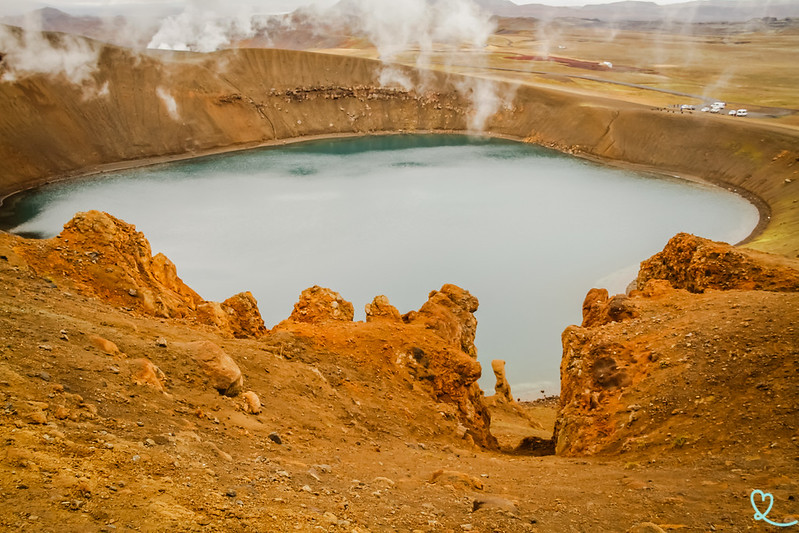
Yes, the Krafla Viti crater is well worth a visit. This large crater, some 300m in diameter, stands out from all the other volcanic sites in the region for its deep-blue inner lake, fed by the surrounding geothermal activity. The hue of the water, due to bacteria and minerals of volcanic origin, varies according to the light: sometimes azure blue, sometimes aqua blue. It’s a rare sight that we found difficult to describe in words alone.
This is one of the best attractions in the Lake Myvatn region.

Our favorite moments
What struck us most during our visit to the Krafla Viti crater:
- The color of the water: an intense blue that changes from hour to hour according to the light.
- Views of the surrounding mountains: colorful, ochre and green, they form a striking panorama from the crater rim.
- The geothermal zone in the middle of the tour: a surreal passage between the two lakes, where the earth smokes and the colors turn to sulfur.

WHERE TO STAY IN myvatn
Fosshotel Myvatn, with beautiful lake views
See top-rated accommodations
Salt – Hotel Myvatn, near the pseudo-craters
See top-rated accommodations
Dimmuborgir Guesthouse, by the lake
See top-rated accommodations

How to get to Krafla Viti crater: access and map
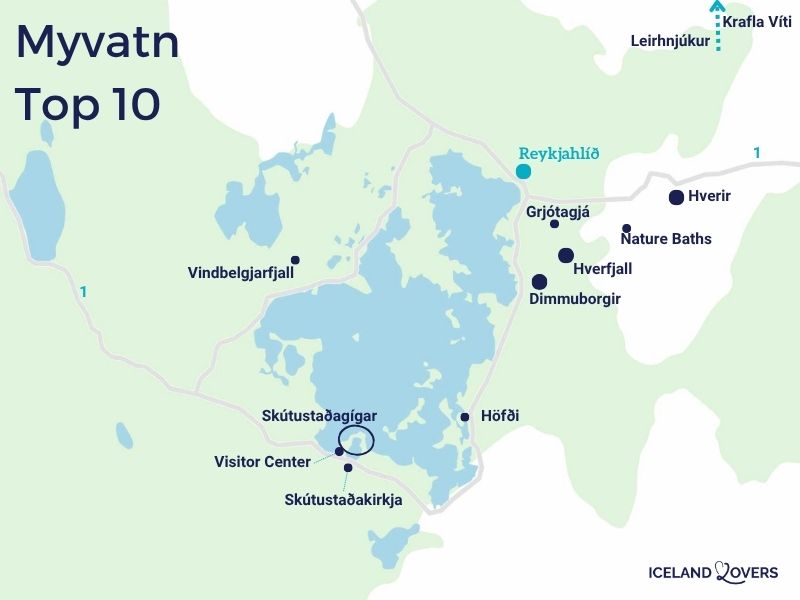
Where is the Krafla Viti crater?
- North Iceland, in the Lake Myvatn region
- Driving time from Reykjahlid (Lake Myvatn): 20min
- Driving time from Akureyri: 1h30
- Here is a map to help you find your way:
How to get there? Access road
The Krafla Viti crater is not accessible by public transport: a car is essential. From Myvatn, head east on Route 1 for 6km, then turn left towards Viti/Krafla. The road passes the Krafla geothermal power station. Please note: there are several parking lots in the area (including Leirhnjukur), which can be confusing. Continue to the end of the road to reach the right parking lot.
Parking
The parking lot is located directly at the foot of the crater, just a few metres from the trailhead. Immediate access from your vehicle.
Pay parking.

RENTING A CAR IN Iceland
Discover the best offers on Discovercars, our preferred platform!
On Route 1, no 4WD required, off Route 1, it depends on your plans.

Useful tips: duration, schedules, difficulties…
Best time to visit, opening hours and prices
Access to the Krafla Viti crater is free (but parking is not). In summer, Iceland’s long hours of daylight mean you can visit at any time of day. The late afternoon light accentuates the golden hues of the surrounding mountains and intensifies the blue of the lake.
Length of visit and main difficulties
Allow around 1 hour for a complete tour of the crater rim. The trail is well-marked, but some sections need attention. The right-hand side from the parking lot is more accessible; the left-hand side, which offers the best views of the lake, is more slippery, even in dry weather. We found this passage tricky and recommend wearing non-smooth-soled walking shoes.
The geothermal zone crossed in the middle of the route is signposted: don’t stray from the marked path, as the heat of the ground can damage the soles of light shoes. We love the photo below with other walkers. This gives you an idea of the size of the place!

Advice on how to visit
From the parking lot, turn left to tackle the easiest section first. You’ll enjoy the best views of the surrounding mountains in this direction. Continuing in a clockwise direction, you’ll then cross the geothermal zone and walk along the left side of the crater, where the plunging view over the lake is most spectacular. The second, smaller lake can be seen at the end of the route from this side.
Visiting with children
The hike around the crater is accessible to children in good physical condition, but some slippery passages and the proximity of the void call for vigilance. The geothermal zone requires careful supervision: explain to younger children that it’s imperative to stay on the light-brown soil areas and not venture into the brighter-colored zones. Swimming in the crater lake is strictly forbidden.

Catering, Toilets and Facilities
There’s no infrastructure on site: no toilets, no catering, no store.
OUR GUIDE TO PLANNING A Dream trip
- 8 maps that make planning easier
- + 100 pre-selected locations
- Practical advice
- + 130 photos to help you choose
The crater lake and its colors
The lake at the bottom of the crater is the first thing that catches your eye. Its hue varies from deep blue to aqua blue, depending on the time of day and cloud cover. This singular color is no accident: it’s the result of the presence of thermophilic bacteria and dissolved minerals, the result of intense geothermal activity in the Krafla area.
We observed these changes in hue throughout the hike, and each angle offered a different nuance. You can expect the show to evolve as you progress around the rim. The lake is present all year round, whatever the weather conditions.

The geothermal zone between the two lakes
Halfway around the crater, the trail crosses an active geothermal zone. The ground suddenly changes texture and color: shades of sulfur yellow, orange and light gray follow one another, steam escapes from cracks in the rock, and the air takes on a distinctive odor. We found this passage particularly striking, almost unreal.
An information panel on site reminds us of an essential rule: only walk on light brown ground. Brightly colored areas correspond to pockets of intense heat, capable of melting ordinary soles. Stay on the signposted path and cross without lingering.

The second Viti lake
Less well known than its larger neighbor, a second lake can be found at the end of the route, on the opposite side to the parking lot. Smaller and more irregular in shape, it can be seen in its entirety once it has risen above the geothermal zone. We enjoyed this unexpected viewpoint: the lake appears in the foreground, with the pipes of the Krafla geothermal power station visible in the background. This contrast between natural landscape and industrial infrastructure gives the site a special character, typical of Iceland where geothermal energy and nature coexist within a few meters of each other.


It’s time to book!
Compare everything: companies, prices, schedules and availability.
The Krafla mountains: a multi-coloured panorama
One of the most unexpected aspects of a visit to the Krafla Viti crater is the beauty of the surrounding mountains. From the rim of the crater, you can look out over a landscape of warm-toned ridges: ochre, moss green, brick red. These colors are a direct reflection of the mineral composition of volcanic rocks, altered by millennia of geothermal activity and oxidation.
We found the most extensive views on the right-hand slope from the parking lot, where the access road remains the only sign of human presence in an otherwise entirely natural panorama.

History and geology of the Krafla Viti crater
The Krafla Viti crater was formed in 1724, during an explosive eruption that marked the start of the “Myvatn fires”, a five-year period of intense volcanic activity in this part of northern Iceland. The eruption occurred on the western flank of the Krafla massif. The name “Viti” means “hell” in Icelandic, in direct reference to the violence of the phenomenon that gave rise to it.
At around 300m in diameter, it’s a crater of significant size. Icelandic poet Jonas Hallgrimsson (1807-1845), a major figure in the country’s Romantic movement, drew inspiration from the crater in a poem entitled “Víti”, as the place has left such a lasting impression over the centuries.

UNFORGETTABLE ACTIVITIES IN Iceland
- Swimming in the Silfra fissure
- Horseback riding
- Hiking on a glacier
- Whale watching (from Reykjavik, Husavik or Akureyri)

Krafla geothermal power plant
The Krafla geothermal power station stands just a few hundred metres from the Viti crater. Commissioned in 1977, it harnesses the underground heat of the volcanic zone to generate around 60 MW of electricity, enough to power much of northern Iceland.
Its pipes and metal structures can be seen in the background from several points along the trail, particularly from the slope overlooking the second lake. This proximity of industry and nature may be surprising at first glance, but it illustrates the pragmatic relationship between Icelanders and their geological environment: here, the Earth’s energy is not just a spectacle, it’s also a resource for everyday life.

The Visitor Centre at the Krafla Geothermal Power Station usually features an interactive exhibition on geothermal energy production in Iceland. We find this type of visit instructive for understanding how Iceland makes the most of its natural resources. Please note: the center will be closed in summer 2026 for renovations. Visit the official website for more info here.
Other nearby attractions
If there’s anything noteworthy:
You can combine your visit to the Krafla Viti crater with these nearby attractions:
- Leirhnjukur, a lava field still steaming from recent eruptions at Krafla (a few minutes’ drive)
- Hverfjall, a large volcanic crater with dark walls and a summit accessible on foot (20min drive).
- Dimmuborgir, a site of columnar lava formations on the shores of Lake Myvatn (20min drive)
- Myvatn Nature Baths (Earth Lagoon), geothermal springs for bathing (25-minute drive)
And see our selection of the best attractions in Myvatn.
VISIT Myvatn
- Attractions around Lake Myvatn
- Where to sleep: hotels and accommodation
- Itineraries: 1 day – 2 days
- How to get there
- Hverfjall
- Hverir
- Dimmuborgir
Frequently asked questions
Can you swim in the Krafla Viti crater lake?
No, swimming is strictly forbidden in Krafla Viti lake. The chemical composition of the water, loaded with minerals from geothermal activity, makes it unsuitable for swimming.
What’s the difference between Krafla Viti and Askja Viti?
The term “Viti” (hell) is frequently used to name places associated with volcanic activity in Iceland. Two craters bear this name: Krafla Viti, in the Lake Myvatn region, easily accessible by car, whose lake is not swimmable; and Askja Viti, located in the Highlands, accessible only by 4WD, whose hot spring is swimmable. Both sites have a high landscape value, but their conditions of access and use are very different. Be sure to check which one you want to visit before planning your itinerary.
PLAN YOUR SUMMER TRIP TO iceland
- Best of
What to do in Iceland
The most beautiful waterfalls
The most beautiful black sand beaches
Volcanic craters to climb
Lava caves to visit
Best excursions from Reykjavik

- Practical advice
Summer travel tips
How to rent a car in Iceland
Driving tips
Where to stay in Iceland
Itineraries: 3 days – 4 days – 5 days – 1 week – 10 days

- The must-dos
What to do in Reykjavik
Best attractions in the Golden Circle
South Coast attractions
Snaefellsnes Peninsula
Silver Circle
Lake Myvatn attractions