
Lake Myvatn, in northeast Iceland, is one of the country’s natural gems. We were struck by the diversity of its volcanic landscapes, with lava fields, steaming geothermal zones and spectacularly silhouetted craters. Here you’ll discover natural formations that are unique in the world, sculpted by millennia of volcanic activity.
Discover our ideas for what to do on Lake Myvatn, illustrated with photos that will make you want to go. Bonus: useful tips and additional activities.
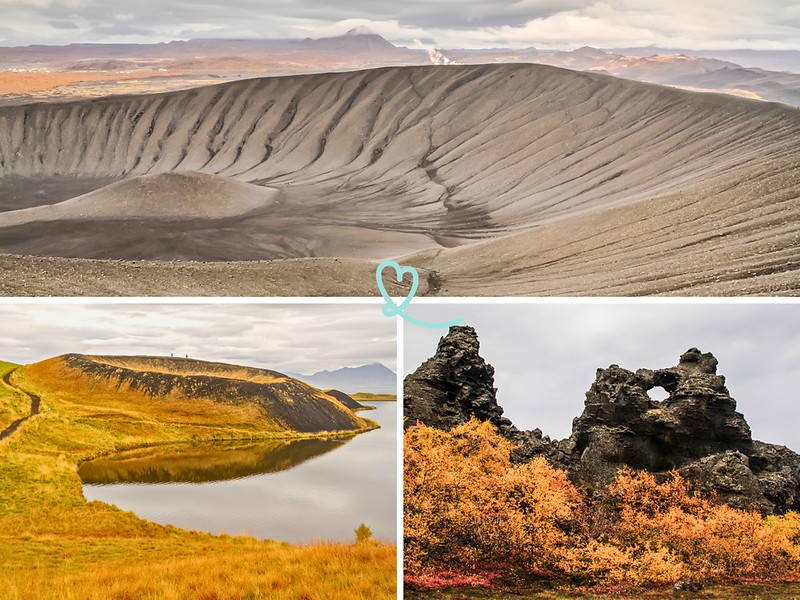
This opinion is completely independent, based on our experiences. We visited the region anonymously, making our own choices and paying our bills in full.
Content
Myvatn attractions: summary + map
This shallow lake, whose name means “lake of the gnats”, covers some 37km² and is a concentrate of Icelandic geology.
Here’s a map of the best attractions, listed in this article, to help you find your way around:
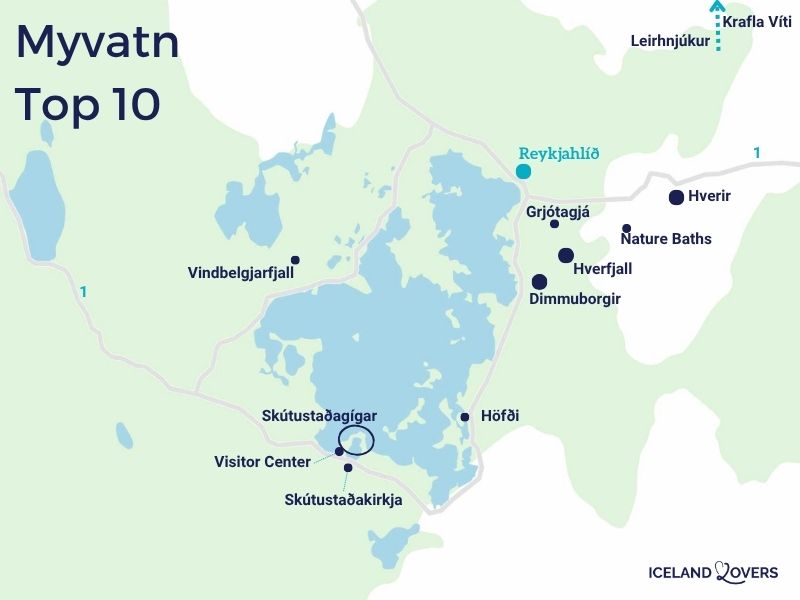
You’re in for a treat:
- a lake
- volcanic craters
- pseudocraters
- geothermal zones
- lava fields at various stages of evolution (still steaming or vegetation-covered)
- surprising lava formations
- …
If you only have a few hours to spare, we recommend: Hverir, Dimmuborir and the pseudocraters of Stukustadir.
And if you don’t want to drive, there are organized excursions from Akureyri. See the options
1. Pseudocraters from Skútustaðagígar

Why visit?
The Skútustaðagígar pseudocraters are among Lake Myvatn’s most fascinating geological sights. Unlike traditional craters, these formations are not the result of volcanic eruptions, but of the explosion of steam caused by lava flowing over marshy ground.
We walked along these small green grass-covered craters scattered along the southern shore of the lake, and the sight is truly singular. It’s our favorite! The circular path winds between the pseudocraters.

Practical advice
- Tour duration: approx. 30min to 1h for the complete loop.
- Opening hours: permanently open.
- Difficulty and PRM access: relatively flat, well-maintained trail. Some sections may be muddy in wet weather. Partially accessible to baby carriages.
- Prices: free of charge.
- Access: located on the south shore of the lake, along route 848, about 5km from Reykjahlíð.
- Parking: free parking at the trailhead, next to Skútustaðakirkja church.
2. Hverir geothermal zone (Námafjall)

Why visit?
The Hverir geothermal zone, also known as Námafjall, is one of the most impressive sites in the Lake Myvatn region. We discovered a lunar landscape where pools of bubbling mud, sulfur fumaroles and solfataras color the ground in shades of ochre, yellow and gray. The smell of sulfur is omnipresent, a sign of the intense geothermal activity beneath your feet.
The terrain, totally devoid of vegetation, offers striking contrasts. We recommend that you take the time to observe the different formations, as each pond and fumarole has its own unique characteristics. You can also climb the slopes of Námafjall hill for a panoramic view of the whole area, with the lake in the background.

Practical advice
- Access: located along Route 1, about 6km east of Reykjahlíð, the main village on Lake Myvatn.
- Visit duration: allow between 30min and 1h to explore the area, more if you climb the Námafjall hill. But don’t stay too long
- Opening hours: the site is open 24 hours a day.
- Difficulties and PRM access: uneven terrain, loose soil and slippery in places. Not suitable for people with reduced mobility. Keep to the marked trails, as the ground can be very hot in the vicinity of fumaroles.
- Parking: pay parking (daily)
- Catering: no on-site catering. But, given the smell, it’s not a place you want to eat in!
WHERE TO STAY IN myvatn
Fosshotel Myvatn, with beautiful lake views
See top-rated accommodations
Salt – Hotel Myvatn, near the pseudo-craters
See top-rated accommodations
Dimmuborgir Guesthouse, by the lake
See top-rated accommodations

3. Dimmuborgir lava field

Why visit?
Dimmuborgir, whose name means “dark castles”, is a natural labyrinth of amazingly shaped lava formations. We surveyed this site, whose columns, arches and caves of volcanic rock are reminiscent of the ruins of an ancient fortress. These structures were formed around 2,300 years ago, when a lake of lava solidified around columns of steam, creating hollow pillars and surprising cavities.
What’s more, Icelandic folklore associates Dimmuborgir with trolls and hidden beings, adding a mysterious dimension to the walk. You can choose from several marked trails of varying difficulty, some of which cross remarkable natural arches such as Kirkjan, “the church” (photo below).

Practical advice
- Visit duration: between 30min and 2h30 depending on the tour chosen.
- Opening hours: permanently open. But buses stop here during the day, so you can come early or late, or pass the paths closest to the parking lot.
- Difficulties and PRM access: the shortest circuit is relatively flat and accessible. Longer trails have rocky, uneven sections. Not suitable for wheelchairs.
- Access: about 3km south of Reykjahlíð, on route 848 along the eastern shore of the lake.
- Pay toilets
- Parking: large parking lot
- Catering: a small café is located near the parking lot during the summer season.
RENTING A CAR IN Iceland
Discover the best offers on Discovercars, our preferred platform!
On Route 1, no 4WD required, off Route 1, it depends on your plans.

4. Earth Lagoon (Myvatn Nature Baths)

Why visit?
The Natural Baths of Myvatn are often compared to the famous Blue Lagoon in southern Iceland, but in a much wilder, less crowded setting. We enjoyed these naturally heated geothermal water pools at around 36-40°C, surrounded by lava fields and steam.
The mineral-rich water comes from underground springs at depths of over 2,500m. The complex features a large outdoor pool, natural steam baths and a relaxation area.

Practical advice
- Length of visit: allow between 1h30 and 2h to fully enjoy the baths.
- Difficulties and PRM access: the facilities are accessible to people with reduced mobility.
- 2026: under construction. Reopening in summer
- Times: noon to 10pm
- Admission: paying entry. See the official website for current rates.
- Latest news on the official website here
- Access: about 3km east of Reykjahlíd, on Route 1.
- Parking: free parking on site.
- Catering: a café-restaurant is located on site.
- Book your ticket now to save time!
5. Hverfjall crater

Why visit?
The Hverfjall crater, also spelled Hverfell, is one of the world’s largest explosion craters. Formed around 2,500 years ago during a phreatomagmatic eruption, it measures almost 1km in diameter and rises to an altitude of 420m. We climbed its ash and black gravel-covered slopes to reach the ridge, from where the 360° view is absolutely breathtaking.
The panorama embraces Lake Myvatn, the Dimmuborgir lava fields, the Hverir geothermal zone and the surrounding mountains. You can walk along the rim of the crater on a circular path that goes all the way around.

Practical advice
- Length of visit: allow around 1h to 2h for the ascent and tour of the crater.
- Opening hours: permanently open.
- Do not climb in windy conditions
- Difficulties and PRM access: the climb is steep over loose ash and gravel. Hiking boots essential. Not accessible to people with reduced mobility. The wind can be violent on the ridge.
- Rates: paid parking
6. Leirhnjúkur and the steaming lava fields

Why visit?
Leirhnjúkur lies at the heart of the Krafla volcanic system. This is the walk that most impressed us in the region. We passed through still-smoldering lava fields, remnants of the eruptions that occurred between 1975 and 1984 during the “Krafla fires”. And as we went early, it felt like being alone in the world after a disaster!
We followed the signposted trail that winds between the various geothermal zones, an experience we consider a must on a stay at Lake Mývatn.

Practical advice
- Access: located about 15km northeast of Reykjahlíð, in the Krafla area. Follow route 863 to the Leirhnjúkur parking lot.
- Length of visit: allow between 1h and 2h for the complete loop.
- Times: open all year round (please note that the access road may be closed in winter).
- Difficulty and access for wheelchair users: path over uneven volcanic terrain. Some sections are slippery. Stay on the marked trails. Not suitable for people with reduced mobility.
- Parking: free parking (at our last check) at the trailhead.
- Catering: no on-site catering
7. Krafla Víti crater

Why visit?
The Víti crater, whose name means “hell” in Icelandic, is located in the Krafla area, in the immediate vicinity of Leirhnjúkur. Formed during an eruption in 1724, it is home to a turquoise lake that contrasts with the dark crater walls. We were surprised by the intensity of this color (which varies with the light and the seasons).
The site is easily accessible from the Krafla geothermal power station parking lot. You can walk around the crater along the path that runs along its rim. We recommend stopping here for at least 20min to appreciate the geometry of this crater and the views of the surrounding mountains.

Practical advice
- Access: located in the Krafla area, about 15km northeast of Reykjahlíd. Follow route 863.
- Length of visit: 20min to 45min depending on whether you want to go all the way round the crater.
- Times: permanently open (access road may be closed in winter).
- Difficulties and PRM access: the access path is short but the terrain is uneven. The full tour of the crater is more demanding. Not suitable for people with reduced mobility.
- Prices: free of charge.
- Parking: paid parking
- Catering: no on-site catering.
8. Höfdi and its forest

Why visit?
The Kalfaströnd and Höfði peninsulas on the eastern shore of Lake Myvatn offer some of the finest views of the lake and surrounding area. We observed the strange pillars of lava emerging from the water, called “klasar”, formed by the interaction between molten lava and the lake. These winding columns create a unique landscape.
The Höfði peninsula is a birch-wooded promontory with shady paths running along the lake shore. You’ll find unobstructed views of the pseudocraters on the opposite shore and the surrounding mountains.

Practical advice
- Access: both peninsulas are on the eastern shore of the lake, along Route 848.
- Visit duration: 30min to 1h for each peninsula.
- Opening hours: permanently open.
- Difficulties and Access for wheelchair users: relatively flat trails at Höfði. More irregular terrain at Kalfaströnd. Partially accessible.
- Prices: free of charge.
- Parking: small free parking lot
- Pay toilets
- Catering: no on-site catering.
9. Grjótagjá

Why visit?
The Grjótagjá caves are a small lava cavity housing a limpid blue hot spring. The cave lies along a tectonic fault, at the boundary between the North American and Eurasian plates. We were captivated by the beauty of this natural pool, whose light filters through cracks in the rock to illuminate the water in a bluish hue.
Swimming has been banned since the eruptions of Krafla in the 1970s-1980s, which raised the water temperature to dangerous levels. You can still admire the grotto and its thermal spring as you approach the opening. We recommend spending a few moments there to appreciate this geological phenomenon, made famous by its appearance in the Game of Thrones series.

Practical advice
- Access: located around 2km east of Reykjahlíd, a short dirt road leads to the site from Route 860.
- Visit duration: 15min to 30min.
- Opening hours: permanently open, but on private land, so the road may be closed at any time by the owner for conservation.
- Difficulties and PRM access: easy access from the parking lot. Not suitable for people with reduced mobility due to the rocky terrain around the cave entrance.
- Prices: free of charge.
- Parking: small free parking lot
10. Around Lake Myvatn

Why visit?
Touring Lake Mývatn by car or bike is a great way to connect all the major sites in the region. The 36km loop mainly follows Route 848, offering new views of the lake, lava formations and mountains at every turn. We took the time to stop regularly to enjoy the many viewpoints along the way. Each stretch of road reveals a different landscape. We particularly liked the large lava fields with giant cracks.

Practical advice
- Times: the route is accessible all year round
- Prices: free of charge.
- Access: the loop starts and returns to Reykjahlíð, via route 848 around the lake.
- Eating out: a few options in Reykjahlíð and Skútustaðir.
11. Vindbelgjarfjall

Why visit?
Vindbelgjarfjall is a mountain on the western shore of Lake Myvatn, with a peak of around 529m. The hike to the top offers one of the most complete panoramas of the entire lake and its surroundings.
The view extends over the entire lake, the Skútustaðagígar pseudocraters, the Hverfjall crater and the Krafla mountains in the distance. You’ll see just how much the region has been shaped by volcanic activity.

Practical advice
- Tour duration: 2 to 3 hours round trip.
- Times: permanently accessible (not recommended in bad weather or in winter without suitable equipment).
- Difficulty and access for wheelchair users: moderate difficulty. The slope is steady but sustained. Hiking boots recommended. Not suitable for people with reduced mobility.
- Prices: free of charge.
- Access: the trailhead is on the west shore of the lake, accessible from Route 1.
12. Skútustaðakirkja Church

Why visit?
Skútustaðakirkja is a charming little Icelandic church on the southern shore of Lake Mývatn, right next to the Skútustadagígar pseudocraters. We found this church to be discreetly charming, set in a natural setting of great beauty. It is slightly elevated and offers beautiful views of the lake.
VISIT Myvatn
- Attractions around Lake Myvatn
- Where to sleep: hotels and accommodation
- Itineraries: 1 day – 2 days
- How to get there
- Hverfjall
- Hverir
- Dimmuborgir
What to do in Lake Mývatn: other ideas
Mývatn Gigur Visitor Center
The Mývatn Gigur Visitor Center is a small exhibition center located near the village of Skútustaðir. Here we found explanatory panels on the geology, ecosystem and history of the Lake Mývatn region. This center is a good introduction before you set off to explore the natural sites. You’ll also get practical information on trails and the day’s weather conditions.

Birdwatching and the Sigurgeir Bird Museum
Lake Mývatn is one of Europe’s most important ornithological sites, home to the world’s greatest diversity of nesting ducks.
Sigurgeir’s Bird Museum, located in Neslandavík on the northeast shore of the lake, features a comprehensive collection of naturalized birds from the region. You’ll discover the different species that frequent the lake throughout the seasons. Visit the official website for more info here.

Krafla Geothermal Power Plant Visitor Centre
The Visitor Centre at the Krafla Geothermal Power Station usually features an interactive exhibition on geothermal energy production in Iceland. We find this type of visit instructive in understanding how Iceland makes the most of its natural resources. Please note: the center will be closed in summer 2026 for renovations. Visit the official website for more info here.

Mývatn Öl Brewery
The Mývatn Öl Brewery is a local craft microbrewery offering guided tours and tastings of beers brewed on site. Book your visit and tasting today!
Excursions around Lake Mývatn
The Lake Mývatn region is ideally situated for visiting many of the outstanding natural sites of northern Iceland. Here are our recommended excursions from the lake.
Dettifoss and Selfoss waterfalls (Diamond Circle)
Dettifoss is Europe’s most powerful waterfall, a natural spectacle of awesome brute force. We felt the vibrations of the ground several metres from the edge. Upstream, the more discreet Selfoss waterfall offers an equally remarkable setting. Both waterfalls are part of the Diamond Circle, a major tourist route in northern Iceland.
They can be reached in around 45 minutes’ drive from Lake Mývatn.

Goðafoss waterfall
Godafoss, the “waterfall of the gods”, is one of Iceland’s most famous waterfalls. Some 30m wide, it flows in an elegant semicircle. Its name comes from a historical episode: in the year 1000, the Icelandic chief is said to have thrown his pagan idols here after Iceland’s conversion to Christianity.
It’s about a 30-minute drive from Reykjahlíð.

Lofthellir cave
The Lofthellir cave is a lava tunnel adorned with natural ice formations, accessible only on guided tours and outside the winter season. We consider this excursion to be a unique experience, as the ice sculptures inside the cave create a magical setting. The visit lasts around 3 hours and requires transport by super-jeep to the cave entrance. You’ll have to crawl in places, which adds an adventurous dimension to this outing. Book your tour now!
Whale watching in Húsavík
The town of Húsavík, about a 50-minute drive from Lake Mývatn, is considered Europe’s whale-watching capital. We were amazed by the possibility of spotting humpback whales, white-beaked dolphins and sometimes even blue whales in Skjálfandi Bay. Several companies offer boat trips lasting 2 to 3 hours. You can combine this excursion with a visit to the village, which also houses a museum dedicated to whales. Book your whale watching trip now!

Akureyri
Akureyri, Iceland’s “capital of the north”, is about 1 hour’s drive west of Lake Mývatn. This dynamic town of almost 20,000 inhabitants offers an urban atmosphere that contrasts with the wilderness of Mývatn. We enjoyed the botanical garden, one of the most northerly in the world, and the lively shopping street. Here you can stock up on provisions, enjoy a variety of restaurants and visit a few museums before heading back to the lake.

Seasonal activities at Lake Mývatn
Northern lights viewing in Mývatn
Lake Mývatn is one of Iceland’s best places to observe the Northern Lights, thanks to its low light pollution and its position in the north of the country. The observation season runs from September to April. In midsummer, the nights are too short to see them. But at the end of August or September, the chances increase. The reflections of the aurora on the surface of the water add an extra dimension to the experience.
Horseback riding or mountain biking
To explore the region’s magnificent landscapes, you can also opt for horseback riding or ATV/buggy excursions. You’ll travel through a varied landscape of lava fields.

Is Lake Mývatn worth a visit?
Lake Mývatn is one of Iceland’s must-see destinations. The concentration of exceptional geological sites in such a small area is rare, even on the scale of this volcanic country. This is one of our favorite corners of Iceland.
We were left with a lasting impression by the diversity of the landscapes, and the feeling of being in another world, where you can feel the power of nature. Whether you’re a geology enthusiast, a hiker or simply curious about nature, this region is sure to meet your expectations.
Midges on Lake Myvatn
Iceland’s Lake Myvatn is aptly named, literally meaning “Lake of the Gnats”. In summer, dense clouds of chironomids rise to form impressive dark columns. Although annoying to visitors, these insects don’t bite. They are the backbone of the local ecosystem, providing abundant food for ducks and fish. Thanks to this unique biomass, the region is home to one of the highest concentrations of ducks in the world.
Take along a net to cover your face.

Useful tips for visiting Lake Mývatn
Where is Lake Mývatn?
- Lake Mývatn is located in northeast Iceland, in the Norðurland eystra region.
- Reykjavík to Lake Mývatn = approx. 5h30 drive (480km) via Route 1.
- Akureyri to Lake Mývatn = approx. 1h drive (100km) via route 1.
- Here is a map to help you find your way:
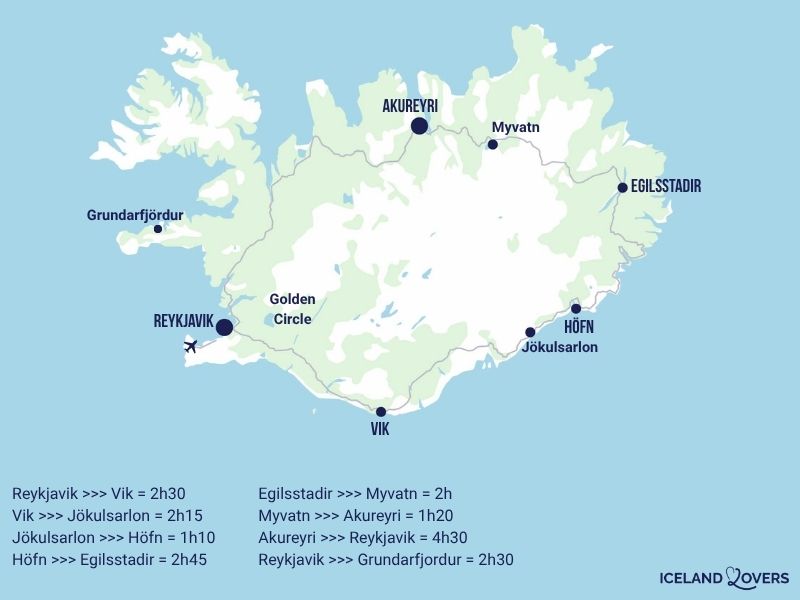
How do I get to Lake Mývatn?
Lake Mývatn is accessible by car via Route 1 (Iceland’s circular road). It’s the most convenient way to explore the region. From Akureyri, it’s about a 1-hour drive east.
In summer, public buses (Strætó) run between Akureyri and Reykjahlíð, the lake’s main village. The nearest airport is Akureyri, served by domestic flights from Reykjavík.

It’s time to book!
Compare everything: companies, prices, schedules and availability.
Where to eat on Lake Myvatn
Dining options around Lake Myvatn remain limited. The village of Reykjahlíd offers a few restaurants and a supermarket. In Skútustadir, on the south shore, you’ll also find a restaurant. We recommend that you pack snacks and water for your days of exploration, as most natural sites don’t offer any refreshments. The Brasserie Mývatn Öl is also a pleasant option for a gourmet break.
Visit Lake Myvatn in winter
Visiting Lake Myvatn in winter is an experience in itself. The landscapes turn white and the atmosphere becomes more intimate, with very few visitors. We found the winter setting particularly conducive to observing the Northern Lights. You can enjoy the Myvatn Natural Baths all year round, providing a welcome moment of relaxation in cold weather. See our dedicated article.

PLAN YOUR SUMMER TRIP TO iceland
- Best of
What to do in Iceland
The most beautiful waterfalls
The most beautiful black sand beaches
Volcanic craters to climb
Lava caves to visit
Best excursions from Reykjavik

- Practical advice
Summer travel tips
How to rent a car in Iceland
Driving tips
Where to stay in Iceland
Itineraries: 3 days – 4 days – 5 days – 1 week – 10 days

- The must-dos
What to do in Reykjavik
Best attractions in the Golden Circle
South Coast attractions
Snaefellsnes Peninsula
Silver Circle
Lake Myvatn attractions