
Here’s our complete guide to planning your trip to Iceland in summer, with all our advice in one place for making choices and getting ready:
- Where to go and how
- Where to sleep
- Map and directions
- What to bring
- What to look out for
- …
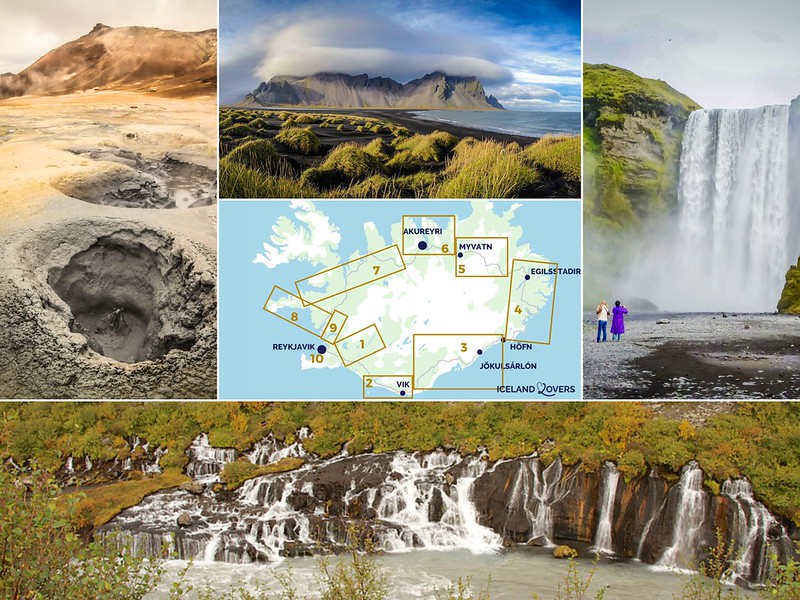
This opinion is completely independent, based on our experiences. We visited the region anonymously, making our own choices and paying our bills in full.
Content
Summer travel in Iceland: the essentials
If you don’t want to read the whole article, here’s a summary of our answers. But you’ll find more detailed information in each section below.
When to go
Summer in Iceland runs from June to August. To enjoy the midnight sun, we recommend the period around the solstice, between mid-June and early July. May and September are transitional months, offering a good compromise between low tourist numbers and favorable conditions.
Temperatures
Summer temperatures in Reykjavik average between 9°C and 14°C. The north of the country experiences similar temperatures, while inland areas can be cooler and windier. But don’t forget to bring warm clothes: the Icelandic summer is anything but tropical.

Where to go
Summer is the only time when the whole island is accessible. Our favorite regions are..:
- The south coast for its waterfalls, glaciers and black sand beaches
- The Snaefellsnes peninsula, with its concentrated diversity of landscapes
- The Westfjords, accessible only in summer, for their isolation and raw nature.
- The Highlands, open from late June to September only
How to get around
There are three main options:
- Rent a car (the best option in summer, with clear roads and long days)
- Join organized excursions (ideal if you don’t want to drive)
- Combine bus and hiking (you can use the long-distance bus network in summer) – but this limits the places you can visit
Our top 3 summer activities
- Swimming in the Silfra fissure
- Horseback riding
- Hiking on a glacier
- Whale watching (from Reykjavik, Husavik or Akureyri)

Map – How long will you be gone?
To discover Iceland in summer under the best possible conditions, we recommend a stay of 10 to 14 days. This is enough time to do a complete tour of the Ring Road, stopping off at the main sites and leaving a few days for detours, such as the Westfjords or the Highlands.
If your time is more limited, 7 days are enough to explore the south, the Golden Circle and the Snaefellsnes peninsula. We did this type of tour on our first trip and remember it fondly.
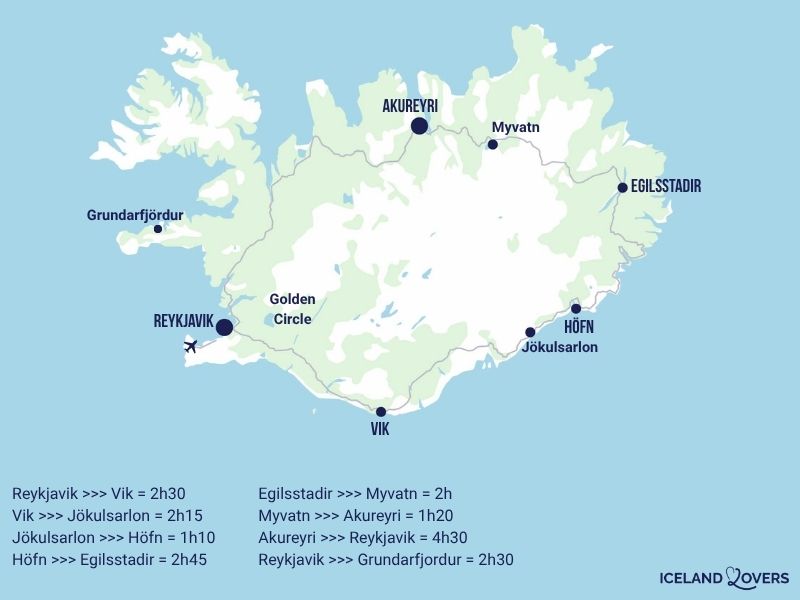
In summer, the long days – with up to 24 hours of daylight around the solstice – allow us to cover greater distances and visit more sites than in winter. The roads are almost all open, and driving conditions are much simpler.
Bear in mind, however, that summer is Iceland’s peak tourist season. Accommodations fill up fast, and popular sites can be very busy in the middle of the day. We advise you to book your accommodation several months in advance, especially for July and August.
RENTING A CAR IN Iceland
Discover the best offers on Discovercars, our preferred platform!
On Route 1, no 4WD required, off Route 1, it depends on your plans.

When to go to Iceland in summer
The Icelandic summer runs from June to August, but the transitional months also offer great opportunities:
- May: 17-21h daylight hours, nature awakens, fewer tourists, some mountain roads still closed
- June: 20-24h daylight, midnight sun, start of puffin season, lupine fields, gradual opening of the Highlands
- July: almost permanent daylight, all roads open, high tourist season
- August: 16-20h of daylight, temperatures still pleasant, start of wild berry season
- September: 12-15h of daylight, autumn colors, chance to see the first aurora borealis

How to get to Iceland in summer
Keflavik International Airport (KEF) is the main point of entry, around 45 minutes from Reykjavik. In summer, the number of flight connections is considerably higher than in winter.
- Direct flights – Available from many European and North American cities. Icelandair and PLAY offer direct flights from Paris, Geneva, London, Amsterdam, New York, etc.

- Ferry – In summer, the Smyril Line ferry links Denmark (Hirtshals) to Seyðisfjörður in the eastern fjords, via the Faroe Islands. The trip takes about 2 days. This is a great option if you want to travel around Iceland in your own vehicle.
- Transfer to Reykjavik – Regular shuttle buses run from the airport to the city center, journey time approx. 45 min.
- Visa – Iceland is part of the Schengen area, check your visa requirements according to your nationality

It’s time to book!
Compare everything: companies, prices, schedules and availability.
Getting around Iceland in summer
Car rental

Summer is the best time to rent a car in Iceland. Driving conditions are much simpler than in winter, and the long days mean that you can drive without time pressure. We covered the whole of the Ring Road by car, which we think is the most pleasant way to discover the country.
- A standard car (2WD) is sufficient for the Ring Road and most tourist sites
- A 4WD is essential for F roads (Highlands) and some unpaved roads
- The F roads are forbidden to non 4×4 vehicles and sometimes require fording rivers – and you need a 4WD high enough for the highlands.
- Book your car as early as possible: demand soars in summer and so do prices
- See all our tips for renting a car in Iceland

Our first instinct is to check out the offers on DiscoverCars.
This platform allows us to easily compare offers from different rental companies: prices and conditions. And every time, we find good deals. What’s more, the insurance is attractively priced.
See the latest car rental offers

Organized excursions
Even in summer, organized excursions remain a practical option for specific activities:
- Glacier hikes (must be guided for safety reasons)
- Whale watching from Húsavík or Reykjavik
- Boat trips on the glacial lagoon of Jökulsárlón
- Golden Circle tours
- Snorkeling or diving in the Silfra fault
Day trips from Reykjavik are available, as well as multi-day tours for those who prefer not to drive. We particularly enjoyed the boat tours on the glacial lagoon, an experience that would otherwise be difficult to achieve.

Long-distance bus
Unlike winter, the long-distance bus network operates during the summer. Companies such as Strætó and Reykjavik Excursions offer routes linking the country’s main towns and cities, as well as certain sites in the Highlands (Landmannalaugar, Þórsmörk). Frequencies remain limited, however. If you opt for this solution, plan your connections carefully.
OUR GUIDE TO PLANNING A Dream trip
- 6 maps that make planning easier
- + 75 pre-selected locations
- Practical advice
- + 115 photos to help you choose
Summer itinerary in Iceland
Summer opens up possibilities that winter doesn’t. We recommend taking advantage of this season to explore otherwise inaccessible regions. Here are our suggested itineraries:
- 7 days: South + Golden Circle + Snaefellsnes (coming soon)
- 10 days: Complete Ring Road (coming soon)
- 14 days: Ring Road + Westfjords or Highlands (coming soon)

What to do in Iceland in summer
Summer transforms Iceland. Green vegetation, the midnight sun and access to the highlands offer a completely different view of the island. We were struck by the contrast between our winter and summer stays: it’s like discovering a different country.
- Tour the Ring Road – waterfalls, fjords, lava fields, lagoons, volcanic craters, geothermal zones… It’s the main business!
- Midnight sun – From mid-June to early July, the sun hardly sets at all. A unique experience that casts a permanent golden light over the landscape
- Hiking – Summer is the great hiking season in Iceland: Landmannalaugar, Þórsmörk, Hornstrandir, Skaftafell and many other trails are within easy reach.
- Puffin spotting – Puffins return to Iceland’s coasts from May to August to nest. The best observation sites are the Vestmann islands, Látrabjarg (Westfjords) and Borgarfjörður Eystri (east).

- Summer activities:
- Glacier hiking (Skaftafell, Sólheimajökull)
- Snorkeling or diving at Silfra (exceptional visibility all year round)
- Whale watching (best period: June to August)
- Kayaking in the fjords
- Cycling on coastal roads
See our full article on Iceland’s attractions (coming soon).

UNFORGETTABLE ACTIVITIES IN winter
- Visit an ice cave
- Glacier hiking
- Whale watching (from Reykjavik, Husavik or Akureyri)

Which region to visit and where to sleep?
In summer, all regions of Iceland are accessible, which considerably expands your possibilities. Your choice of location will depend on your interests and the length of your trip.
Reykjavik
The capital Reykjavik is a natural starting point and a pleasant city to explore, especially in summer when life is more outdoor:
- Lively café terraces in the center, around Laugavegur
- Outdoor concerts and festivals
- Kolaportið’s colourful harbour and weekend flea market
- Starting point for excursions to the Golden Circle and south coast
- Access to the Blue Lagoon

In summer, the range of accommodation is wider than in winter, but so is demand. We recommend booking at least 3 months in advance for July and August.
Our favorite hotels:
Reykjavik Konsulat Hotel – Check photos and availability.
Black Pearl Apartment Hotel – Check photos and availability
See the top-rated accommodations in Reykjavik.
South coast of Iceland
The south coast remains a must in summer, especially as the long days mean you can enjoy the sites without rushing. We were able to see the waterfalls from a completely different angle, surrounded by green moss and purple lupines.
- Seljalandsfoss (you can walk behind it) and Skógafoss waterfalls
- The glacial lagoons of Jökulsárlón and Fjallsárlón, sometimes in glorious sunshine
- Diamond Beach and its icebergs on black sand
- Hiking on the Skaftafell and Sólheimajökull glaciers
- The black sand beaches of Vík and the rock formation of Dyrhólaey
- Puffin colonies on the cliffs of Dyrhólaey and the Vestmann Islands

On the south coast, accommodation is spread out over a number of locations:
- Selfoss, between the Golden Circle and the coast
- Vík, in the center of the south coast
- Höfn, to the east, gateway to the Vatnajökull glacier
Our favorite hotels:
Hotel Kria – Check photos and availability.
Fosshotel Glacier Lagoon – Check photos and availability
In summer, numerous guest farms and guesthouses open their doors along the coast, offering an immersion in rural Icelandic life. We’ve stayed in several of them and it’s an experience we’d recommend.
The Golden Circle
The Golden Circle is Iceland’s most famous route. In summer, the sites are surrounded by greenery and the Gullfoss waterfall is fed by melting snow, making it even more powerful. We were impressed by the volume of water in July compared to our winter visit. The three main sites are:
- Thingvellir, historic site of the first Viking parliament (AD 930) and tectonic fault between the North American and Eurasian plates
- The Geysir geothermal zone and the Strokkur geyser, which spurts out every 5 to 10 minutes
- Gullfoss waterfall, whose flow peaks in summer

In summer, the Golden Circle is Iceland’s busiest circuit. To avoid the crowds, we advise you to leave early in the morning or late in the afternoon – the light is much more beautiful there.
Our favourite hotel: The Hill Hotel at Flúðir – Check photos and availability
See the top-rated accommodations on the Golden Circle.
The Snaefellsnes Peninsula
The Snaefellsnes peninsula remains one of our favorite regions, summer and winter alike. In summer, vegetation covers the lava fields and the Snæfellsjökull glacier stands out against an often clear sky. We found a quieter atmosphere here than on the south coast.
Among the must-haves:
- Kirkjufell mountain and its waterfalls, photographed from every angle
- Arnarstapi lava cliffs and the coastal path to Hellnar
- The black church of Búðakirkja, surrounded by green lava fields in summer
- The Saxhöll crater, with its panoramic view of the glacier and coastline
- Djúpalónssandur beach and its rock formations

In summer, more B&Bs and guesthouses open on the peninsula, giving you more options for your stay. The two main towns remain:
- Grundarfjörður, at the foot of Kirkjufell
- Stykkishólmur, a lively fishing port and departure point for the ferry to the Westfjords
Our favorite: Hotel Hamar in Borgarnes – Check photos and availability
See the best rated accommodations on Snaefellsnes Peninsula
See our article on where to stay on the Snaefellsnes peninsula.
Eastern Fjords
The eastern fjords reveal a beauty in summer that winter only hints at. Green slopes plunge into calm waters, and the road winds from fjord to fjord. We found this part of the trip particularly soothing after the hustle and bustle of the south coast.

The region is distinguished by:
- Authentic fishing villages such as Seyðisfjörður, Djúpivogur and Fáskrúðsfjörður
- Wild reindeer visible along roadsides
- Little-used hiking trails in the valleys
- The village of Seyðisfjörður, the ferry terminal from Denmark, is home to an active artistic community.
Egilsstaðir remains the region’s main town, and a stopping-off point if you’re touring the island on Route 1. The town offers a wide range of services and shops, making it a good place to spend the night.
Our favorite: Gistihúsið – Lake Hotel Egilsstaðir – Check photos and availability
See the top-rated accommodations in Egilsstaðir.
Lake Myvatn
The Lake Myvatn region takes on a whole new dimension in summer. The pseudo-craters are covered with sparse vegetation, the Dimmuborgir lava formations are adorned with green moss, and the lake is home to numerous bird species. We observed dozens of Harlequin Ducks, a rare species in Europe.
But beware: the name “Myvatn” means “fly lake” in Icelandic. In summer, small midges swarm around the lake. They do not sting, but can be a nuisance. We advise you to bring a mosquito net for your face.

Not to be missed in the region:
- The Skútustaðagígar pseudo-craters
- Dimmuborgir lava formations
- The Hverir geothermal zone and its fumaroles
- Krafla volcano and Víti crater
- The Myvatn Nature Baths, a quieter and less expensive alternative to the Blue Lagoon
Our favourite: Fosshotel Myvatn – Check photos and availability
See top rated accommodations around Lake Myvatn.
Akureyri, capital of the North
Akureyri is Iceland’s second-largest city (population approx. 20,000) and is particularly lively in summer. Situated at the bottom of a long fjord, it enjoys a milder microclimate than the rest of the north. We were surprised to find a botanical garden with flowers that survive nowhere else in Iceland.
- Akureyri Botanical Garden, one of the most northerly in the world, free to visit
- Starting point for whale-watching excursions to Húsavík (45min drive)
- Excursions to the Goðafoss waterfall, one of the most famous in the country
- Base for exploring the Diamond Circle: Húsavík, Ásbyrgi, Dettifoss
- Lively nightlife in summer for a city of its size

The town offers a wide choice of accommodation. The options outside the center, on the shores of the fjord, offer remarkable views of the surrounding mountains.
Our favorite: Akureyri Berjaya – Check photos and availability
See the top-rated accommodations in Akureyri.
The Westfjords
The Westfjords are Iceland’s most remote and least-visited region. Inaccessible in winter, these deep fjords are only open to visitors from June to September. We spent 3 days there and it was one of our most memorable experiences in Iceland: few people, unspoilt wilderness and a rare sense of isolation.
Westfjords roads are often unpaved and winding. Expect longer journey times than indicated by the GPS. A 4WD vehicle is recommended, although some sections are accessible by standard car.

- The cliffs of Látrabjarg, Europe’s most westerly point, home to thousands of puffins.
- Rauðasandur beach and its orange-red sand
- The Dynjandi waterfall, monumental and accessible after a short walk
- Hornstrandir nature reserve, accessible only by boat, for experienced hikers
Accommodation in the Westfjords is limited, so book in advance. Ísafjörður is the region’s main town and offers a range of options, including hotels, guesthouses and restaurants.
The Highlands
The Highlands are the uninhabited heart of Iceland: an immense volcanic plateau accessible only from late June to September by F-roads. A sturdy 4WD vehicle is essential, as the roads ford rivers and cross stony tracks. We did Landmannalaugar in 4WD, and crossing the fords requires some experience.

The main sites in the Highlands are:
- Landmannalaugar and its rhyolite mountains of many colors – red, yellow, green, blue
- Þórsmörk, a green valley wedged between three glaciers
- The Laugavegur trek, one of the world’s most famous hiking trails (55km over 4 days between Landmannalaugar and Þórsmörk)
- The Askja volcano and its Víti crater lake
- Landmannalaugar’s natural hot springs, free and open-air
Accommodation in the Highlands is limited to mountain huts and camping. Huts should be booked well in advance, especially on the Laugavegur trek. No hotel accommodation is available in this zone.
What to wear in Iceland in summer
The Icelandic summer can be deceptive. Temperatures rarely exceed 15°C and the weather changes very quickly: you can experience sun, rain, wind and fog in the same day. We experienced afternoons at 18°C in our t-shirts, followed by gusts of freezing wind the next day. The layering principle remains the best approach:
- First layer (against the skin):
- Merino wool or technical T-shirt
- Lightweight leggings for cooler days or high-altitude hikes
- Intermediate layer (insulation):
- Light fleece or wool sweater
- Compact down jacket for evenings or windy days
- Outer layer (protection):
- Waterproof and windproof jacket – essential even in summer
- Lightweight waterproof hiking pants

Accessories required:
- Light hat and thin gloves (for high-altitude hikes or boat excursions)
- Sunglasses (the sun can be low and glaring for long hours)
- Sunscreen (UV rays can be surprisingly strong despite cool temperatures)
- Comfortable, waterproof hiking boots
- Bathing suit (for hot springs and geothermal pools)
- Anti-fly mask if you plan to visit Lake Myvatn
Summer safety in Iceland
Weather conditions
Even in summer, Icelandic weather remains unpredictable. Winds can pick up suddenly and temperatures plummet in a matter of hours. Here are the essential precautions:
- Check the weather forecast daily on vedur.is
- Wind remains the main danger, especially near cliffs and on exposed roads.
- Fog can considerably reduce visibility, especially in the Highlands.
- Download the 112 Iceland emergency application
- In case of emergency, dial 112

Hiking and nature
Summer opens up many hiking trails, but caution is still called for:
- Stay on marked trails to protect fragile vegetation (Icelandic moss takes decades to regrow)
- Don’t get too close to cliffs: erosion makes the edges unstable
- Observe warning signs in geothermal zones – the ground can be hot within a few centimetres of the surface
- River fording in the Highlands is risky: find out about conditions before you set off.
- Report your itinerary on safetravel.is

Summer driving
Driving in summer is much easier than in winter. However, there are a few points to bear in mind:
- Sheep roam freely along roads from June to September: slow down in rural areas
- The F roads (Highlands) are 4WD only and forbidden to standard vehicles.
- Dust and gravel on unpaved roads reduce grip
- Single-lane bridges are common: priority is given to the vehicle arriving first.
- Never drive off-road – it’s forbidden and does lasting damage to nature

Water
Iceland’s tap water is one of the purest in the world, and perfectly drinkable. It comes directly from glacial springs and natural aquifers. A slight sulfur odor may be present in hot water due to its geothermal origin, but it is totally harmless. Take along a reusable water bottle: you’ll save money and reduce plastic waste.
The midnight sun
The midnight sun is one of Iceland’s most remarkable summer phenomena. Around the summer solstice (June 21), the sun only briefly dips below the horizon in Reykjavik, creating a luminous twilight that lasts all “night”. In the north of the country, above the Arctic Circle (on the island of Grímsey), the sun doesn’t set at all for a few days.
This permanent light has practical implications for your trip. We have noticed that sleep can be disturbed: a night mask is essential. Moreover, the golden light of “evening” (which lasts for hours) is ideal for landscape photography.
Icelandic wildlife in summer
Summer is the richest season for wildlife observation in Iceland. Migratory birds return, whales frequent coastal waters and sheep graze freely in the countryside.

The Arctic fox
The fox abandons its white winter fur for a more colorful coat.
Puffins
Puffins are probably Iceland’s most emblematic birds. They return to the coast from May to August to nest. Iceland is home to around 60% of the world’s puffin population. We were lucky enough to observe them at close quarters on the Látrabjarg cliffs: they are not shy and can be approached from just a few metres away.
The best observation sites are:
- The cliffs of Látrabjarg (Westfjords)
- The Vestmann Islands (accessible by ferry from the south coast)
- Borgarfjörður Eystri (East Iceland)
- Dyrhólaey cliffs (south coast), accessible from May to mid-June before closing for nesting.

Whales and marine life
Summer is peak whale-watching season. Húsavík, in the north, is considered Europe’s whale-watching capital. Here you can spot humpback whales, minke whales and, more rarely, blue whales. Excursions are also available from Reykjavik and Akureyri.
See excursion options
The sheep
From June to September, Icelandic sheep graze freely in the countryside and mountain areas. They are descended from those brought by the Vikings in the 9th century. In September, the Réttir (sheep gathering) is an important community event: farmers travel the highlands on horseback to bring their flocks back to the valleys before winter.

The Icelandic horse
Summer is the best season for horseback riding. The Icelandic horse, a purebred for over 1,000 years, is known for its “tölt”, a particularly comfortable gait. Numerous farms offer outings lasting from a few hours to several days in a variety of landscapes. – View options and book

Migratory birds
In addition to puffins, Iceland is home to many species of migratory birds in summer: Arctic terns, golden plovers, purple sandpipers and eiders. Lake Myvatn is one of Europe’s best sites for observing ducks, which gather here in large numbers to nest.
Camping in Iceland in summer
Camping is a popular and economical option in summer. Iceland has many campsites throughout the country, most of which are only open from June to September.
Some practical information:
- The Camping Card gives access to around 30 campsites for 28 nights.
- Most campsites have hot showers, sanitary facilities and sometimes communal kitchens.
- Wild camping is regulated: it is forbidden to camp on cultivated or private land without authorization.
- Bring windproof equipment: long sardines, gust-resistant tent
Practical aspects
Iceland remains an expensive destination in summer, especially as the high season pushes up the price of accommodation and car rentals. Here’s what you need to know:
- Currency: Icelandic krona (ISK), but credit cards are accepted everywhere, even in the most remote areas.
- Electricity: European 230V sockets (type C and F)
- Internet: Wifi widely available in accommodation. Remember to take a local option to access the Internet between towns, especially to check the weather and road conditions.
- Language: English is widely spoken
- Shop opening times:
- Supermarkets: generally 10am-8pm (extended hours in summer)
- Restaurants: 11:30am-10pm
- Olis and N1 service stations are the most reliable shops in rural areas (fuel, snacks, toilets).

Frequently asked questions about Iceland in summer
Is it hot in Iceland in summer?
No, summer temperatures fluctuate between 10°C and 15°C on average, rarely above 20°C. Wind can accentuate the feeling of coolness. Bring warm, waterproof clothing, even in July.
Can you see the northern lights in summer?
Generally speaking, no. The midnight sun makes it impossible to observe the northern lights from May to August. To see them, the sky has to be dark enough, which is only possible from the end of August and especially from September to March.
Do you need a 4WD to visit Iceland in summer?
Not necessarily. A standard car is sufficient for the Ring Road and the vast majority of tourist sites. On the other hand, a 4WD is essential for the F roads (Highlands), the Westfjords and some secondary tracks.
Is it possible to make a complete tour of the island?
Yes, summer is the only season when riding the entire Ring Road (around 1,320km) is really comfortable. Allow at least 7 days for the complete loop, 10 days to take the time to stop and explore each region.
Are the ice caves accessible in summer?
The natural ice caves in the Vatnajökull glacier are only accessible in winter (November to March). In summer, temperatures cause glacial structures to melt and caves become unstable. There are, however, artificial ice tunnels, such as Langjökull, which can be visited all year round.
Are there many tourists in summer?
Yes, summer is clearly the high season in Iceland. Popular sites like the Golden Circle, Jökulsárlón and Skógafoss can get very crowded in the middle of the day. For a more leisurely experience, we recommend visiting the sites early in the morning or late at night (light permitting), and exploring less popular areas such as the Westfjords, Eastern Fjords or Highlands.
PLAN YOUR SUMMER TRIP TO iceland
- Best of
What to do in Iceland
The most beautiful waterfalls
The most beautiful black sand beaches
Volcanic craters to climb
Lava caves to visit
Best excursions from Reykjavik

- Practical advice
Summer travel tips
How to rent a car in Iceland
Driving tips
Where to stay in Iceland
Itineraries: 3 days – 4 days – 5 days – 1 week – 10 days

- The must-dos
What to do in Reykjavik
Best attractions in the Golden Circle
South Coast attractions
Snaefellsnes Peninsula
Silver Circle
Lake Myvatn attractions