
Are you taking a road trip through north-east Iceland and havea day to visit Lake Myvatn? It’s possible, as long as you’re organized. We travelled through this volcanic region concentrated around a small, shallow lake, and the diversity of landscapes within such a compact perimeter really surprised us: geothermal zones, lava fields, explosion craters, columns of rock emerging from the water.
With our 1-day itinerary for Lake Myvatn, you can make the most of these few hours.
This opinion is completely independent, based on our experiences. We visited the region anonymously, making our own choices and paying our bills in full.
Content
Practical tips for visiting Lake Myvatn in 1 day
What can you see on Lake Myvatn in 1 day? The must-dos
In one well-paced day, you can cover the essential sites: geothermal zone, crater, lava fields and pseudocraters. The perimeter is compact and the distances short, making the sequence of stops fluid. In our opinion, the must-haves are:
- The Hverir / Námafjall geothermal zone
- Hverfjall crater (hiking) or just from afar
- Dimmuborgir
- The Skútustaðagígar pseudocraters
We’ll also share with you alternatives to suit your own pace and desires.
To put together your own program, take a look at our selection of the best attractions in Mývatn.
How to get to Lake Myvatn
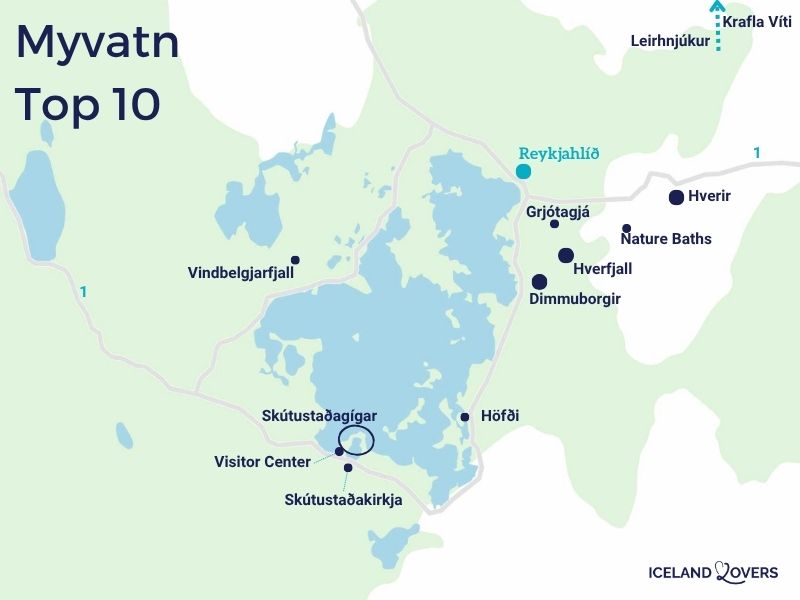
Lake Myvatn is located in north-east Iceland, on Route 1. Our itinerary starts from Egilsstadir in the east (approx. 1 hr 45 min drive) and reaches Akureyri in the west (approx. 1 hr), in the classic clockwise Icelandic road trip direction. The reverse order works just as well if you’re coming from Akureyri.
If your day in Myvatn is part of a longer road trip, check out our selection of the best accommodation in the region to organize your nights before and after.
A car is essential: the sites are scattered around the lake for some 36km, and there is no public transport linking the natural areas. In summer, public buses (Strætó) run between Akureyri and Reykjahlíð, the main village.
WHERE TO STAY IN myvatn
Fosshotel Myvatn, with beautiful lake views
See top-rated accommodations
Salt – Hotel Myvatn, near the pseudo-craters
See top-rated accommodations
Dimmuborgir Guesthouse, by the lake
See top-rated accommodations

Stop 1 – En route from Egilsstadir: possible detour to Dettifoss
If you leave Egilsstaðir early, a detour to the Dettifoss and Selfoss waterfalls is a must before reaching the lake. Both sites are about a 45-minute drive from Mývatn, accessible via route 862 or 864 depending on your direction. Dettifoss is Europe’s most powerful waterfall in terms of flow: water from the Jökulsá á Fjöllum cascades down 45m in a roar that can be heard several metres from the edge. We were gripped by the raw power of this place from the very first approach.

Moving slightly upstream, Selfoss offers an interesting contrast: wider and lower, its orange-tinged basin is less spectacular than Dettifoss, but just as photographic. Allow 1h30 to 2h for both sites. This detour is optional if you’re short on time, but it’s one of the most striking stops in northern Iceland.
Stop 2 (1h): Hverir, the Námafjall geothermal zone
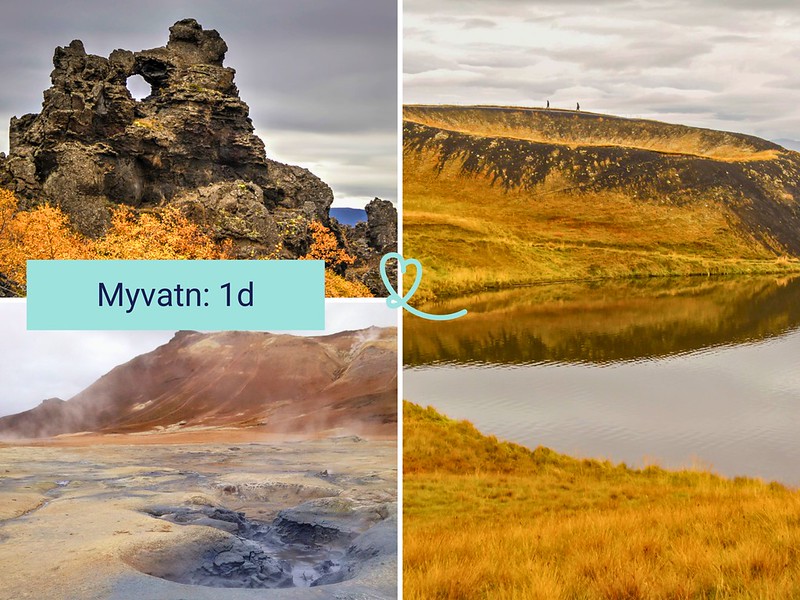
First stop along Route 1, 6km east of Reykjahlíð: the Hverir geothermal zone, at the foot of the Námafjall pass. The contrast with the landscapes crossed from Egilsstaðir is immediate. The terrain, totally devoid of vegetation, is covered with pools of bubbling mud, solfataras and fumaroles of ochre, yellow and ash-grey hues. Here we discovered a landscape whose lunar appearance reminds us that Icelandic volcanic activity is not just a phenomenon of the past.

You can follow the marked paths at your own pace, observing the diversity of the formations: each pond has its own color and viscosity. You can climb the slopes of Námafjall for a bird’s eye view of the area and the lake in the background. Allow 30min to 1h. Pay parking is available. Keep to the marked paths: the ground can be very hot outside safe areas.
Find out more.
RENTING A CAR IN Iceland
Discover the best offers on Discovercars, our preferred platform!
On Route 1, no 4WD required, off Route 1, it depends on your plans.

Stop 2a (2h): Hike to Hverfjall crater for the fittest
The Hverfjall crater is one of the largest explosion craters in the world, with a diameter of almost 1km and an altitude of 420m. Formed around 2,500 years ago in a phreatomagmatic eruption, its perfectly circular profile stands out from the road. The climb is over loose ash and black gravel, steep and unshaded. We recommend tackling this hike early in the day, when legs are cool.

At the summit, the 360° panorama of Lake Mývatn, the Dimmuborgir lava fields and the Krafla mountains more than justifies the effort. A path runs along the edge of the crater to take you all the way around. Allow 1 to 2 hours, depending on your pace. Hiking boots are essential; do not climb in strong winds. Pay parking at base.
Find out more.
Stop2b (1h): Höfdi for less adventurous hikers
If hiking to the Hverfjall crater doesn’t suit your fitness level or weather conditions, the Höfði peninsula offers a more accessible alternative on the eastern shore of the lake. This birch-wooded promontory, rare in such a mineral environment, exudes an atmosphere very different from the rest of the region. Shady paths run along the shore, with unobstructed views of the pseudocraters and surrounding mountains. We found this place particularly restful after Hverir’s world of sulfur and ash.

At Kalfaströnd, lava pillars emerge directly from the water – “klasar”, formed by the interaction between molten lava and the lake. Allow 30min to 1h. The trails are relatively flat and accessible.
OUR GUIDE TO PLANNING A Dream trip
- 8 maps that make planning easier
- + 100 pre-selected locations
- Practical advice
- + 130 photos to help you choose
Stop 3 (30min to 2h): Dimmuborgir
Dimmuborgir is a maze of columns, arches and lava cavities. These formations were formed around 2,300 years ago, when a lake of molten lava solidified around columns of steam. We’ve walked this labyrinth, whose silhouettes evoke the ruins of an ancient fortress, and it’s easy to understand why Icelandic folklore has associated it with hidden creatures.

Several marked trails of varying difficulty allow you to explore the site. Among the highlights: the natural arch of Kirkjan, “the church”, which crosses a lava wall.
We suggest you opt for tours away from the main parking lot, where the atmosphere is much quieter. Duration: 1 to 2 hours. Paying toilets on site; a café is open in summer.
Find out more.
Stop 4 (1h): The Skútustadagígar pseudocraters
On the southern shore of the lake, the Skútustadagígar pseudocraters are one of the region’s most unusual sites, and one of our favourites! These small grass-covered knolls, scattered along the water’s edge, are not volcanic craters in the strict sense of the term: they are the result of a steam explosion caused by the meeting of a lava flow and marshy soil.

A relatively flat circular path runs alongside the pseudocraters on the lakeshore. We enjoyed the serenity of this place, often less crowded than Dimmuborgir at the same time of day. On the way, you’ll see the small church of Skútustadakirkja. Allow 30min to 1h. Free access, free parking.

It’s time to book!
Compare everything: companies, prices, schedules and availability.
Stop 5: Earth Lagoon, if you sleep in Mývatn
If you’re spending the night in the area rather than in Akureyri, end the day at the Earth Lagoon geothermal basins (formerly Myvatn Nature Baths), about 3km east of Reykjahlíð on Route 1. The water, naturally heated to 36-40°C by springs at a depth of over 2,500m, is ideal for recovery after Hverfjall. The atmosphere is much more intimate than at the Blue Lagoon: less crowded, less staged, more tranquil.

The complex features a large outdoor pool, natural steam baths and a café-restaurant. We recommend that you book your ticket in advance in high season, as capacity is limited. Check schedules and prices on the official website here. Book your ticket now to save time.
Alternative 1: Grjótagjá cave
Just a few minutes from Hverir, the Grjótagjá cave is a quick and memorable stopover. This small lava cavity is home to a limpid blue hot spring, illuminated by light filtering through cracks in the rock. The descent into the cave is very short but requires a little flexibility. Swimming has been banned since the Krafla eruptions of 1970-1980, which raised the water temperature to dangerous levels. The site was also made famous by its appearance in the Game of Thrones series.
Allow 15-30min. Access is via a small dirt track on Route 860. Free of charge. Private land: access can be closed at any time.

UNFORGETTABLE ACTIVITIES IN Iceland
- Swimming in the Silfra fissure
- Horseback riding
- Hiking on a glacier
- Whale watching (from Reykjavik, Husavik or Akureyri)

Alternative 2: Leirhnjúkur and Víti crater (Krafla area)
If you have extra time – or if you’re replacing Dimmuborgir – the Krafla area, about 15km northeast of Reykjahlíð via route 863, is well worth a visit. Leirhnjúkur was our most memorable walk in the whole region: the still-smoldering lava fields, remnants of the “Krafla fires” eruptions between 1975 and 1984, exude a unique sense of desolation. The signposted trail winds between several active geothermal zones.
A few minutes away, the Víti crater contains a turquoise lake of surprising intensity, formed in 1724. It offers surprisingly colorful views!
- Allow 1h to 2h for Leirhnjúkur, and a further 20 to 45min for Víti Crater.
- Pay parking on both sites. No on-site catering.

Alternative 3: Stop at Godafoss on the way to Akureyri
On the way to Akureyri (approx. 1h from Mývatn), a stop at the Goðafoss waterfall adds just 30min to your journey. It’s located directly on Route 1, and parking is just a few seconds away. Approximately 30m wide, this waterfall flows in a semicircle into an open setting. Its name “cascade of the gods” comes from a seminal episode in Icelandic history: in the year 1000, a chieftain is said to have thrown his idols here after the country’s conversion to Christianity.

VISIT Myvatn
- Attractions around Lake Myvatn
- Where to sleep: hotels and accommodation
- Itineraries: 1 day – 2 days
- How to get there
- Hverfjall
- Hverir
- Dimmuborgir
What you need to know for your day at Lake Mývatn
The crowds at Lake Mývatn
The high season (July-August) attracts many visitors, especially to the most accessible sites such as Hverir and Dimmuborgir. The midday hours are the busiest. We recommend an early start, from 8am if possible, to get to Hverir and Hverfjall before the rush. At Dimmuborgir, straying from the paths close to the parking lot radically changes the experience. The region remains less crowded than Iceland’s south coast, making most sites manageable even in high season.
Adapt your itinerary when it rains
Rain doesn’t compromise a day on Mývatn: Hverir and Dimmuborgir can still be visited on an overcast day, and the fumaroles of Námafjall are sometimes even more spectacular in the mist. On the other hand, the ascent to Hverfjall is not recommended in strong winds or heavy rain, as the ash floor becomes slippery.
The Sigurgeir Bird Museum, on the north-eastern shore of the lake, is also an interesting indoor alternative. Visit the official website for more info here.
PLAN YOUR SUMMER TRIP TO iceland
- Best of
What to do in Iceland
The most beautiful waterfalls
The most beautiful black sand beaches
Volcanic craters to climb
Lava caves to visit
Best excursions from Reykjavik

- Practical advice
Summer travel tips
How to rent a car in Iceland
Driving tips
Where to stay in Iceland
Itineraries: 3 days – 4 days – 5 days – 1 week – 10 days

- The must-dos
What to do in Reykjavik
Best attractions in the Golden Circle
South Coast attractions
Snaefellsnes Peninsula
Silver Circle
Lake Myvatn attractions