
Want to take advantage of the Icelandic summer to explore the island under the midnight sun?
Here are our tips for choosing the number of days you want to spend in Iceland this summer.
This opinion is completely independent, based on our experiences. We visited the region anonymously, making our own choices and paying our bills in full.
Content
How many days to spend in Iceland in summer: quick answers
- Minimum to get an overview of the south and the Golden Circle: 4 to 5 days
- Number of days to see the most famous places (south, Golden Circle, Snaefellsnes peninsula): 7 days
- Ideal number of days for a complete tour of the Ring Road, possible in 7 days in summer, but in our opinion: 10 days.
- For in-depth exploration, including remote areas (Westfjords, Highlands): 3 to 4 weeks
- If you just want to relax in hot springs and enjoy nature… it all depends on the number of days you have available and your budget.
There is no universal answer to this question. It depends on a number of criteria. We give you more details in the article to help you make your decision.

The Icelandic summer offers a considerable advantage: the days are extremely long, with up to 24 hours of daylight around the solstice in June. This means you can cover greater distances and visit more sites than in winter. The roads are almost all open, and driving conditions are much simpler.

It’s time to book!
Compare everything: companies, prices, schedules and availability.
Number of days to see the highlights
In our opinion, the must-see places in Iceland are..:
- The Golden Circle (Thingvellir, Geysir, Gullfoss)
- The south coast: Seljalandsfoss and Skógafoss waterfalls, Reynisfjara black sand beach
- The Vatnajökull glacier and the Jökulsárlón glacial lagoon
- The Snaefellsnes Peninsula
- The Mývatn region in the north
- Húsavík for whale watching
- Akureyri, the capital of the north
- Natural hot springs (Blue Lagoon or Sky Lagoon near Reykjavík, Mývatn Nature Baths in the north)
- Landmannalaugar and its colourful mountains (accessible in summer only, route F)
- Reykjavík and its cultural life

We think that in 7 days, you can comfortably cover the south of the island, the Golden Circle and the Snaefellsnes peninsula. This is the type of tour we did on our first trip to Iceland, and we remember it fondly.
To see the north (Mývatn, Húsavík, Akureyri) and complete the Ring Road, allow 10 to 14 days. This allows us to stop at the main sites and leave a few days for detours.
It’s also possible to do the Ring Road in 7 days in summer, but then you have to make important choices about stops and maintain a steady pace.
Find out more in our article on Iceland’s top attractions (coming soon).

Size and travel time
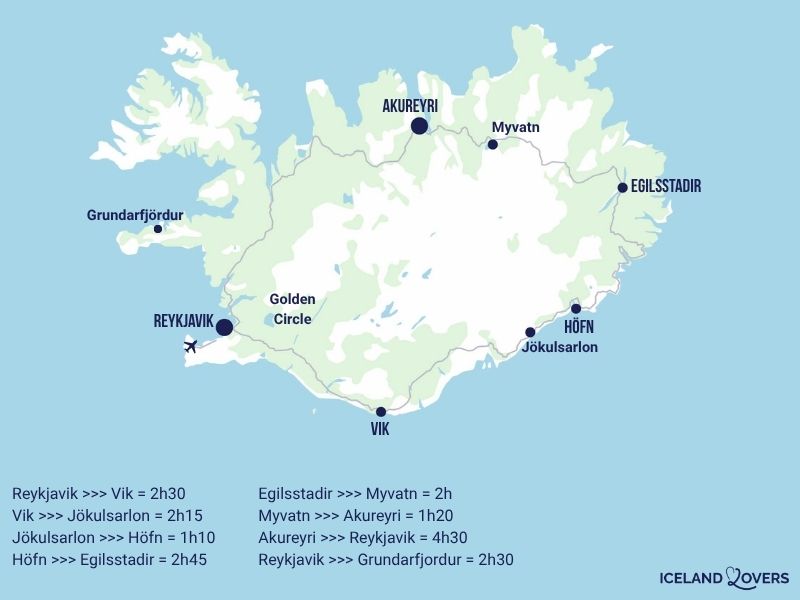
Iceland is much bigger than most people imagine. The Ring Road (Route 1), which circles the island, measures around 1,322km. Even if the roads are in good condition in summer, the distances between sites take time.
Reykjavík to Vík (south coast), approx. 2h30 drive. From Reykjavík to Akureyri (north), allow around 4 hrs 30 mins by direct route, or much longer if you go via the west coast and the Snaefellsnes peninsula. We recommend that you do not underestimate these distances when planning your itinerary.
In summer, most roads are open, including some F-roads (mountain trails) that provide access to the Highlands. These trails require a 4WD vehicle and are generally only passable from late June to September. Find out about road conditions on road.is before each trip.
Here’s a map with the main driving times to give you an idea:
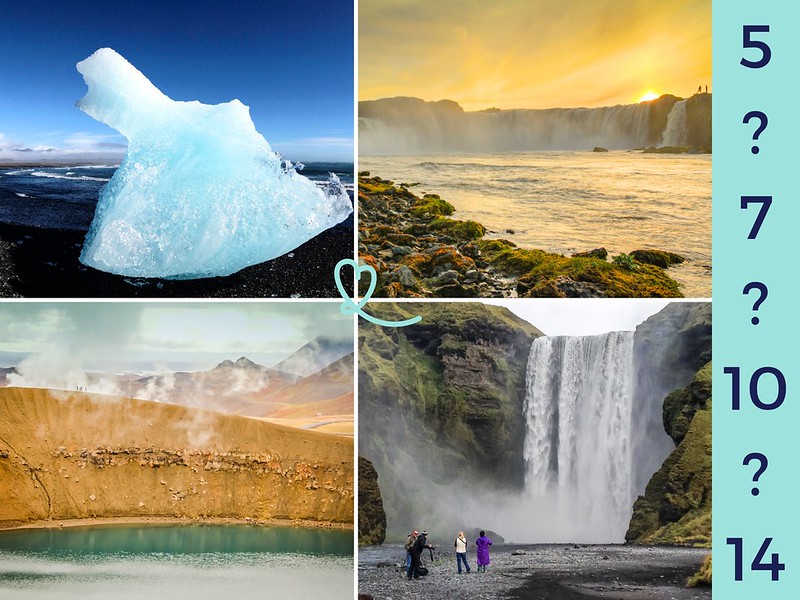
5, 7, 10 or 14-day itineraries
To get an even better idea of what you can see, take a look at our itinerary suggestions:
- 5-day itinerary in Iceland in summer (coming soon)
- 7-day itinerary in Iceland in summer (coming soon)
- 10-day summer itinerary in Iceland (coming soon)
- 14-day itinerary in Iceland in summer (coming soon)
RENTING A CAR IN Iceland
Discover the best offers on Discovercars, our preferred platform!
On Route 1, no 4WD required, off Route 1, it depends on your plans.

Criteria for deciding how long to spend in Iceland in summer
Budget
Iceland is a destination with a high cost of living. Prices for accommodation, restaurants and activities are significantly higher than in most European countries. In summer, the high season pushes up prices even further, especially for accommodation.
Evaluate how much you can afford in total: this helps you determine how many days you can stay. We advise you to book your accommodation several months in advance, especially for July and August, as availability decreases rapidly.
- Find out more about car hire in Iceland and see the best deals.
- If you stick to the main roads and attractions, there’s no need for 4WD in summer.

For accommodation, price ranges vary enormously between camping, youth hostels, guesthouses, hotels and luxury lodgings. So we can’t give you an exact price. Research prices for your type of accommodation and take into account the cost of petrol, which remains high.
WHERE TO STAY IN Iceland
Our independent picks for the accommodation of your dreams:
- Where to stay in Iceland (coming soon)
- Where to sleep in Reykjavik (coming soon)
- Best 5-star hotels (coming soon)
- Where to sleep on the South Coast (coming soon)
- Where to sleep on the Golden Circle (coming soon)
- Where to sleep on the Snaefellsnes peninsula

To keep costs down, camping is a popular option in summer. Iceland has a good network of campsites throughout the country, and many travelers choose them to extend their stay without blowing their budget.

Your desires, interests and goals
Hiking? Whale watching? Exploring glaciers? Hot springs?
Your desires have an impact on the time you need to enjoy your destination.
For example, if you want to hike in the Highlands or explore the Westfjords, you’ll need more time than a classic tour along the Ring Road.
In Iceland in summer, the offer is very rich:
- Number of different landscapes: very high
glaciers, volcanoes, waterfalls, fjords, black sand beaches, colorful mountains, geysers, moss-covered lava fields… - Number of hikes: very high
walks accessible to multi-day treks (Laugavegur, Fimmvörðuháls) - Number of cultural venues: moderate
concentrated in Reykjavík (museums, galleries, music scene) - Number of charming villages: moderate
Seyðisfjörður, Siglufjörður, Vík…

- Number of boat trips: high
whale watching from Húsavík or Reykjavík, zodiacs on the glacial lagoon, kayak excursions - Number of hot springs and natural pools: high
throughout the country - Number of beautiful beaches: low
The black sand beaches are breathtaking, but not suitable for swimming (very cold water).

Visa
Iceland is part of the Schengen area.
If your passport is outside this area, the traditional tourist visa authorizes you to travel for a maximum of 90 continuous days within the Schengen zone, including Iceland. The request must be made on ETIAS.
For citizens of the European Union and the Schengen area, no visa is required. A valid passport or identity card is all you need.
OUR GUIDE TO PLANNING A Dream trip
- 8 maps that make planning easier
- + 100 pre-selected locations
- Practical advice
- + 130 photos to help you choose
Personal circumstances
Take into account your own schedule, including work commitments and personal responsibilities. This will help you realistically assess how much time you can devote to the trip.
If you’re traveling with young children, plan on a slower pace. Distances in Iceland are long and the days on the road can be tiring. In this case, we recommend extending the length of your stay or concentrating your itinerary on a specific region.

Weather and summer conditions
Summer in Iceland lasts from June to August, with average temperatures between 10°C and 15°C. The weather remains unpredictable: it can change several times in the same day. Bring layered clothing and waterproof equipment, whatever the length of your stay.
The months of June and July offer the longest days, a real advantage for optimizing your visiting time. In August, the nights start to return, making the aurora borealis possible at the end of the month, although rare. We’ve found that this almost permanent brightness in June allows us to visit sites in the evening, when visitor numbers drop.
Bear in mind that summer is the peak tourist season in Iceland. Popular sites such as the Golden Circle, Jökulsárlón and Reynisfjara can be very busy in the middle of the day. For a quieter experience, we recommend visiting the highlights early in the morning or at the end of the day.

UNFORGETTABLE ACTIVITIES IN Iceland
- Swimming in the Silfra fissure
- Horseback riding
- Hiking on a glacier
- Whale watching (from Reykjavik, Husavik or Akureyri)

Frequently asked questions
Are 5 days enough in Iceland in summer?
With 5 days, you can explore the Golden Circle, the south coast to Vík or Jökulsárlón, and enjoy a day in Reykjavík. It’s a good overview, but you’ll have to make choices and keep a steady pace.
Are 7 days enough in Iceland in summer?
With 7 days, you can comfortably cover the south, the Golden Circle and the Snaefellsnes peninsula. It is also possible to complete the Ring Road in 7 days, but this involves long days on the road and limited stops. We recommend that you concentrate on one part of the island to enjoy it without rushing.
Is 10 days too long in Iceland in summer?
No, 10 days is not too long. In our opinion, this is the minimum time needed to do the Ring Road at a pleasant pace, taking time to stop off at the main sites and do a few hikes. Iceland is a country where the landscape is constantly changing, and every stop has something new to discover.
Is 14 days too long in Iceland in summer?
No, two weeks is ideal. You can loop around the Ring Road, take detours to less-frequented areas and save time for hikes or boat trips. If you love nature and wide open spaces, you’ll have no trouble filling your days.
What’s the difference between travelling to Iceland in summer and winter?
In summer, the days are very long (up to 24 hours of daylight), the roads are almost all open and you can access the Highlands. In winter, days are short (4 to 5 hours of daylight in December), some roads are closed and driving can be difficult. Winter, on the other hand, offers the northern lights and snowy landscapes. The two seasons offer very different experiences. To find out more, see our article How many days to spend in Iceland in winter.
PLAN YOUR SUMMER TRIP TO iceland
- Best of
What to do in Iceland
The most beautiful waterfalls
The most beautiful black sand beaches
Volcanic craters to climb
Lava caves to visit
Best excursions from Reykjavik

- Practical advice
Summer travel tips
How to rent a car in Iceland
Driving tips
Where to stay in Iceland
Itineraries: 3 days – 4 days – 5 days – 1 week – 10 days

- The must-dos
What to do in Reykjavik
Best attractions in the Golden Circle
South Coast attractions
Snaefellsnes Peninsula
Silver Circle
Lake Myvatn attractions