
Would you like to discover Iceland under its blanket of snow, between northern lights and ice caves?
Here are our tips for choosing the number of days you want to spend in Iceland in winter.
This opinion is completely independent, based on our experiences. We visited the region anonymously, making our own choices and paying our bills in full.
How many days to spend in Iceland in winter: quick answers
There is no universal answer to this question. It depends on a number of criteria.
- Minimum to get an overview of the south and the Golden Circle: 4 to 5 days
- Number of days to see the most famous places accessible in winter: 7 to 8 days
- In our opinion, the ideal number of days is 10 to 12.
- Days are short in December and January (4h to 6h), reducing daily exploration time, but longer in February and March.
The Icelandic winter lasts from November to March. This season offers unique experiences: northern lights, natural ice caves, snow-covered landscapes. But it also imposes severe constraints on travel and sunshine duration. We have made this journey and adapted our advice to these realities.
We give you more details in the article to help you make your decision.
RENTING A CAR IN Iceland
Discover the best offers on Discovercars, our preferred platform!
On Route 1, no 4WD required, off Route 1, it depends on your plans.

What you can see and do in Iceland in winter
Winter limits access to certain regions, but opens the door to unique experiences. In our opinion, these are the season’s must-see activities:
- Visit an ice cave
- Aurora hunting
- Admire the sometimes frozen waterfalls
- See icebergs in lagoons or on a black sand beach
- Heating up in a geothermal zone
- Hiking on a glacier
- Relax in hot springs
- Seeing in black and white in lava fields
- Enjoy the atmosphere of Reykjavik
See our article on the best winter activities in Iceland.
We think that in 7 to 8 days, you can cover these major sites without rushing. Most of Iceland’s winter attractions are concentrated in the south, which makes planning easier.

WHERE TO STAY IN Iceland
Our independent picks for the accommodation of your dreams:

What’s closed or inaccessible in winter
Some regions and roads become impassable in winter. This information is essential for planning your stay and determining how many days to allow.
- Highlands (F-roads): closed from October to June. The Landmannalaugar area, very popular in summer, is inaccessible.
- Western fjords: most secondary roads are closed or dangerous. Only the main section remains open at times, but conditions are unpredictable.
- Attractions far from Route 1 in the north (such as Dettifoss)
- Puffin watching: these birds are only present between May and August to breed. The rest of the year, they’re out at sea.
- Some hikes: many mountain trails are closed or snow-covered. Glacier hikes are only possible on guided tours.
Check daily road conditions on the official website road.is and weather forecasts on vedur.is.
Be careful in winter, as the weather can change radically in just a few hours.

UNFORGETTABLE ACTIVITIES IN winter
- Visit an ice cave
- Glacier hiking
- Whale watching (from Reykjavik, Husavik or Akureyri)

Road times and winter constraints
In winter, journey times are longer than in summer. Snow, ice and wind make journeys longer.
What’s more, short days mean that we have to drive partly in the dark.
We recommend allowing 30-50% more time than in summer.
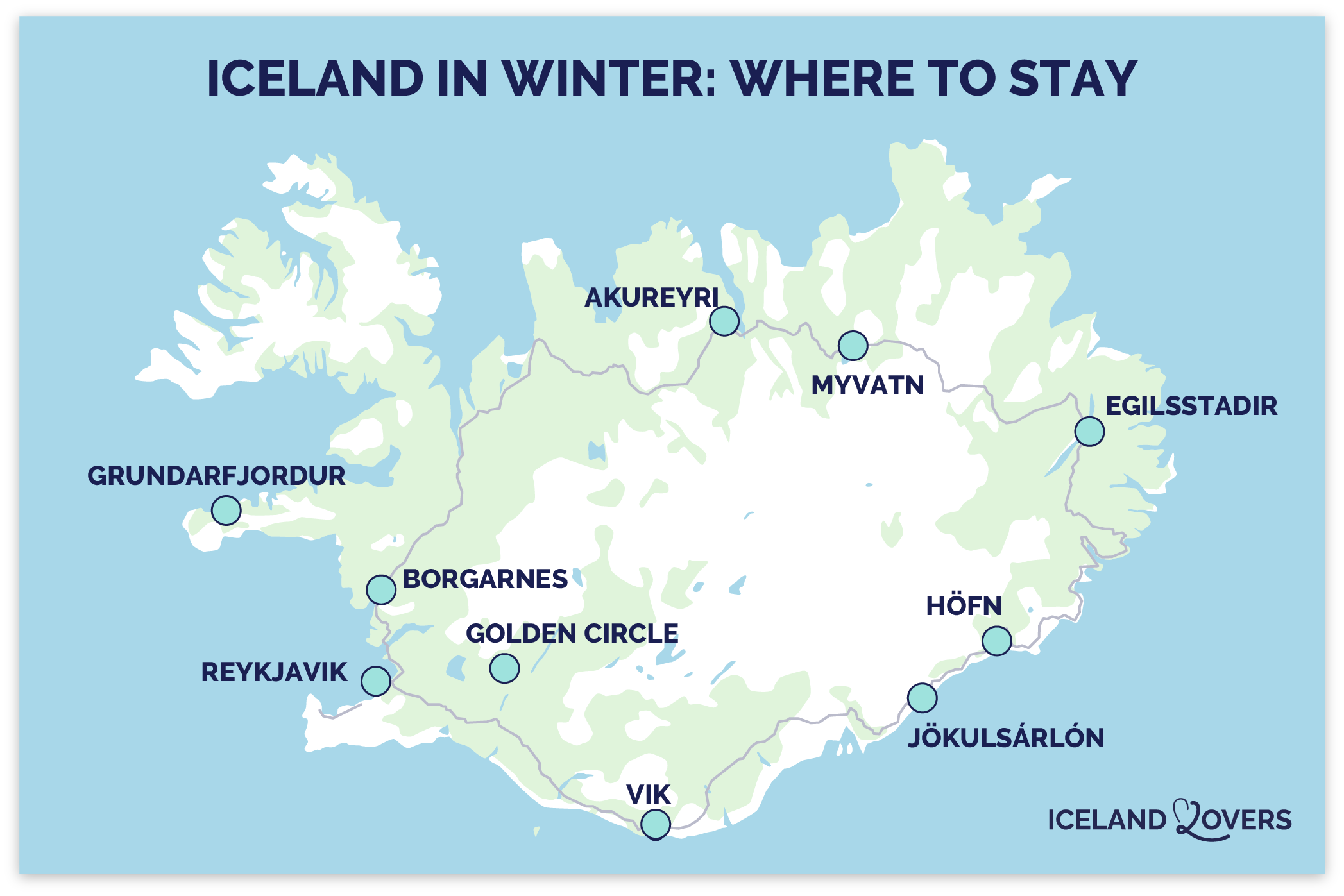
Some examples of driving times between the main points of interest (normal winter conditions):
- Reykjavik – Golden Circle (Geysir): approx. 1h30
- Reykjavik – Vik (south coast): approx. 3h
- Vik – Jökulsárlón: approx. 3h
- Reykjavik – Snæfellsnes Peninsula: approx. 2h30
- Reykjavik – Blue Lagoon (Grindavik): 50min approx.
These times are indicative only. In the event of a storm, some roads may be temporarily closed. You have to accept the power of nature when traveling in Iceland in winter, and appreciate every moment, even if you’re stuck in a hotel.


Find the best deals on our preferred car rental platform: DiscoverCars
5, 7, 10 or 12-day itineraries in winter
In winter, itineraries focus mainly on the south and west of Iceland. Here’s what you can expect, depending on the length of your stay:
5 days: the South and the Golden Circle
This is the most common format for a first winter stay. You can discover the Golden Circle, the waterfalls and beaches of the south coast, and enjoy an evening watching the Northern Lights. In 5 days, we reckon you’ll have a good overview of the winter landscape, without reaching the glacial lagoon of Jökulsárlón (unless you’re travelling at a steady pace).
7 to 8 days: the complete south and Snæfellsnes
With one week, you can travel along the south coast to Jökulsárlón, visit an ice cave, hike on a glacier and explore the Snæfellsnes peninsula. We recommend this duration for a well-balanced winter stay. You’ll also have time to enjoy Reykjavik and try your hand at several evenings of Northern Lights viewing.
Or you can take the Route 1 tour if you’re very strict about your choice of stops.

10 to 12 days: in-depth exploration
This duration allows us to add the Reykjanes Peninsula, spend more time in each zone, do several glacier hikes and plan buffer days in case of bad weather. Experienced travelers might consider a foray north (Akureyri, Lake Mývatn), accessible by domestic plane from Reykjavik or by road if conditions permit. We consider this duration to be ideal for a complete winter holiday.
To get an even better idea of what you can see, check out our itinerary suggestions:
- 5-day itinerary in Iceland in winter (coming soon)
- 7-day winter itinerary
- 10-day winter itinerary

Criteria for deciding how long to spend in Iceland in winter
Budget
Iceland is one of Europe’s most expensive destinations, and this is also true in winter. However, accommodation prices are lower than in the high summer season (around 20% to 30% lower on average). Renting a winter-appropriate car is a major expense.


It’s time to book!
Compare everything: companies, prices, schedules and availability.
Your desires, interests and goals
Watching the northern lights? Visiting ice caves? Hiking on a glacier? Photographing snow-covered landscapes?
Your priorities determine how much time you’ll need to enjoy your destination in winter.
For example, the northern lights are not visible every night: planning several nights in advance increases your chances of seeing them.
In Iceland in winter, we focus on..:
- Number of accessible waterfalls:
high (most of the large waterfalls in the south remain accessible, some partially frozen) - Numerous glaciers accessible by excursion:
high (Sólheimajökull, Skaftafell, Vatnajökull) - Numerous hot springs and geothermal baths:
high (Blue Lagoon, Sky Lagoon, Secret Lagoon, natural baths)

- Many possible hikes:
moderate (limited to marked trails and guided glacier tours) - Numerous cultural venues:
moderate (museums and galleries in Reykjavik, historic churches) - Marine wildlife observation:
moderate (whale-watching trips possible from Reykjavik and Húsavik, but sometimes difficult sea conditions) - Landscape photography:
exceptional (low-angled light, contrasting snow and basalt, northern lights)

Daylight: a major constraint
This is the factor most underestimated by travelers. At the height of winter (December-January), Iceland enjoys only 4 to 5 hours of daylight. In November and February, allow 6-8 hours. This reduced period of sunshine has a direct impact on your daily schedule.
In practical terms, this means that you can only visit one or two sites per day, as opposed to three or four in summer. This is the main reason why we recommend allowing more days than distances alone suggest. On the other hand, the low-angled light of winter creates atmospheres you won’t find in any other season.

Your winter driving experience
Driving in Iceland in winter requires a certain amount of experience on snowy and icy roads. Crosswinds can reach 100km/h, considerably reducing visibility. Coastal roads are sometimes covered in black ice.
If you’re not used to these conditions, you have two options:
- book guided excursions from Reykjavik (a common option for 4- to 6-day stays) – see our favourites
- or limit your travels to the main roads in the south, where snow clearing is a priority, and choose a 4WD for greater control.

Visa
Iceland is part of the Schengen area. If your passport is outside this area, the tourist visa authorizes you to travel within the zone, including Iceland, for a maximum of 90 continuous days.
Personal circumstances
Also consider your tolerance to cold and short days. Some travelers find that prolonged darkness affects their energy. In this case, we advise you to plan lighter days, alternating excursions with relaxation in the hot baths.

Weather and conditions specific to winter
Temperatures range from -5°C to 5°C by the sea, sometimes lower inland. Wind is the most restrictive factor: it accentuates the sensation of cold and can make certain visits unpleasant or dangerous (especially on cliffs and beaches).
A few points to remember:
- November: start of the aurora borealis and ice cave season, about 7 hours of daylight, temperatures still moderate
- December-January: shortest days (4h to 6h of daylight), ice caves in optimal conditions, New Year’s Eve celebrations in Reykjavik.
- February: light returns gradually (6 to 8 a.m.), the ice caves are still accessible, the roads are beginning to be more passable.
- Mars: around 8 to 9 hours of daylight, last few weeks for ice caves, northern lights still visible, road conditions improving
We recommend February or March for a first winter stay. There’s plenty of light to enjoy the scenery, while retaining the winter experience. December and January are more suited to travelers seeking the most immersive atmosphere, provided they can accept the very short days.

Do you need a 4WD in Iceland in winter?
Yes, without hesitation. Unlike summer, when a classic car is sufficient for the circular route, winter makes a 4WD indispensable. Secondary roads are not always cleared of snow, steep hills become slippery slopes, and conditions change from hour to hour. You’ll have much better control of the vehicle.
But, again, if you have no experience of driving on snow and ice, this is not the place to learn. Take a guided tour!

Frequently asked questions
Are 4 days enough in Iceland in winter?
With 4 days, you can discover Reykjavik, the Golden Circle and part of the south coast (Seljalandsfoss and Skógafoss waterfalls, Reynisfjara beach). It’s a quick but satisfying overview, especially if you book a guided tour to optimize your time. You won’t have time to reach Jökulsárlón or visit an ice cave, saud if you concentrate on that (one-way only) along the south coast.
Is 5 days enough in Iceland in winter?
With 5 days, we think you can add Jökulsárlón and Diamond Beach to your itinerary, or even a glacier hike. The pace will be brisk, with no break days, but it’s achievable if the weather cooperates.
Is 7 days too long in Iceland in winter?
No, 7 days is not too long. This is the length of time we recommend for a complete winter stay in the south. You can include the Golden Circle, the south coast to Jökulsárlón, an ice cave, a glacier hike, the Snæfellsnes Peninsula and Reykjavik, while keeping a buffer day for the weather. You’ll also have several evenings to try and spot the northern lights.
Is 10 days too long in Iceland in winter?
No, 10 days is not too long. This length of time allows you to explore without rushing, to revisit places in different lights, to devote time to hot springs and to have real buffer days in case of storms. Travelers with a passion for photography particularly appreciate this more leisurely pace.
Can you do a complete tour of Iceland in winter?
This is possible because the circular road (Route 1) remains open in winter.
But we don’t recommend it to most travellers. Northern sections are regularly closed by storms, short days make long trips difficult, and many northern attractions are closed or difficult to access.
When to book excursions (ice caves, glacier)?
Book as soon as possible. Ice cave tours are in great demand and places are limited. You don’t want to miss this show!
Glacier hikes can also be booked in advance, although availability is generally better.
Are the northern lights guaranteed?
No, no guarantee. The aurora depends on solar activity and cloud cover. Clear skies and low light pollution are required. The longer you stay, the better your chances. With 7 days in Iceland, you’ll have a statistically good chance of seeing one at least once.
PLAN YOUR TRIP TO iceland IN WINTER

- Practical advice
How to rent a car in Iceland
Winter driving tips
Where to stay in Iceland in winter
Itineraries: 3 days – 4 days – 5 days – 1 week – 10 days