
On your tour of the Snæfellsnes peninsula, don’t miss the Lóndrangar cliffs, two impressive basalt pillars overlooking the Atlantic Ocean. We enjoyed the majesty of these rock formations, sculpted by millennia of volcanic erosion. In this article, you’ll find our photos and tips for making the most of your visit to Lóndrangar in summer.
Here are some useful tips to help you prepare for your visit and have a wonderful time!
This opinion is completely independent, based on our experiences. We visited the region anonymously, making our own choices and paying our bills in full.
Content
Why visit Lóndrangar in summer?
Is Lóndrangar worth a visit? Our opinion:
Absolutely! The Lóndrangar cliffs are one of Iceland’s most photographed geological formations. These two basalt pillars, remnants of an ancient volcanic crater eroded by the ocean, rise respectively 75m and 61m above the waves.
It’s one of the must-see places on the Snaefellsnes peninsula.

In summer, the long Icelandic days allow you to fully appreciate the play of light on the black rock. We were captivated by the contrast between the power of the waves and the verticality of these stone columns.
Our favorite moments
Lóndrangar offered us some remarkable moments. We particularly appreciated it:
- The gradual approach from the parking lot, where the rocky peaks grow taller with every step.
- The observation platform at the top of the cliffs, offering unobstructed views of the pillars and the ocean.
- The coastal path to Malarrif through a moss-covered lava field to the red-and-white lighthouse.
- Local wildlife: puffins and other birds.

WHERE TO STAY IN Snaefellsnes
In Grundarfjordur, near Kirkjufell
See top-rated accommodations
In Stykkisholmur, surrounded by water and islands
See top-rated accommodations
In Borganes, at the junction of Route 1 and Snaefellsnes
See top-rated accommodations

How to get to Lóndrangar: access and map
Where is Lóndrangar?
- On the south-west coast of the Snæfellsnes peninsula in western Iceland
- About 7km from Hellnar
- Driving time from Grundarfjördur: 55min
- Driving time from Borgarnes: 1h30
- Driving time from Reykjavik: 2h30
- Here is a map to help you find your way:
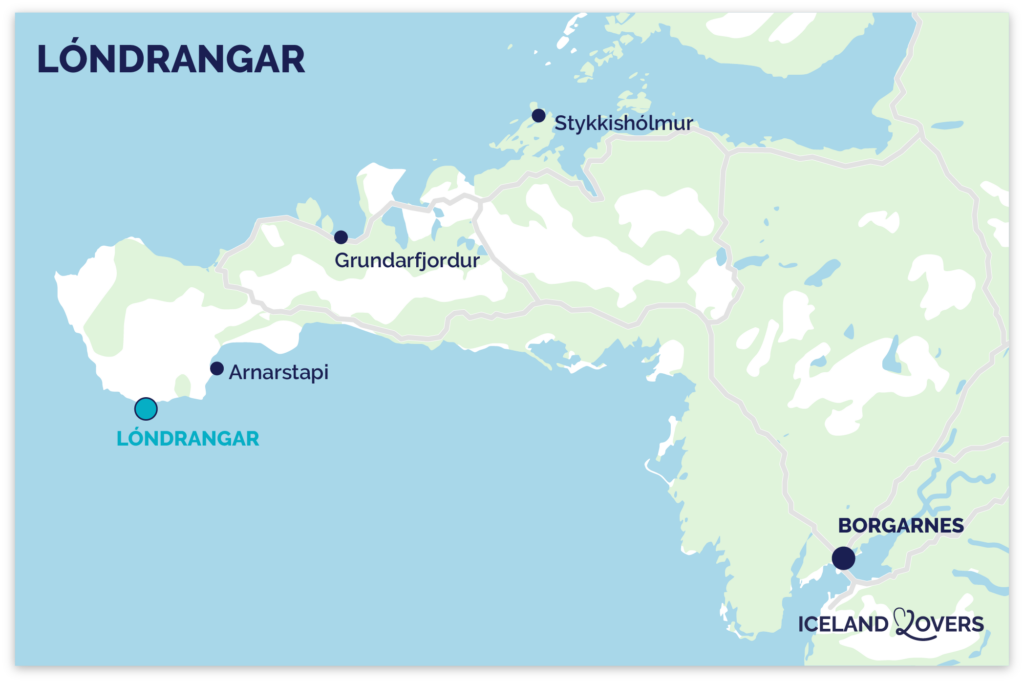
How to get there? Access road
Lóndrangar can be reached via route 574, which runs along the south-western coast of the Snæfellsnes peninsula. From this main road, the parking lot is less than 100m away. The best option is to travel by car, as there is no public transport serving the site directly. In summer, the road is in good condition and does not require a 4WD vehicle.
If you don’t want to drive, excursions from Reykjavik typically stop at Londrangar. See available options.

Parking Svaltufa
The main parking lot is along Route 574. It’s clearly visible. We advise you to book early in the morning during the peak summer season, as places fill up quickly.
RENTING A CAR IN Iceland
Discover the best offers on Discovercars, our preferred platform!
On Route 1, no 4WD required, off Route 1, it depends on your plans.

Useful tips: duration, schedules, difficulties…
Best time to visit, opening hours and prices
Access to Lóndrangar is free, day and night. The view of the rock formations faces southwest, making it an ideal spot for sunsets. We enjoyed the golden light at the end of the day, which sublimated the basalt reliefs. To enjoy the site without the crowds, you can come early in the morning or in the evening.
Length of visit and main difficulties
Allow around 30min to reach the observation platform from the parking lot, enjoy the view and take plenty of photos.

If you’d like to extend the walk to Malarrif lighthouse, add around 45min for the 2.6km round trip along the coast. The trails are well-marked and accessible to all. We encountered no major difficulties on the route.
Make sure you bring closed-toe shoes and a windproof jacket, as the wind often blows hard on this stretch of coastline.
Visiting with children
The path to the platform is short and not particularly difficult for families. However, be careful on the edge of the cliffs, as there are no protective barriers on some stretches.
Catering, Toilets and Facilities
Nothing on this site.
Just a few minutes’ drive away, the Snæfellsjökull National Park Visitor Center, located next to the Malarrif lighthouse, offers tourist information and exhibitions on the region. There are no on-site catering facilities. The nearest options are Hellnar and Arnarstapi, two fishing villages just a few minutes’ drive away.
Lava field and cliff approach

From the parking lot, the path crosses volcanic terrain towards the cliffs. In summer, unlike winter when snow covers everything, you realize you’re walking through a vast lava field.
The peaks of the rock formations gradually appear on the horizon, and excitement builds with every step. From this initial perspective, the pillars don’t look very imposing. We were surprised by the deceptive impression of distance that minimizes their stature. As you get closer, their true scale is revealed.
OUR GUIDE TO PLANNING A Dream trip
- 8 maps that make planning easier
- + 100 pre-selected locations
- Practical advice
- + 130 photos to help you choose
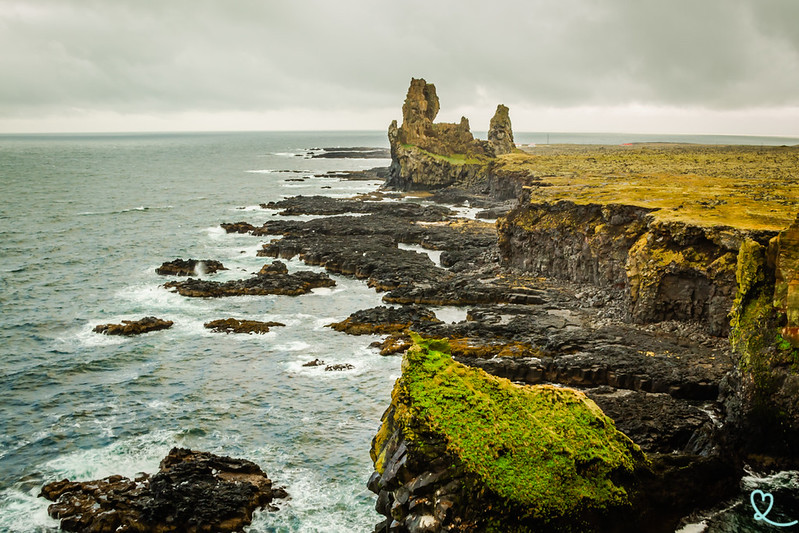
The moss-covered lava field
The coastal path linking the Lóndrangar cliffs to the Malarrif lighthouse passes through a typically Icelandic landscape: a lava field carpeted with soft green moss. This thick, spongy plant cover has developed over the centuries on basaltic flows.
We were struck by the intensity of this luminous green, which contrasts with the black of the volcanic rock.

Viewpoint on Lóndrangar
The highlight of the visit is the platform atop the Þúfubjarg cliffs. From this observatory, the view plunges straight down onto the two basalt pillars and the ocean.
The Lóndrangar are the remains of an ancient volcanic crater eroded by the sea over thousands of years. The largest rises to 75m (246ft) and the second to 61m (200ft). These columns were formed during the rapid cooling of lava flows: the remaining rock proved more resistant than the surrounding layers, which were gradually swept away by erosion.
We were impressed by the force of the waves breaking at their base.
It can be difficult to understand the size of these stone giants in these photos, as reference points are lacking. But we can assure you that it’s impressive.

Basalt formations
Take time to observe the geological details from the platform. Just below, hexagonal basalt columns bear witness to the lava’s cooling process. As the surface of a flow cools, thermal contraction creates polygonal, mainly hexagonal, fractures that sink into the rock.
We noticed several different types of rock in the surrounding sea. In summer, the low-angled light at the end of the day accentuates the relief and texture of these formations.
In the photo above, for example, you can see the rock in the foreground with its distorted basalt columns.

View towards the Snæfellsjökull glacier
If you turn your gaze inland from the observation platform, the Snæfellsjökull glacier rises to the horizon. This ice-covered volcano rises to an altitude of 1446m and dominates the entire peninsula. It is famous for having inspired the novel “Journey to the Center of the Earth” by 19th-century French writer Jules Verne. In summer, its eternal snow contrasts with the green of the surrounding meadows.
An essential visual landmark to accompany your visit to Lóndrangar.
No photo, because for us the view was cloudy….
Trail to Malarrif lighthouse
From the path, just before reaching the platform, the two rock pillars and the Malarrif lighthouse line up in the same field of vision. This vantage point makes for a fine photographic composition. The red-and-white lighthouse looks tiny next to the Lóndrangar formations.

We recommend extending the walk to Malarrif to admire its stature up close and visit the national park visitor center. The coastal path that leads there crosses the moss-covered lava field, a walk as pleasant as it is accessible.
Distance: 2.6km
Difficulty: Easy
Elevation: 0
Duration 1h30

Birds and local fauna
The Lóndrangar cliffs are home to a particularly active colony of seabirds in summer. Puffins, but especially fulmars, nest in the many cavities of the two pillars. The soundscape can be striking, depending on the season: bird calls mingle with the crash of waves against rock.
Keep your eyes peeled, as Arctic foxes sometimes prowl the area in search of food. If you’re patient and discreet, you’ll be able to catch a glimpse of them.
Legends and folklore
As is often the case in Iceland, Lóndrangar is surrounded by legendary tales. The name “Lóndrangar” translates as “castle pillars”, and according to Icelandic folklore, these formations are the petrified remains of an ancient fortress. The nearby hill of Svalthufa, also known as Þúfubjarg, belongs to the region’s elves, according to the most superstitious locals. It was precisely at the foot of this cliff that the poet Kolbeinn Jöklaskáld, a medieval Icelandic literary figure, is said to have had an encounter with the devil.
Other nearby attractions
You can combine your visit to Lóndrangar with these nearby attractions:
- Malarrif and its visitor center in Snæfellsjökull National Park, just a few minutes’ walk along the coastal path.
- Arnarstapi, a fishing village with remarkable coastal rock formations
- Vatnshellir, an underground lava cave open to guided tours
- Djúpalónssandur, a black pebble beach bordered by volcanic cliffs
- Saxhóll crater, accessible via a metal staircase offering a panoramic view of the coastline

Frequently asked questions
Can you climb the pillars of Lóndrangar?
Climbing the Lóndrangar is forbidden. It’s a protected natural area.
But technically it’s possible, albeit dangerous. The highest pillar was first climbed in 1735 by Ásgrímur Bergþórsson.
What’s the best time of day to photograph Lóndrangar in summer?
The best conditions are found in the late afternoon and at sunset, when the golden light illuminates the rock formations. In summer, Iceland’s long evenings provide extra hours for photography. As the main viewpoint faces south-east, the morning light is also ideal.
Can you visit Londrangar when it snows?
Yes, Londrangar can be visited in winter under the snow. See our dedicated article.

PLAN YOUR SUMMER TRIP TO iceland
- Best of
What to do in Iceland
The most beautiful waterfalls
The most beautiful black sand beaches
Volcanic craters to climb
Lava caves to visit
Best excursions from Reykjavik

- Practical advice
Summer travel tips
How to rent a car in Iceland
Driving tips
Where to stay in Iceland
Itineraries: 3 days – 4 days – 5 days – 1 week – 10 days

- The must-dos
What to do in Reykjavik
Best attractions in the Golden Circle
South Coast attractions
Snaefellsnes Peninsula
Silver Circle
Lake Myvatn attractions