
On the shores of Lake Myvatn in northern Iceland, the pseudo-craters of Skutustadir form one of the most unusual landscapes you’ll ever see in this country. We were struck by the geometric precision of these cones scattered around the Stakholstjorn basin.
In this article, you’ll find our photos and tips for making the most of your visit to Skutustadir’s pseudo-craters.
This opinion is completely independent, based on our experiences. We visited the region anonymously, making our own choices and paying our bills in full.
Content
Why visit Skutustadir’s pseudo-craters
Are Skutustadir’s pseudo-craters worth a visit? Our opinion:
Yes, Skutustadir’s pseudo-craters are well worth a visit. This site is one of the most remarkable geological landscapes on Lake Myvatn, and by extension in the whole of Iceland. These rare formations, also documented on Mars, will give you a unique perspective on the power of volcanic phenomena.

The walk around the Stakholstjorn basin is accessible, varied and offers successive views of the lake. It’s one of the most beautiful natural sites on Lake Myvatn and a must-see on any tour of northern Iceland.
Our favorite moments
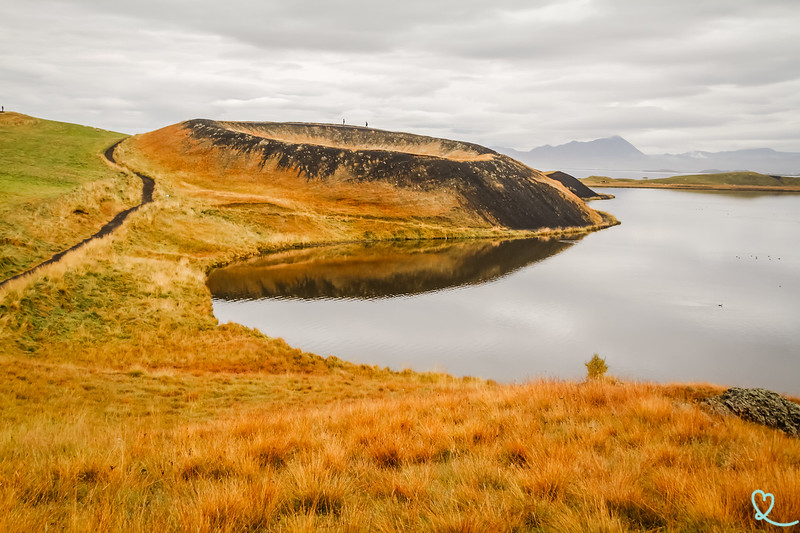
We particularly enjoyed climbing the first pseudo-crater accessible at the start of the trail: the view from the edge of the cone over Lake Myvatn and the surrounding hills is breathtaking. The morning light, playing on the reflections of the water in the Stakholstjorn basin, is a spectacle in itself. The path along the pond also offers a wide variety of views, from vegetated cones to calm waters and an open horizon overlooking the lake. We were there in September, so the grass has already turned orange.

About the name
The site is known by two Icelandic names. Skutustadir (Skútustaðir in Icelandic) refers to the place in the broadest sense: the historic farmhouse and surrounding area, named after an ancient local hero, Viga-Skuta. Skutustadagigar (Skútustaðagígar) is the precise geological term: it refers specifically to the group of pseudo-craters, the suffix gígar meaning “craters” in Icelandic. In practice, the two names are often used interchangeably to designate the same site.
WHERE TO STAY IN myvatn
Fosshotel Myvatn, with beautiful lake views
See top-rated accommodations
Salt – Hotel Myvatn, near the pseudo-craters
See top-rated accommodations
Dimmuborgir Guesthouse, by the lake
See top-rated accommodations

How to get to Skutustadigar: access and map
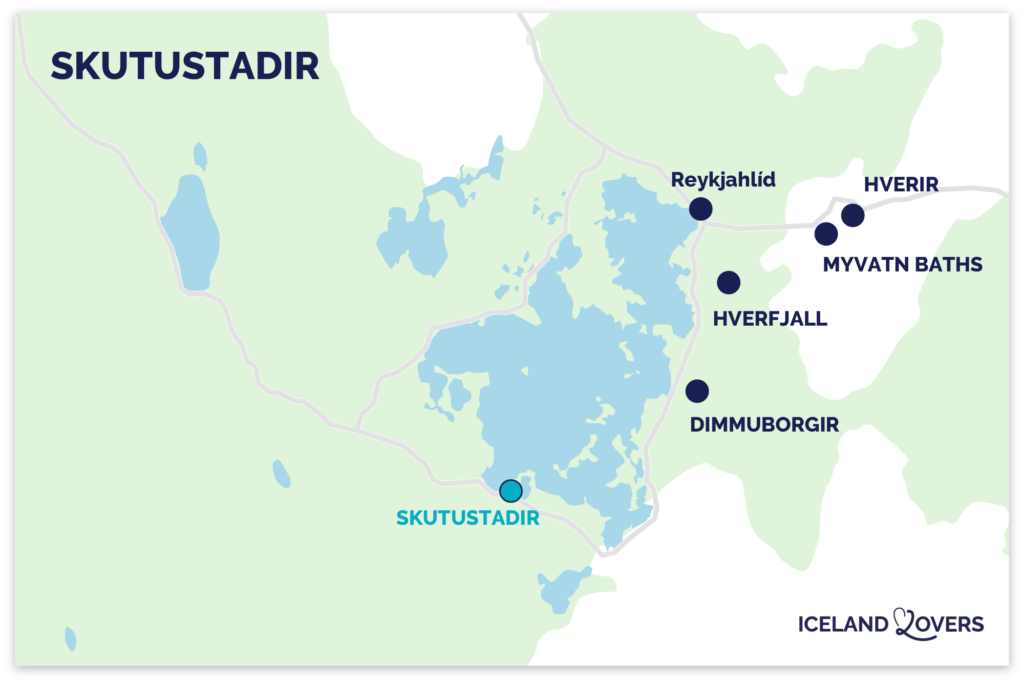
Where is Skutustadir?
- On the southern shore of Lake Myvatn, in northern Iceland
- Driving time from Reykjahlid (main village of Myvatn): 15min
- Driving time from Akureyri: 1h05
- Driving time from Egilsstadir: 2h15
- Here is a map to help you find your way:
How to get there? Access road
Most organized tours from Akureyri include Skutustadir in their itinerary, but the stop is often short and not enough for a complete tour of the pond(see options).
If you want to take your time and climb the accessible craters, a private car is the best option. The road along Lake Myvatn passes directly in front of the site. Access by car is easy and the road is in good condition.
Parking
Ample parking is available opposite the Guesthouse de Skutustadir, directly along the main road. It is suitable for standard cars and provides immediate access to the trailhead.
RENTING A CAR IN Iceland
Discover the best offers on Discovercars, our preferred platform!
On Route 1, no 4WD required, off Route 1, it depends on your plans.

Useful tips: duration, schedules, difficulties…
Best time to visit, opening hours and prices
In summer, the site enjoys long hours of natural light, with green and then orange vegetation contrasting with the dark cones of the pseudo-craters. We recommend coming early in the morning for two reasons: firstly, the low-angled light creates beautiful reflections on the Stakholstjorn basin; secondly, crowds are lower. Access to the trail is free and unrestricted.
A special note for the summer season: midges, the small flies that are very active around Lake Myvatn, are particularly prevalent in June and July. We strongly recommend that you take along a face protection net, as well as protective clothing. Even if it doesn’t sting, this detail can turn a pleasant ride into a difficult experience if you’re not prepared for it.

Length of visit and main difficulties
The walk around the Stakholstjorn basin takes about 1 hour at a leisurely pace. The trail is flat and well-marked, with no particular technical difficulties. Some passages may be slightly muddy depending on the recent weather. Closed-toe shoes are still recommended. You can climb some of the pseudo-craters; others are protected and marked as such. Respect these limits. If you don’t have time to go all the way around, the west side of the trailhead offers the best views.
Advice on how to visit
The trail forms a loop around the Stakholstjorn basin. You can walk it in either direction, but we’ve found that starting on the west side, from the main parking lot, offers the best views right from the start. The first accessible pseudo-craternity is just a few minutes away; you can climb up to get a first view of the site and lake.

Visiting with children
The trail is accessible to young children, with no major obstacles. Climbing the cones is fun, and children generally enjoy this area of discovery. But don’t forget the midges: young children are particularly sensitive to them. Make sure you have suitable netting and repellents from June onwards.
Catering, Toilets and Facilities
On the other side of the road, opposite the parking lot, you’ll find a café, a restaurant, toilets and a petrol station. It’s perfect for a break before or after a ride. There are no facilities directly on the trail.
OUR GUIDE TO PLANNING A Dream trip
- 8 maps that make planning easier
- + 100 pre-selected locations
- Practical advice
- + 130 photos to help you choose

The geology of pseudocraters: a rare phenomenon on Earth
The name “pseudo-craters” can be misleading: these formations are not the result of a classic volcanic eruption. Their origins are more subtle. Around 2,300 years ago, during the eruptions of Ludentaborgir and Threngslaborgir, lava flows covered the wet sediments at the bottom of an ancient lake, the predecessor of today’s Lake Myvatn. On contact with these water-saturated sediments, the intense heat caused violent steam explosions, creating the characteristic hollow cones.

We found it fascinating to learn that this phenomenon, documented at the Myvatn interpretation center, has been identified on Mars: the red planet is home to large groups of craters formed by a similar mechanism, when hot lava flowed over frozen ground. The pseudo-craters of Lake Myvatn are considered to be the largest and best-preserved on Earth. You can get very close to these formations, and even climb on top of some of them to perceive their inner hollows.


It’s time to book!
Compare everything: companies, prices, schedules and availability.
The first cone

Even if you don’t have time to go all the way round, walking and climbing on the first cone will give you a better view of the lake and its formations.
This is our favorite part of the place.

The walk around the Stakholstjorn basin
The trail around the Stakholstjorn basin is the most complete way to discover the site. From the parking lot, the path quickly leads to the first accessible pseudo-crater – the largest and most impressive on the route. We climbed it without difficulty and were rewarded with an open panorama of Lake Myvatn and its surroundings. Sheep sometimes grazed on the sides of the cones, adding a touch of life to this mineral landscape.

The rest of the path runs quietly alongside the pond. The water is calm, sometimes mirror-like at the start of the day. You’ll come across other cones, some marked and protected, others practicable. The green vegetation in summer contrasts with the black and grey of the rock formations, and there are many birds along the banks – the site is renowned for its birdwatching.

Wear closed-toe shoes, as you’ll sometimes be walking on small black lava gravel, and these little pieces like to get under your feet!

UNFORGETTABLE ACTIVITIES IN Iceland
- Swimming in the Silfra fissure
- Horseback riding
- Hiking on a glacier
- Whale watching (from Reykjavik, Husavik or Akureyri)

Birdwatching around Lake Myvatn
The area around the Stakholstjorn basin is ideal for birdwatching, especially in summer. Lake Myvatn is one of Iceland’s richest ornithological sites, and the Skutustadir area is home to many of them. We spotted several species of diving ducks and shorebirds along the banks as we passed.
Diversity is particularly notable between June and August, when the aquatic fauna is in full swing. Having failed to take any photos of birds, here’s one of sheep. Having failed to take any photos of birds, here’s one of sheep.

Views of Lake Myvatn from Skutustadir
Lake Myvatn stretches as far as the eye can see from the heights of the accessible pseudo-craters. In summer, the panorama changes according to the time of day: the late evening light casts long shadows on the cones, giving the site a very different atmosphere from that of the morning. If you can, plan two visits at different times to see Skutustadir from two different angles. You’ll be amazed at the variety of atmospheres the same place offers as the hours go by.

VISIT Myvatn
- Attractions around Lake Myvatn
- Where to sleep: hotels and accommodation
- Itineraries: 1 day – 2 days
- How to get there
- Hverfjall
- Hverir
- Dimmuborgir
Other nearby attractions
You can combine your visit to Skutustadir’s pseudo-craters with these nearby attractions:
- Hverfjall, the large volcanic tephra crater on the eastern shore of Lake Myvatn, whose rim offers an exceptional 360° panorama (approx. 15min drive).
- Dimmuborgir, the lava field with its labyrinthine rock formations and strange silhouettes (10min drive)
And see our selection of the best attractions in Myvatn.
Frequently asked questions
Why are we talking about “pseudo-craters” and not real craters?
A true volcanic crater is the result of a direct magmatic eruption. The Skutustadir pseudo-craters, on the other hand, were formed when molten lava covered wet sediments: the trapped water turned to steam under the heat and exploded upwards, creating these hollow cones. No magma has risen from underground. It’s this distinction that earns them their name.
Can you visit Skutustadir in half a day?
Absolutely. The walk around the Stakholstjorn basin takes about 1 hour. Including time to pause at accessible craters and take a few photos, half a morning is more than enough. If you combine the visit with other sites on Lake Myvatn, such as Dimmuborgir or Hverfjall, allow a full day to enjoy the area without rushing.
Can we visit Skutustadir in winter?
The entire path around the lake is not cleared of snow in winter, but with crampons you can reach the first cone and climb up. We loved it. The experience is completely different. See our article.
PLAN YOUR SUMMER TRIP TO iceland
- Best of
What to do in Iceland
The most beautiful waterfalls
The most beautiful black sand beaches
Volcanic craters to climb
Lava caves to visit
Best excursions from Reykjavik

- Practical advice
Summer travel tips
How to rent a car in Iceland
Driving tips
Where to stay in Iceland
Itineraries: 3 days – 4 days – 5 days – 1 week – 10 days

- The must-dos
What to do in Reykjavik
Best attractions in the Golden Circle
South Coast attractions
Snaefellsnes Peninsula
Silver Circle
Lake Myvatn attractions