
Lake Myvatn, in northeast Iceland, is one of the country’s most unique destinations. We were struck by the density of this territory: in just a few kilometers, nature unfurls a geology of gentle violence, between craters, smoking areas and lakes teeming with life. In this article, we share with you 8 reasons to visit Lake Myvatn. Why it’s worth the trip.
This opinion is completely independent, based on our experiences. We visited the region anonymously, making our own choices and paying our bills in full.
Content
Is Lake Myvatn worth a visit?
Yes, without hesitation. Lake Myvatn concentrates all of Iceland’s most geologically spectacular features in a single location. Here we found a raw, untouched nature that leaves a lasting impression.
We list the reasons in more detail below, or you can check out our selection of the region’s top attractions.

Reason 1 – The raw power of nature, visible at every step
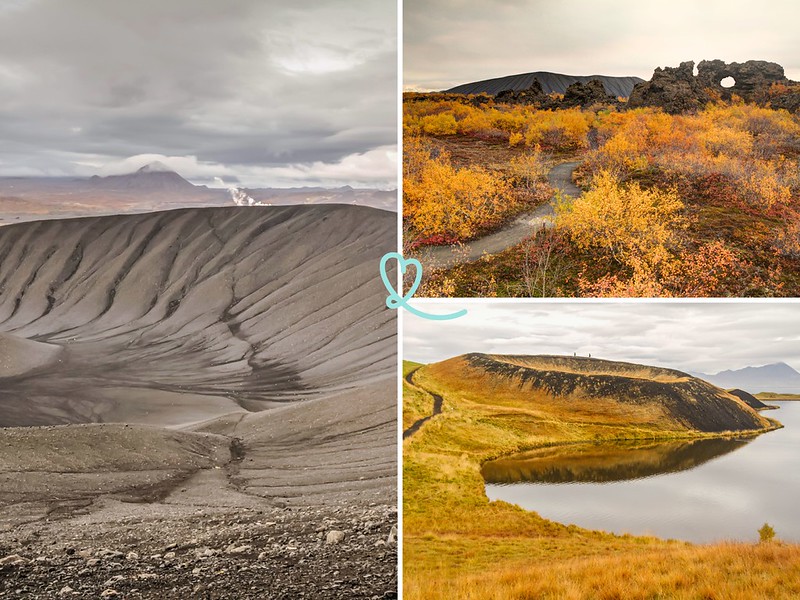
There are places where nature imposes itself without trying to seduce. Lake Myvatn is one of them. Right from the start, the ground smokes, the smell of sulfur permeates the air, and the landforms tell the unfiltered story of thousands of years of volcanic activity. We felt this particularly keenly at Hverir, Namafjall’s geothermal zone, where pools of bubbling mud and fumaroles color the terrain in ochre, yellow and gray.

The Hverfjall crater, one of the world’s largest explosion craters, was formed around 2,500 years ago. We climbed the black ash-covered slopes to reach an edge overlooking everything. Nowhere else in Iceland have we had such an immediate sensation of being in front of something much bigger than ourselves.

WHERE TO STAY IN myvatn
Fosshotel Myvatn, with beautiful lake views
See top-rated accommodations
Salt – Hotel Myvatn, near the pseudo-craters
See top-rated accommodations
Dimmuborgir Guesthouse, by the lake
See top-rated accommodations

Reason 2 – Far less crowded than South Iceland
Most mass tourism is concentrated in southern Iceland: the Blue Lagoon, the road to Vik, the Golden Circle. As for Lake Myvatn, it attracts travellers who have chosen to go further afield. As a result, you can breathe easy on footpaths, in geothermal zones and even on lakeshores. We strolled along Leirhnjúkur early in the morning and felt as if we were alone in the world.

The Skútustadagígar pseudocraters, which we skirted on their circular trail, were almost deserted at sunrise. You’ll be able to stop, observe and listen to the silence without being pressured by groups. This tranquility profoundly changes the quality of the experience.
Reason 3 – Landscapes that seem to emerge from another world
Some places around Lake Myvatn give you the feeling of walking through an end-of-the-world setting. It’s not a metaphor. At Leirhnjukur, in the heart of the Krafla volcanic system, we walked over still-smoldering lava fields, remnants of the eruptions that took place between 1975 and 1984. The floor is black, twisted, silent. Steam rises in places. You won’t come across many people, especially early in the morning, and the atmosphere is that of a territory that the lava has just released.

Dimmuborgir takes this impression even further: its lava columns, natural arches and caves form a labyrinth that Icelandic folklore associates with trolls and hidden beings. These structures were formed around 2,300 years ago, and their silhouette evokes the ruins of a fortress that no one would ever have inhabited.

RENTING A CAR IN Iceland
Discover the best offers on Discovercars, our preferred platform!
On Route 1, no 4WD required, off Route 1, it depends on your plans.

Reason 4 – A geological concentration unique in the world
Rarely do so many geological phenomena coexist in such a small area. Around Lake Myvatn, in less than 36km, you’ll find pseudocraters, a major explosion crater, active geothermal zones, lava fields in various stages of evolution, a hydrothermal grotto…

The Skútustadagígar pseudocraters, for example, were not born of classic volcanic eruptions, but of the explosion of steam caused by a lava flow over marshy ground, a rare process.
The Grjótagja cave lies right on the fault line between the North American and Eurasian plates. We found this geological diversity breathtaking: each site tells a different story of the same land. For nature lovers and geology buffs alike, Mývatn is an exceptionally rich destination.


It’s time to book!
Compare everything: companies, prices, schedules and availability.
Reason 5 – Wildlife in the heart of volcanic chaos
Herein lies the paradox of Lake Myvatn: this seemingly hostile territory, windswept and dominated by black rock, is home to one of the largest concentrations of nesting ducks in the world. The shallow lake, whose name literally means “lake of the gnats”, owes its ornithological richness to the swarms of insects that form its food base. These non-stinging midges feed a remarkably diverse avian fauna. We recommend you bring a safety net if you come in summer: the clouds can be dense.

The Sigurgeir Bird Museum, on the northeast shore of the lake, offers a comprehensive collection of naturalized species from the region, useful for identifying what you see in the field. Visit the official website for more info here. This contrast between the brutality of the volcanic landscape and the abundance of wildlife is one of Myvatn’s most striking features.
Reason 6 – An ideal base for exploring northern Iceland
A stay at Lake Myvatn also places you at the heart of one of the richest regions in northern Iceland. In less than 1 hour’s drive, you’ll have access to sites of considerable scale. Dettifoss, Europe’s most powerful waterfall, is about 45min to the east: we felt the vibrations of the ground several meters from the edge.

Godafoss, the “waterfall of the gods”, is 30 minutes to the west – its elegant semicircle contrasts with the violence of Dettifoss.
Húsavík, considered the whale-watching capital of Europe, can be reached in 50 minutes. Several companies offer 2 to 3-hour boat trips to observe humpback whales, dolphins and sometimes blue whales in Skjálfandi Bay. Book your whale watching trip now. Akureyri, the “capital of the north”, completes the picture, just an hour’s drive away. We found Mývatn to be a particularly effective radiation base.

Reason 7 – The northern lights in total isolation
From September to April, Lake Myvatn becomes one of Iceland’s best natural observatories for the northern lights. The region’s remoteness, combined with much lower light pollution, offers some of the most favorable viewing conditions in the country.
From late August onwards, you’re likely to see aurorres, as the nights are longer.
In winter, the chances are even greater, but the region is completely different, all white. You can also read our article dedicated to visiting Lake Myvatn in winter to prepare your stay.
OUR GUIDE TO PLANNING A Dream trip
- 8 maps that make planning easier
- + 100 pre-selected locations
- Practical advice
- + 130 photos to help you choose

Reason 8 – Hiking at all intensities
Lake Myvatn is not just for experienced hikers. The sites can be visited at a wide range of difficulty levels, making this destination accessible to a broad public. The circular trail around the Skútustaðagígar pseudocraters is flat, well-marked and takes 30min to 1h.

At the other end of the scale, the climb up to the Hverfjall crater, on a steep slope of black ash and gravel, requires more effort, but rewards you with a 360° view of the entire region. In between, Dimmuborgir offers several signposted trails of varying difficulty, some of which cross remarkable natural arches.
We also like the short walk around the Krafla Viti crater, less challenging than Hverfall but with equally spectacular scenery.
For those who prefer to explore in a different way, mountain bike tours are also available through the lava fields.

VISIT Myvatn
- Attractions around Lake Myvatn
- Where to sleep: hotels and accommodation
- Itineraries: 1 day – 2 days
- How to get there
- Hverfjall
- Hverir
- Dimmuborgir
Some disadvantages of a trip to Lake Myvatn
Gnats in summer
The lake owes its name – “midge lake” – to the swarms of chironomids that rise above its surface in summer. These insects don’t bite, but their presence can be invasive, especially in July and August. We strongly recommend that you bring a face protection net: it’s the most useful piece of equipment for your summer holiday.
Outside the peak summer season, this phenomenon is much less pronounced.

Isolation and limited restoration options
Lake Mývatn is a slightly less touristy region, even if it is under development, and this is reflected in the infrastructure. Dining options are concentrated in Reykjahlíð, the main village, and in Skútustaðir on the southern shore. The vast majority of natural sites do not offer on-site catering. We advise you to pack a day’s provisions before setting out to explore.

PLAN YOUR SUMMER TRIP TO iceland
- Best of
What to do in Iceland
The most beautiful waterfalls
The most beautiful black sand beaches
Volcanic craters to climb
Lava caves to visit
Best excursions from Reykjavik

- Practical advice
Summer travel tips
How to rent a car in Iceland
Driving tips
Where to stay in Iceland
Itineraries: 3 days – 4 days – 5 days – 1 week – 10 days

- The must-dos
What to do in Reykjavik
Best attractions in the Golden Circle
South Coast attractions
Snaefellsnes Peninsula
Silver Circle
Lake Myvatn attractions