
Six days in Iceland in the winter: that’s enough time to see a lot without turning the trip into a series of long, exhausting legs. This itinerary covers the island’s most spectacular sites on a road trip that strikes a balance between sightseeing and driving time. And alternatives if you want to drive less or more.
This opinion is completely independent, based on our experiences. We visited the region anonymously, making our own choices and paying our bills in full.
Content
What You Need to Know Before Setting Off on a 6-Day Winter Trip to Iceland
Icelandic winters come with their own set of rules: short days, roads that can be slippery at times, and seasonal activities like ice caves. This guide provides you with the key information you need to plan a realistic and well-prepared trip.
1. Day length: a key variable
In December and January, the days last only 4 to 5 hours. In February, the days quickly get longer, reaching 8 hours or more by the end of the month. This time difference has a direct impact on your itinerary: in December, set out before dawn so you’ll arrive at your first stop at sunrise.
Don’t pack too much into each day, and be prepared to drive after dark if you’re there in December or January. We recommend that you adjust your pace to fit the time of year you’re traveling, rather than the other way around.

2. Winter Driving: Don’t Improvise
Major roads are generally clear during the day, but conditions can change quickly. If you’ve never driven on black ice or packed snow, make sure to do your research thoroughly before getting behind the wheel.
Make sure your car is equipped with winter tires. Please refer to our guide on driving in Iceland in winter for all the practical details. And always check road conditions on road.is.

Find the best deals on our preferred car rental platform: DiscoverCars
3. Book in Advance
Several stops along this route require advance reservations, sometimes several weeks before departure. This is the case for the ice caves (Day 2) and the glacier hike (Day 3). Accommodations also fill up quickly during the peak winter season. Check out our tips for choosing where to stay in Iceland in the winter.
6-Day Winter Itinerary in Iceland: Map
Here is a map of the itinerary we’ve planned.
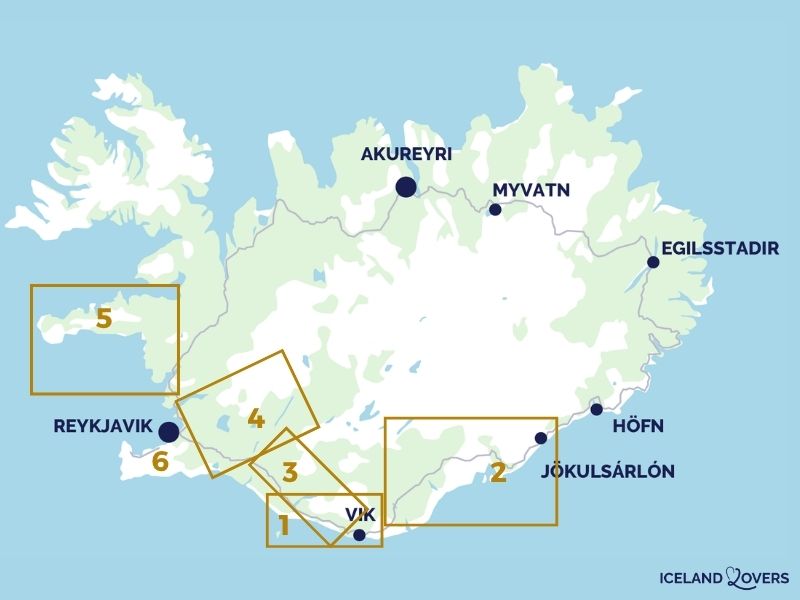
Here are the estimated daily driving times, excluding stops and visits:
- Day 1 (Reykjavik → Vik via the south coast): about 2½ to 3 hours
- Day 2 (Vik → glaciers → back to Vik): about 4 hours and 30 minutes round trip
- Day 3 (Vik → Solheimajökull Glacier → Fludir): about 3 hours
- Day 4 (Fludir → Golden Circle → Borgarnes): about 2½ to 3 hours
- Day 5 (Borgarnes → Snaefellsnes → Borgarnes): approximately 3.5-hour loop
- Day 6 (Reykjavik): 0 or drive to the airport

Day 1 – Southwest Coast
Total travel time: about 2½ to 3 hours
From Reykjavik, Route 1 heads east, initially following the coast until it reaches the first waterfalls on the south coast. This first day takes in three sites that are very different in terms of atmosphere and scenery. Leave early so you can enjoy each stop while it’s still light out—especially in December.
Stop 1 – Seljalandsfoss Waterfall

Seljalandsfoss plunges 60 meters from an ancient coastal cliff that has since receded inland. The trail that leads behind the waterfall is closed in winter for safety reasons, but the waterfall is still impressive when viewed from the front. In extremely cold weather, icicles form on the weaker sections of the slopes, creating bluish reflections.
A paved path runs along the ancient cliffs toward a smaller waterfall hidden within the rock: Gljufrabui. We recommend that you don’t miss this stop, which many visitors skip because there are no signs pointing to it.
Learn more about Seljalandsfoss in winter.
Stop 2 – Skogafoss Waterfall

Thirty kilometers further east, Skogafoss cascades down in a curtain of water 60 meters high and 25 meters wide. Its powerful flow prevents it from freezing in winter, creating a striking contrast between the moving masses of water and the snow-covered black rock.
There are two vantage points to choose from: from below, the waterfall fills your entire field of vision; from the elevated platform, accessible via more than 350 steps, the view opens up onto the coastal plain. We find Skogafoss more striking in winter than in summer, precisely because of these black-and-white contrasts. Learn more about Skogafoss in winter.
Stop 3 – Reynisfjara Black Sand Beach

The black-sand beach at Reynisfjara gets its distinctive character from the basalt columns that line it and the Reynisdrangar sea stacks that rise out of the sea. In winter, the snow on the cliffs heightens the contrast with the dark sand and the waves of the North Atlantic.
One absolute rule: Do not go near the water’s edge. Some waves surge suddenly very high up onto the beach and can catch you off guard in a matter of seconds. We were struck by the rugged atmosphere of this place, which is particularly intense on windy days. Learn more about Reynisfjara in winter.
Stop 4 – The Village of Vik

Vik i Myrdal is the natural place to end the day on the south coast. This small village owes part of its reputation to its church perched on the hill: the view from up there, overlooking the black sand beach and the basalt cliffs, is well worth the few-minute climb. In the evening, the Lava Show—a demonstration of molten lava—offers a hands-on immersion in Icelandic volcanism, a wonderful way to understand what you’ve seen in the day’s landscapes. Learn more about Vik in winter. Book your tickets for the Lava Show.
Overnight in Vik
Book a 2-night stay. Here are a few suggestions:

- Hotel Vik i Myrdal
In the village, elegant and quiet.
See photos and availability - Hotel Kria
On the outskirts of the village, large picture windows overlooking the mountains.
See photos and availability - Hotel Katla
Surrounded by nature, a 5-minute drive from the village. We like the renovated rooms.
See photos and availability
Day 2 – Glaciers on the South Coast
Total travel time: about 4 hours and 30 minutes round trip from Vik
This is the most demanding day in terms of driving: the Jökulsárlón lagoon is about 2 hours and 15 minutes east of Vik. Be sure to set out at dawn, especially in December when daylight is limited.
If you’ve booked an ice cave tour, it usually takes place in the afternoon and departs from the lagoon; be sure to check the time when you make your reservation. Part of the return trip will likely take place at night.
Stop 1 – Diamond Beach

Located directly across from the Jokulsarlon lagoon, Diamond Beach gets its name from the blocks of translucent ice that wash up on the black volcanic sand after drifting down from the glacier. Their shape, size, and transparency vary from day to day depending on the tides and weather conditions. Nothing is guaranteed, but it’s always worth a visit.
We recommend arriving early to enjoy the sunlight of the sunrise reflecting off the ice, which can be spectacular on a clear day.
Learn more about Diamond Beach in winter.
Stop 2 – Jokulsarlon Glacial Lagoon

The Jokulsarlon lagoon formed as the Vatnajökull glacier retreated during the 20th century. The icebergs that break off from its front edge drift slowly out to sea, creating a constantly changing spectacle. On a clear day, the glacier’s front is clearly visible in the background. We found this place to be more contemplative than we expected; it’s worth spending some time there rather than just stopping by for a quick photo.
Learn more about Jökulsárlón in winter.
Stop 3 – Ice cave tour (must be booked in advance)

The natural ice caves are only accessible from mid-November to early March: they form every winter on the glacier tongues of Vatnajökull and Kötlujökull, and then melt in the spring. Every year, new cavities take shape—some an electric blue, others the black of volcanic ash.
The tour begins with a 4WD ride over rough terrain (not recommended for people with back problems), followed by a guided walk inside the cave. We consider this experience one of the highlights of a winter trip to Iceland—but spots fill up fast: be sure to book several weeks in advance.
Learn more about ice caves.
View the available tour options.
Bonus Stop – Fjallsarlon (if the days are longer)

If you’re traveling in late February, when the days are 8 hours or longer, stop at Fjallsarlon before Jokulsarlon. This nearby lagoon, which is smaller and less crowded, freezes over completely in the middle of winter—there are no icebergs, but the nearby glacier tongue is visible from the frozen shore. The tranquility there stands in stark contrast to the hustle and bustle of Jökulsárlón.
Learn more about Fjallsarlon in winter.
Second Night in Vik
Back to the same hotel.
Day 3 – Glacier Hike and Secret Lagoon
Total driving time: about 3 hours (toward Fludir)
This day, which marks the transition from the southern coast to the center of the country, combines morning exercise with a visit to a spa in the late afternoon. The road to Fludir passes near the Sölheimajökull glacier—that’s where the glacier hike takes place.
Stop 1 – Hike on the Sölheimajökull Glacier

Sölheimajökull is a glacier tongue of the large Myrdalsjökull glacier, one of the most accessible from Route 1. The guided ice hike usually lasts 2½ to 3 hours: with crampons strapped to your boots, you make your way past crevasses, glacial mills, and ice that shifts in color from milky white to deep blue.
In winter, unexpected ice formations create landscapes that aren’t visible during the summer. Book in advance and be sure to go with a guide: the ice is unstable and the terrain is unpredictable.
See availability and book.
Stop 2 – Secret Lagoon in Fludir
The Secret Lagoon in Fludir is Iceland’s oldest natural geothermal pool, in operation since 1891. The water there maintains a temperature of about 38 to 40°C, both in summer and winter.
During the cold season, the steam rising above the pool creates an enveloping atmosphere, which is especially pleasant after a day of walking on ice. Less crowded than the Blue Lagoon, this place offers a more peaceful and equally relaxing experience. We recommend staying there for at least 1 hour and 30 minutes to fully enjoy the bath. Book your ticket to the Secret Lagoon.

Overnight in Fludir
Once you’re fully relaxed, you can sleep right next to the lagoon. For example:
- The Hill Hotel at Fludir
Modern comfort, a warm atmosphere, and close to the Secret Lagoon.
See photos and availability
Or see all options in Fludir. or on the golden circle.
Day 4 – Golden Circle
Total driving time: about 2 hours and 30 minutes (loop from Fludir to Borgarnes)
From Fludir, the three sites of the Golden Circle are, in a sense, already within easy reach—you’re right in the heart of the area. This day’s itinerary features a spectacular waterfall, an active geothermal field, and a national park with an exceptional historical background.
Stop 1 – Gullfoss Waterfall

Gullfoss cascades down two tiers along the Hvítá River, which is fed by the Langjökull Glacier—Iceland’s second-largest glacier. The total drop is 32 meters. Its strong current prevents it from freezing completely, but ice forms along the edges in winter, adding a visual element that the summer season does not offer.
Arrive early to avoid the crowds and enjoy the morning light on the waterfall. We found Gullfoss even more impressive under the snow than in the summer photos.
Learn more about Gullfoss in winter.
Stop 2 – Haukadalur Geothermal Field

The Haukadalur geothermal field is home to two geysers: the famous Geysir, which is currently inactive, and Strokkur, which erupts every few minutes, shooting a column of water between 15 and 40 meters high. Between eruptions, pools of bubbling mud, steam jets, and sulfur deposits create a landscape of utter strangeness.
In winter, the contrast between the warmth rising from the ground and the surrounding snow gives the site an even more surreal atmosphere. We waited through several consecutive eruptions—it was hard to leave.
Learn more about Haukadalur in winter.
Stop 3 – Thingvellir National Park

Thingvellir National Park is listed as a UNESCO World Heritage Site for two distinct reasons. Geologically speaking, the rift between the Eurasian and North American tectonic plates is visible to the naked eye: the two continents have been drifting apart at a rate of 2 cm per year for millions of years.
Historically, the parliament there was founded in the 10th century. Representatives met there outdoors until the end of the 18th century. A marked trail allows you to follow the main fissure; it is well-maintained even in snowy conditions.
For adventure seekers, snorkeling in the Silfra fissure—between the two tectonic plates, in water that’s 2°C—is still possible in winter: check availability.
We enjoyed the peaceful atmosphere of the park during the winter off-season, when it was much less crowded than the rest of the Golden Circle.
Learn more about Thingvellir in winter.
Overnight in Borgarnes

A Stay in Borganes. Book a two-night stay to cut down on travel time.
For example:
- Hamar Hotel
Modern rooms, private patios, views of the Borgarfjördur Fjord. Outdoor sauna and hot tubs.
See photos and availability - Hotel Stafholt
Away from the city, surrounded by nature.
See photos and availability - Kria Cottages
Across the water, cottages nestle at the foot of small mountains.
See photos and availability
Or view all options in Borgarnes.
Day 5 – Snaefellsnes Peninsula
Total driving time: about 3 hours and 30 minutes for a round trip from Borgarnes
The Snaefellsnes Peninsula is often called “Iceland in miniature”: within a span of less than 100 km, it features a glacier, lava cliffs, fishing villages, and remarkable geological formations. Leave Borgarnes early, complete the loop clockwise, and return in the evening.
Stop 1 – Kirkjufell and the Kirkjufellsfoss Waterfalls

Kirkjufell Mountain (463 m) is one of Iceland’s most recognizable landmarks, photographed from the Kirkjufellsfoss waterfalls below. The two waterfalls, which are about 16 meters high in total, are partially frozen in winter, creating bluish ice formations. We were surprised by how intimate the site felt compared to the photographs—plan on spending 30 minutes finding the right angles depending on the light. Learn more about Kirkjufell in winter.
Stop 2 – Londrangar

Londrangar refers to two basalt spires, 75 meters and 61 meters tall, that rise from the ocean’s edge: the remnants of an ancient volcanic crater sculpted by the waves over thousands of years. In winter, the snow-covered black lava field below accentuates their verticality. Local folklore links them to supernatural creatures—and when you see them on a gray day, you can understand why. Learn more about Londrangar in winter.
Stop 3 – Arnarstapi and the Gatklettur Arch

A coastal trail runs along the basalt cliffs of Arnarstapi from the parking lot to the natural arch at Gatklettur, a rock formation with a hole right at water level. The lava formations in the foreground stand in stark contrast in winter to the snow-covered Snaefellsjökull glacier, which is visible in the background on clear days. The walk takes about 45 minutes and is accessible even in winter conditions. We found this section to be one of the most photogenic on the peninsula. Learn more about Arnarstapi in winter.
Stop 4 – Budakirkja Black Church

Budakirkja, a small wooden church painted black, stands isolated in the middle of a lava field, far from any village. It is one of the most photographed buildings in Iceland—its simple architecture, typical of the Icelandic countryside, stands out particularly well against the white snow in winter. The stop is brief but memorable. Allow 15 minutes.
Second night in Borgarnes
Day 6 – Reykjavik

Reykjavik is often seen as nothing more than a starting point, but the capital is worth a full day on its own. Hallgrimskirkja Cathedral, whose concrete facade is inspired by the basalt columns found in Iceland’s landscapes, towers over the city. From its summit, the view of the colorful rooftops and the surrounding fjords offers a beautiful panorama of the entire capital.
The old port, the street art district, and the covered market halls are other landmarks worth exploring at a leisurely pace. We enjoyed Reykjavik for the laid-back atmosphere of its cafés and the city’s intimate scale, which is very different from that of European capitals. See all of Reykjavik’s winter attractions.

Overnight stay in Reykjavik.
- Black Pearl Apartment Hotel
5-star self-contained apartments in the city center.
See photos and availability - Reykjavik Konsulat Hotel
Tasteful decor, sophisticated atmosphere, great location.
See photos and availability - Rey Apartments
Spacious apartments right in the city center, with fully equipped kitchens.
See photos and availability
Alternative for Day 6 or Day 7: Silver Circle
If you want to see other natural wonders in Iceland during the winter
Total driving time: about 2 hours (Borgarnes → attractions → Reykjavik)
The Silver Circle encompasses several remarkable sites in the Hvítá River valley, about 1 hour and 30 minutes northeast of Reykjavik. Less well-known than the Golden Circle, it offers complementary experiences that are much less crowded. The day ends in Reykjavik, where you’ll spend the last two nights.
Stop 1 – Deildartunguhver Geothermal Spring

Deildartunguhver is the most powerful geothermal spring in Europe: it discharges 180 liters of water per second at a temperature of 97°C. Safety barriers mark off the area around the steam jets. Stay behind them!
In winter, the clouds of warm steam blend into the cold surrounding air, making the site even more spectacular. We were struck by the sheer power of this place, which gives a tangible sense of the geothermal energy that powers much of Iceland’s heating system.
Stop 2 – Hraunfossar and Barnafoss Waterfalls

Hraunfossar is radically different from any waterfalls seen so far: thousands of small streams spring directly from between the lava slabs and flow into the Hvítá River without forming a single visible main waterfall. In winter, the result is a tri-color scene: the black of the lava, the white of the snow, and the glacier-blue of the river.
We consider this site one of our favorites, precisely because it’s unlike anything else. 500 meters downstream, Barnafoss features a narrow rapid flanked by two rock walls. Learn more about these waterfalls in winter.
Stop 3 – Vidgelmir Lava Tube

Vidgelmir is Iceland’s largest lava tube and one of the best-preserved in Europe, stretching over 1,585 meters in length. It was formed during an eruption estimated to have occurred around the year 900 AD. The guided tour follows a trail through the cave, which is illuminated by a discreet lighting system.
In winter, ice stalagmites form on the ground where water droplets seep in and freeze—a phenomenon specific to the cold season. We found this underground experience to be the perfect complement to the landscapes above ground. View the schedule and make a reservation.
An alternative with less driving: a 6-day itinerary
If the idea of a demanding drive puts you off or if winter conditions are holding you back, a shorter version of this route is still a very good option:
- Remove the Snaefellsnes day (Day 5) and redistribute the time saved along the south coast:
- Spending a third night in Vik allows you to add a glacier hike on Day 2 instead of scheduling it for Day 3, and to devote Day 3 to a more leisurely exploration of Skaftafell National Park.
Option 2: A 6-Day Tour of Route 1
If you’re comfortable driving for long periods and the desire to see everything wins out, it’s possible to complete the entire Route 1 loop in 6 days—but only if you don’t make any detours. Please be aware that some days involve more than 5 hours of driving and that the pace leaves little time for breaks. You have to be willing to take a broad look rather than dive deep.
Day 1
Route to the South Coast: Seljalandsfoss, Skogafoss, Reynisfjara.
Overnight in Vik.

Day 2
Route to Höfn: Diamond Beach, Jökulsárlón (and the ice cave, if booked).
Overnight stay in Höfn.
See accommodations: Höfn Berjaya Iceland Hotel or Guesthouse Dyngja.
Day 3
Route to Egillsstaðir: the eastern fjords (Hvalnes Lighthouse, Fauskasandur, Djúpivógur).
Overnight stay in Egillsstaðir.
Accommodations: Gistihusid Lake Hotel in Egilsstaðir or Hérad Berjaya Iceland Hotels.
Day 4
Myvatn Area: Hverir Geothermal Field, Dimmuborgir Lava Formations, Skutustadir Pseudo-Craters.
Overnight stay in the Myvatn area or drive to Akureyri.
See our guide to Myvatn in winter.

Day 5
Drive to Akureyri: Godafoss Waterfall, exploring Akureyri (the capital of the north; whale watching optional).
Overnight stay in Akureyri.
Accommodations: Akureyri Berjaya or Saga Apartments Akureyri.
Day 6
Return to Reykavik via Route 1.
Allow about 5 to 6 hours of driving without stops.
Frequently asked questions
Do I need a 4WD for this route?
For the main itinerary (Days 1 through 7, excluding the Route 1 loop), a standard car equipped with winter tires is sufficient as long as you stay on the main roads. But a 4WD offers you more comfort and safety.
To rent a car in Iceland, check out all our tips.
When should I book a tour of the ice caves?
As soon as possible, ideally 3 to 4 weeks before your departure. Ice caves are Iceland’s most popular winter activity, and spots fill up quickly, especially on weekends and during school breaks. See available options.
Can you see the Northern Lights on this route?
Yes. The Northern Lights can be seen from anywhere in Iceland on clear nights between October and March. On this itinerary, the nights in Vik, Fludir, Borgarnes, and on the Snaefellsnes Peninsula feature low light pollution, which is ideal for stargazing. Some hotels send alerts to their guests when solar activity is high. The weather remains the deciding factor: overcast or rainy skies block out everything.
Is this itinerary feasible in December?
Yes, but with some adjustments. In December, the days are 4 to 5 hours long. Set out at dawn every morning, focus your sightseeing on daylight hours, and be prepared to drive in the dark. Day 2 (round trip to the glaciers from Vik) is the most demanding in this regard: leave at 7:00 a.m. or 7:30 a.m., depending on the season. In February, the days get longer quickly and life becomes less stressful. We believe that late January or early February offers the right balance between daylight hours and the likelihood of snow on the ground.
PLAN YOUR TRIP TO iceland IN WINTER
- Best of
Iceland’s winter landscapes
Best things to do in Iceland in winter
The most beautiful waterfalls
Ice caves
Best excursions from Reykjavik

- Practical advice
How to rent a car in Iceland
Winter driving tips
Where to stay in Iceland in winter
Itineraries: 3 days – 4 days – 5 days – 1 week – 10 days