
Iceland in winter bears little resemblance to the lush island of summer. The days are getting shorter, the cold is setting in, and the landscapes are covered in snow and ice. It’s also the only time of year when certain experiences become possible, such as exploring an ice cave or chasing the Northern Lights. We’ve tried out a wide variety of winter activities right here, and we’re sharing our selection with you here, listed in no particular order.
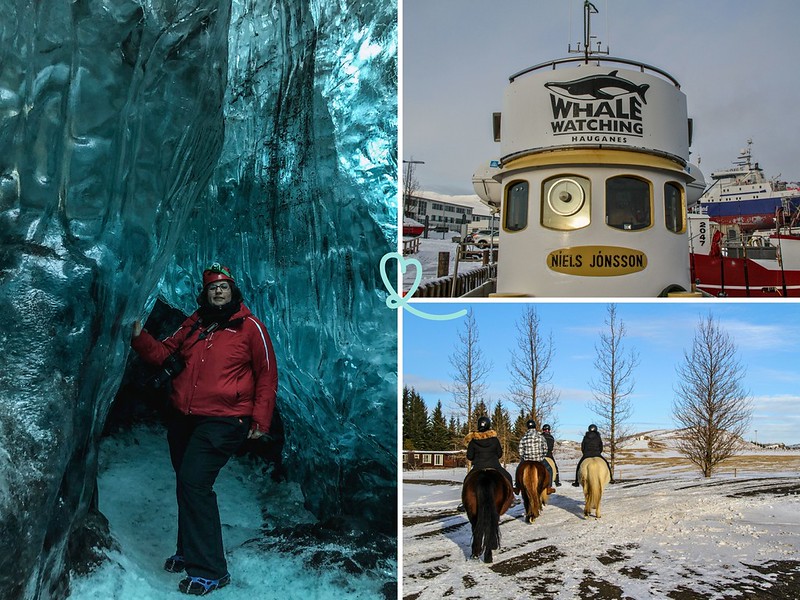
This opinion is completely independent, based on our experiences. We visited the region anonymously, making our own choices and paying our bills in full.
The Best Winter Activities in Iceland
Winter in Iceland sets its own pace: night falls early, inland roads are often closed, and many activities depend directly on the day’s weather. It requires a little flexibility in your schedule, but in return offers experiences you can’t have the rest of the year. The three best-known ones are:
- The Ice Cave Tour
- The Northern Lights
- Relaxing in a hot spring
- But there are other activities that are even more unique.
1. Explore an ice cave

Why do it? Our review
Ice caves form every winter beneath certain Icelandic glaciers, carved out by melting ice and the movement of the ice. We were struck by the shades of blue visible inside, caused by the compression of the ice over several centuries. These caves are accessible only from approximately November through March, when the structure is deemed stable enough, and only when accompanied by a guide trained in this type of terrain. And there are black ice caves, too!
We highly recommend this activity! Find out more in our article on ice caves.

Practical advice
- Season: approximately November through March, depending on ice conditions
- Tours are available only with a guide
- Be sure to pack warm, waterproof clothing and sturdy shoes
- Crampons are provided
- Duration: depends on the tour selected
- Do not do this if you have back pain (the 4WD ride is very bumpy) or if you suffer from claustrophobia
- View the different tour options
RENTING A CAR IN Iceland
Discover the best offers on Discovercars, our preferred platform!
On Route 1, no 4WD required, off Route 1, it depends on your plans.

2. Watch the Northern Lights

Why do it? Our review
Seeing the Northern Lights remains one of the main reasons to visit Iceland in the winter. The phenomenon depends on several factors occurring simultaneously: a clear sky, low light pollution, and sufficient solar activity. We were lucky enough to see some on two out of three outings, which shows that there are no guarantees, even on an organized tour. Above all, these excursions let you get away from the bright lights of Reykjavik and enjoy the convenience of a driver who monitors the weather forecast in real time.

Practical advice
- Season: September through April, the longest and darkest nights
- Check the auroral activity index (Kp index) before booking your evening out
- Many tours offer a free second attempt if you don’t succeed
- Plan to wear several layers of clothing for long waits outdoors
- There are options for boat, bus, or jeep tours
- View the different tour options
3. Hiking on a Glacier

Why do it? Our review
Glacier hiking is done under the guidance of a guide, with crampons on your feet and an ice axe in hand. The two most accessible areas for this type of outing are Sólheimajökull and Skaftafell, both located in the southern part of the island. We chose Skaftafell and have wonderful memories of the bluish crevasses and moraines that the guide showed us along the way. No prior experience is required, but being in reasonably good physical condition makes the outing easier.

Practical advice
- Two main areas: Sólheimajökull and Skaftafell, in southern Iceland
- Equipment (crampons, ice axe, harness) is generally provided by the organizer
- Good physical condition is recommended; no prior experience is required
- Sólheimajökull: Check Availability
- Skaftafell: Check Availability
WHERE TO STAY IN Iceland
Our independent picks for the accommodation of your dreams:

4. Whale Watching

Why do it? Our review
Whale-watching tours depart mainly from Reykjavik, Akureyri, and Húsavík, the latter of which is known as Iceland’s whale-watching capital. In winter, the selection is more limited but still available, as the waters are home to porpoises and, occasionally, minke whales. We recommend building in some flexibility into your schedule, as some excursions may be canceled or postponed depending on sea conditions.

Practical advice
- Departures available from Reykjavik, Akureyri, and Húsavík
- Fewer options in winter than in summer
- Thermal suits provided on board
- Bring medication for seasickness if you are prone to it
- See excursion options
5. Visit a lava tube

Why do it? Our review
A lava tube forms when the surface of a lava flow cools and solidifies, while the still-molten lava continues to flow inside, leaving a tunnel once the eruption is over. Our favorite is still Vidgelmir, one of the country’s largest accessible caves, where walkways and special lighting allow visitors to observe the mineral-rich colors of the walls. In addition, during the winter, ice stalagmites form, and snow blows into the openings of the tube.

Practical advice
- Tours are available only with a guide
- Helmet and lighting provided on site
- View availability and book

It’s time to book!
Compare everything: companies, prices, schedules and availability.
6. Go on an Icelandic horseback ride

Why do it? Our review
The Icelandic horse is distinguished by its small size, its calm temperament, and an additional gait unique to the breed—the tölt—which is particularly comfortable for the rider. The horse farms offer rides suitable for all skill levels, including beginners. We found the winter experience particularly enjoyable: the horses, accustomed to the cold, move calmly through snow-covered landscapes that are completely different from those in the summer.

Practical advice
- Suitable for beginners and experienced riders alike
- Several horse farms offer rides around Reykjavik and along the Golden Circle
- Be sure to pack warm clothes, especially for your hands and feet
- View options and book
7. Snowmobile or dog sled

Why do it? Our review
Both of these activities are typically practiced on a glacier, most often the Langjökull Glacier in the western part of the island. Snowmobiling is ideal for those seeking a more thrilling experience, while dog-sledding excursions—pulled by teams of several dogs—offer a more leisurely pace and closer contact with the animals. Both options require a 4WD ride to the starting point, which is often included in the tour.
Practical advice
- Thermal suits and helmets are generally provided
- 4WD ride to the starting point included
- See options and availability

8. Diving or snorkeling in Silfra

Why do it? Our review
The Silfra Fissure formed at the junction of the North American and Eurasian tectonic plates. The water, filtered through volcanic rock over several kilometers, offers remarkable visibility, which explains the site’s reputation among divers from around the world. You can go snorkeling or scuba diving there.
Practical advice
- Located in Thingvellir National Park, on the Golden Circle
- Snorkeling is open to anyone, no certification required; scuba diving is reserved for certified divers
- A drysuit is provided due to the water temperature
- View availability and book
9. Relax in a hot spring

Why do it? Our review
Swimming outdoors when the air temperature is around zero degrees is one of the experiences we recommend most in the winter. Three lagoons stand out in particular: the Blue Lagoon, near Reykjavik, remains the best known and most visited; the Secret Lagoon, on the Golden Circle, offers a more laid-back and less touristy atmosphere; and finally, the Earth Lagoon, in the north of the island, charms visitors with its geothermal setting and smaller crowds. We recommend making reservations in advance, especially for the Blue Lagoon.
Practical advice
- Blue Lagoon, near Reykjavik: Book Your Tickets
- Secret Lagoon, on the Golden Circle: Book Your Tickets
- Earth Lagoon, in Northern Iceland (Myvatn Nature Baths): Book Your Tickets
- Advance reservations are recommended, especially for the Blue Lagoon
10. Float in a glacial lagoon

Why do it? Our review
We haven’t done it yet, but we’re tempted to!
This activity involves swimming in a buoyant drysuit in the middle of a glacial lagoon. You float right on the surface of the water, lying down, surrounded by blocks of ice.
Practical advice
- Takes place at theFjallsárlón glacial lagoon in eastern Iceland
- A flotation suit is provided; it should be worn over warm clothing
- This activity is dependent on lagoon conditions: please confirm again before your visit
- View availability and book
Frequently asked questions
When is the best time to visit Iceland to see the Northern Lights?
The season runs from September through April, when the nights are long and dark enough. No date guarantees a sighting, as this depends on the sky and current solar activity.
Do I need to book these activities in advance?
Yes, especially for the ice caves, the Silfra Fissure, and the Blue Lagoon, where spots fill up quickly during peak season. However, weather-dependent excursions may be canceled or postponed, even after a reservation has been made.
What winter activities are suitable for beginners?
Horseback riding on Icelandic horses, whale watching, relaxing in a hot spring, and snorkeling in Silfra require no prior experience. Glacier hiking and diving in Silfra, on the other hand, require good physical fitness or a certification, depending on the activity.
PLAN YOUR TRIP TO iceland IN WINTER

- Practical advice
How to rent a car in Iceland
Winter driving tips
Where to stay in Iceland in winter
Itineraries: 3 days – 4 days – 5 days – 1 week – 10 days