
Iceland is a land shaped by fire and ice. Beneath its lava fields lie tunnels and caves sculpted by ancient volcanic eruptions. To explore one of these caves is to discover an underground world of colorful formations, minerals and natural sculptures.
Here’s our selection of the best lava tubes and caves in Iceland, with our practical tips and photos.

This opinion is completely independent, based on our experiences. We visited the region anonymously, making our own choices and paying our bills in full.
Content
The best lava caves in Iceland
More than 500 lava tunnels are known to exist in Iceland, many of them still unknown. Some are easily accessible on a road trip, others require hiking or special equipment. Some remain accessible in winter.
If you have to visit only 1, our favorite is Vidgelmir, especially as you can combine it with the Hraunfossar waterfall on the Silver Circle. It can be visited in summer and winter.
Book your visit to be sure of a place.
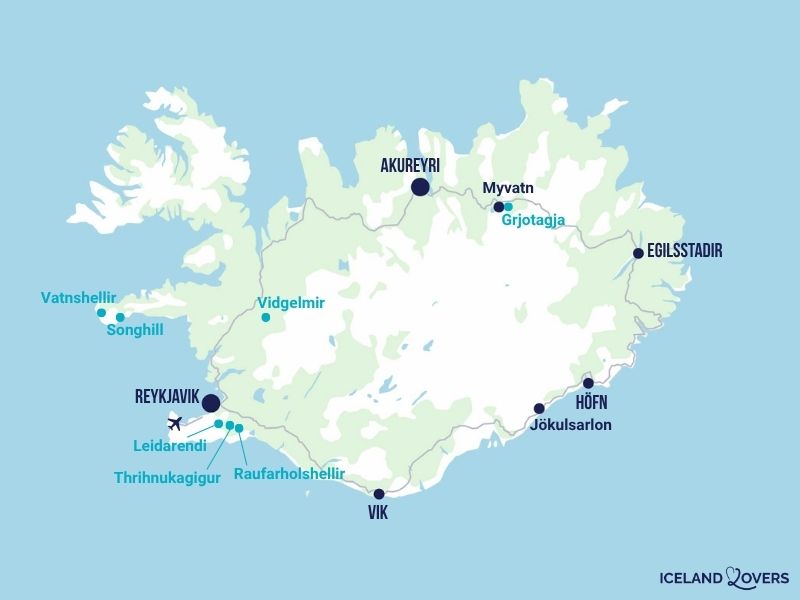
Map of lava caves to visit
Here is a map to help you find your way:
Be careful, we’re talking about lava caves, which sometimes have ice inside. If you’d like to visit ice caves under glaciers in winter, see our dedicated article.
Things to know before visiting a lava cave
Whatever cave you choose, a few precautions are essential. Wear closed-toe shoes, ideally hiking boots. Take several layers of clothing with you, as the temperature inside often differs from that on the surface. We do not recommend these visits if you suffer from claustrophobia. Finally, always listen to the guide’s instructions and wear your safety helmet correctly.
RENTING A CAR IN Iceland
Discover the best offers on Discovercars, our preferred platform!
On Route 1, no 4WD required, off Route 1, it depends on your plans.

1. Vidgelmir cave – Iceland’s largest

Why visit it? Our review
Vidgelmir is our favorite lava cave in Iceland. This volcanic tunnel, the longest in the country, stretches for 1585m. In its widest section, it reaches over 16m in width for an equivalent height. The dimensions are striking, and we were struck by the diversity of lava formations lining the walls: congealed flows, minerals in a variety of hues and surprising textures.
In winter, water seeping through the rock is transformed into ice sculptures inside the tunnel, creating a striking contrast between dark lava and translucent ice. It’s well worth the detour, especially as the guides are friendly and enthusiastic. We recommend this visit to all travelers passing through West Iceland.

Practical advice
- On the Silver Circle, not far from the Hraunfossar waterfalls
- From Reykjavik = 1h45 drive to Husafell, then unpaved road to the cave (shuttle bus available)
- Open in summer and winter
- Access only by guided tour – duration: 1h30 from the visitor center
- Level of difficulty: easy, mostly flat course with one staircase – suitable for families
- Helmet provided on site
- Limited number of visitors – book your visit to be sure of getting a place
2. Vatnshellir cave, at depth

Why visit it? Our review
Vatnshellir is a cavity (shorter tunnel (200m)), but its depth of 35m below the surface and its height give it a special atmosphere. This 8,000-year-old cave is located on the Snaefellsnes peninsula, a region we love. It can be easily integrated into a tour of the peninsula without requiring a major detour.
It’s not the most spectacular to our eyes, but it’s still a great introduction to Iceland’s underground world if you don’t go to the other regions. The red and orange hues of the frozen lava recall the volcanic origin of the site. Access is via a large spiral staircase that descends into the depths – those prone to vertigo will find the descent uncomfortable.

Practical advice
- On the Snaefellsnes peninsula, west coast
- From Reykjavik = 2h30 drive
- From Grundarfjordur = 50min drive
- Paved road to the grotto
- Open in summer and winter
- Access only by guided tour – duration: 50min from the office
- Helmet provided on site
- Limited number of visitors – book your visit
- Nearby accommodation: we recommend Grundarfjordur, next to Kirkjufell, one of the peninsula’s most photographed sites.
OUR GUIDES TO PLAN YOUR Dream trip
3. Raufarholshellir lava tunnel

Why visit it? Our review
Raufarholshellir is undoubtedly Iceland’s best-known lava cave, thanks in large part to its proximity to Reykjavik. It’s more of a tube or tunnel than a cave in the classical sense. The ceiling is pierced by three natural openings that let in daylight, revealing the red, green and golden hues of the lava. We found this play of light particularly photogenic.
Formed some 5,000 years ago, this tunnel attracts many photographers and has even been used as a film set. It’s an ideal option if you don’t have much time in Reykjavik and want to discover the inside of a lava tunnel without wandering far.

Practical advice
- Southwest Iceland, 10-minute detour from Route 1
- From Reykjavik = 40min drive
- Open all year round
- Access only by guided tour – duration: 1h from the reception desk
- Level of difficulty: no technical difficulties, but the ground is uneven (unlike at Vidgelmir) – wear comfortable walking shoes
- Helmet provided on site
- Limited number of visitors – book your visit
- Day trips are available from Reykjavik if you don’t drive – see options
4. Grjotagja and its swimming pool

Why visit it? Our review
Grjotagja is a small lava cave formed by a crack in the earth’s crust. What makes it so special is the hot-water basin it contains, heated by geothermal energy. The depth of this basin varies from a few centimetres to several metres. Once a popular bathing spot, the cave saw its water temperature rise following Krafla’s volcanic activity between 1975 and 1984. Even today, the water oscillates between 40 and 50°C and swimming is forbidden.
We found the place fascinating for its atmosphere: the steam escaping from the water, the light filtering through the fissure above and the dark lava walls surrounding the turquoise pool. The site also gained notoriety after being used as the setting for the Game of Thrones series.

Practical advice
- North Iceland, near Lake Myvatn
- From Reykjahlid (village east of Lake Myvatn), take route 1 east, then exit onto gravel road 860 – accessible to 2WD vehicles, large parking area available.
- Attention! The grotto is on private land. Opening and closing depend on the owner. The site has been closed on several occasions due to the influx of visitors and their bad behavior. Be respectful!
- Two entrances, each of which requires you to climb down some rocks. We do not recommend access for people with knee problems.
- The roof is not stable – stay alert
- Swimming prohibited. We know, it’s tempting. But it’s also dangerous: the temperature can rise at any moment and burn you.
- Self-guided tour, no fixed schedule – check on site if the site is open
WHERE TO STAY IN Iceland
Our independent picks for the accommodation of your dreams:
- Where to stay in Iceland (coming soon)
- Where to sleep in Reykjavik (coming soon)
- Best 5-star hotels (coming soon)
- Where to sleep on the South Coast (coming soon)
- Where to sleep on the Golden Circle (coming soon)
- Where to sleep on the Snaefellsnes peninsula

5. Thrihnukagigur magma chamber (“Inside the Volcano”)

Thrihnukagigur (Þríhnjúkagígur) is not strictly speaking a lava cave. This is an accessible magma chamber inside a volcano that has been dormant for 4,000 years, with no sign of activity. It’s probably one of the most unusual experiences you can have in Iceland. We regard this descent as an adventure in its own right. We hope to be able to do it soon.
The activity, dubbed “Inside the Volcano”, involves walking across a lava field and then descending 120m into the bowels of the earth. The walls of the chamber display colors found nowhere else on the surface, testimony to subterranean geological processes.

Practical advice
- Southwest Iceland
- From Reykjavik = 35min drive
- Accessible only via an organized tour from Reykjavik
- A 6-hour tour including hike, descent and traditional soup: see program
- A hike is required to reach the site. You need to be in very good physical shape.
- Not available in winter
6. Songhill cave
Why visit it? Our review
Here’s a cave that’s very different from the others.
It’s not a tube, but a cavity that’s dormant on the side of the lava, and is Iceland’s most famous “singing cave”. It is renowned for its echoes.

Practical advice
- South coast of the Snaefellsnes peninsula
- Route 570 from Arnarstapi to the Snæfellsjökull glacier.
- Ascent on unpaved road from the main road.
- Free access
7. Leidarendi cave
Why visit it? Our review
Leidarendi stands out from the previous caves for its raw character. Located in the lava field, there are no artificial structures to facilitate the route: no footbridge, no ramp, no permanent lighting. This is precisely what makes it so attractive to visitors seeking a more authentic experience.
The cave is actually made up of two cavities created by two separate eruptions, 2000 and 1000 years ago. The walls display a variety of colors: the red of iron, the yellow of sulfur and the green of copper. In winter, ice sculptures complete the picture. You’ll appreciate this wilder atmosphere, even if the low ceilings mean you sometimes have to bend down. Remember to wear your helmet!

Practical advice
- Southwest Iceland, near the Blue Mountains
- From Reykjavik = 30min drive
- Admission is free, but we strongly advise you to visit only in the company of a professional guide who will provide you with the appropriate equipment.
- Duration of guided tour: approx. 1 hour from Aurora base camp
- Level of difficulty: no path, low ceilings in places – you’ll have to crouch down.
- Open all year round
- Excursions combining the cave and other activities (such as diving at Silfra) are available from Reykjavik – see options.

It’s time to book!
Compare everything: companies, prices, schedules and availability.
8. Lofthellir cave
Why visit it? Our review
Lofthellir is a 370m-long lava tube formed around 35,000 years ago in the Laxardalshraun lava field. Its main attraction is its natural ice sculptures, among the largest to be seen in an Icelandic cave. Unlike glacier caves, this is a real ice cave inside a lava tunnel. The contrast between the icy formations and the multicoloured lava walls is striking.
However, access requires a certain amount of physical effort. It’s a 30-minute walk from the parking lot, then a crawl in places to get inside. We recommend this visit to travelers who aren’t afraid of getting dirty and are looking for a more involved underground adventure.
Practical advice
- North Iceland, near Lake Myvatn
- Parking lot near Mount Hvannfell, then 30min walk
- Soil contains water and ice
- Don’t venture out without a guide – book a guided tour
Subscribe to our Newsletter
- Get away from it all with Region Lovers’ beautiful destinations!
- Once a month
- Advertising-free
Other lava caves in Iceland
Surtshellir cave
Surtshellir extends for 1310m into the Hallmundarhraun lava field, the same area as Vidgelmir. Its name evokes Surtr, the fire giant of Norse mythology. The tunnel served as a refuge for outlaws in the 10th century, a past that gives it a historical dimension. In winter, ice formations develop in sections with low ceilings. Access is via a rough track, and a 4WD vehicle is recommended.
West Iceland.
Mariuhellar caves
Just a 15-minute drive from Reykjavik, the three Mariuhellar caves are located in the Heidmork nature reserve. They are known as Urridakotshellir, Vifisstadahellir and Draugahellir. They are easily accessible and admission is free. We find them less impressive than the caves mentioned above, but they offer a quick exit for the curious. Remember to bring a flashlight and a helmet.
Heidmork nature reserve, near Reykjavik.
Gjabakkahellir cave
Also known as Helguhellir or Stelpuhellir, this cave was formed 9,000 years ago in Thingvellir National Park. It features beautiful lava formations and seasonal ice sculptures. Access is free, but the entrance is through a very narrow passage and the visit involves progressing over large rocks. Bring hiking boots, warm clothing, a helmet and a flashlight.
Thingvellir National Park

How are lava caves and tunnels formed?
To better appreciate these cavities, it is useful to understand their origin. During a volcanic eruption, lava flows to the surface in rivers. The outer layer, in contact with the air, cools and solidifies to form a crust. Under this crust, the lava remains fluid and continues to advance.
When the eruption ceases or the lava source dries up, the still-liquid magma flows down the slope by gravity. All that remains are the empty tunnels beneath the surface. These cavities remain hidden until part of the roof collapses, creating a natural opening. It is through these collapses that most of Iceland’s lava caves have been discovered over the centuries.
PLAN YOUR TRIP AROUND iceland
- Best of
Things to do in Iceland (coming soon)
Most beautiful waterfalls (coming soon)
Most beautiful black sand beaches (coming soon)
Best excursions from Reykjavik (coming soon)
Best things to do in Iceland in winter
Winter ice caves (coming soon)

- Practical advice
Getting around (coming soon)
How to rent a car in Iceland (coming soon)
Driving tips (coming soon)
Itineraries (coming soon)
Where to stay in Iceland (coming soon)
Itineraries: 3 days – 4 days – 5 days – 1 week – 10 days (to come)

- The must-dos
Things to do in Reykjavik (coming soon)
Best attractions in the Golden Circle (coming soon)
South Coast attractions (coming soon)
Snaefellsnes Peninsula (coming soon)
Silver Circle (coming soon)
Lake Myvatn attractions (coming soon)
Jokulsarlon (coming soon)