
Want to go to Iceland in July?
Find out if the region is right for you at this time of year, with our comprehensive guide to climate, travel conditions, crowds, prices, attractions and events.
This opinion is completely independent, based on our experiences. We visited the region anonymously, making our own choices and paying our bills in full.
Travelling to Iceland in July: quick answers
Is the weather nice in Iceland in July? Is this a good time to visit?
July is the warmest month of the year in Iceland, and one of the most favorable for travel. Temperatures are peaking, the days are very long thanks to the last weeks of the midnight sun, and all the roads are open, including the tracks in the Highlands.
We love this time of year for the variety of activities on offer. It’s also the peak of the high season: visitors are very numerous, accommodation fills up fast and prices are at their highest.


It’s time to book!
Compare everything: companies, prices, schedules and availability.
Travelling to Iceland in July: summary of conditions
Temperatures
July offers the highest temperatures of the year in Iceland. In Reykjavik and on the south coast, the thermometer fluctuates between 10°C (50°F) and 15°C (59°F) during the day. In the north, around Akureyri, averages are comparable, even a little milder in the wind-sheltered fjord bottoms. Nights rarely fall below 7°C (45°F) on the coast. At higher altitudes, temperatures remain much lower.
Crowds and prizes
July is the busiest month of the year. Iconic sites such as the Golden Circle, Reynisfjara beach and Jökulsárlón welcome a steady stream of visitors throughout the day. We strongly advise you to book accommodation, rental cars and excursions several months in advance. Fares are the highest of the year in all categories.

Opening conditions
All open in July. The F roads of the Hautes Terres are accessible (but check road.is for conditions before each outing, as occasional closures are possible after heavy rain). All museums, restaurants, hotels, campsites and activity providers are operating at full capacity.
Length of day
In July, the days remain very long. At the beginning of July, the midnight sun is still present, then the nights get progressively longer. At the end of the month, the sun sets around 11pm and rises around 3:30am, leaving a luminous twilight in between. You have around 19h to 22h of usable light, depending on the time of the month.

WHERE TO STAY IN Iceland
Our independent picks for the accommodation of your dreams:

Best attractions in Iceland in July
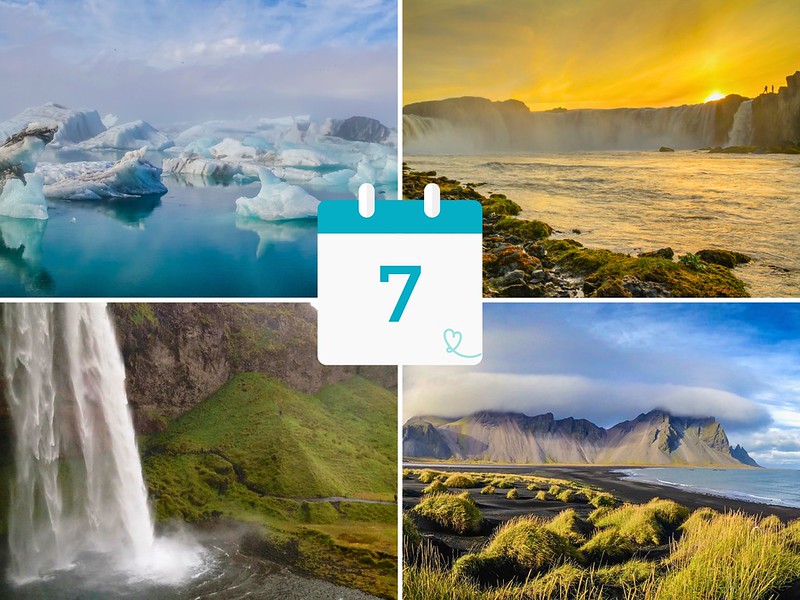
July allows you to enjoy all of Iceland’s attractions, with no road or winter weather restrictions. We liked it:
- Hiking in the colorful Landmannalaugar mountains, accessible by 4WD
- Puffin watching on the Vestmann Islands or Látrabjarg
- Touring the Golden Circle: Thingvellir, Geysir and Gullfoss
- Sailing among the icebergs of the Jökulsárlón glacial lagoon
- Discover the southern waterfalls: Seljalandsfoss, Skógafoss and Svartifoss
- Admire the Snæfellsnes peninsula, Iceland in miniature with its glacier
- Bathing in Reykjadalur’s warm river after a 45-minute walk
- Take a whale-watching tour from Húsavík
- Visit the Fjaðrárgljúfur canyon and its geological formations
- Drive Route 1 (circular route) for a complete tour of the island
- …

Climate in Iceland in July – weather forecast
July is statistically the mildest month in Iceland. However, the weather remains unpredictable: a day can alternate between sunshine, clouds, light rain and sunny spells in the space of a few hours. We have often experienced these rapid changes on the spot, sometimes even within a few kilometers.
On the coasts and in the south
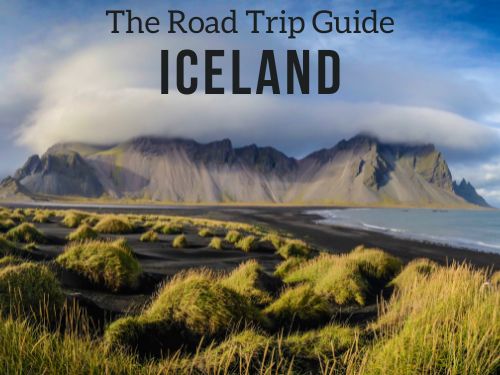
The southern coast enjoys some of the mildest temperatures in the country. The days are regularly punctuated by sunny spells, interspersed with short showers. The wind blows constantly, especially on the exposed black sand beaches. The region between Vik and Höfn is Iceland’s wettest: bring waterproof layers even in fine weather. We suggest you keep a windproof jacket handy at all times.

In the north
The north of Iceland, protected by mountain ranges, receives less precipitation than the south. The Akureyri region sometimes enjoys calm, sunny days, with temperatures reaching 18°C (64°F) at the head of the Eyjafjörður fjord. Around Lake Mývatn, the weather is drier than on the coast, but midges are very common in July: head nets are useful. On the other hand, the more exposed northeast coast remains cool and windy.

In the Highlands
In July, the Highlands are fully accessible. This is the best time to explore Landmannalaugar, Askja or the Þórsmörk valley. Temperatures range from 5°C (41°F) to 12°C (54°F) during the day, but can drop sharply if the wind picks up. Sandstorms sometimes occur in inland desert areas. We recommend a 4WD vehicle suitable for crossing fords, as the rivers are fed by melting glaciers and their levels can rise during the day.

UNFORGETTABLE ACTIVITIES IN Iceland
- Swimming in the Silfra fissure
- Horseback riding
- Hiking on a glacier
- Whale watching (from Reykjavik, Husavik or Akureyri)

July temperatures in Iceland
July boasts the highest temperatures of the year, even if they remain cool compared to other summer destinations. Here are the averages for three representative cities.
Temperature in Reykjavik
- Average daytime temperature: 13°C (55°F)
- Average night-time temperature: 8°C (46°F)
Temperature in Akureyri
- Average daytime temperature: 14°C (57°F)
- Average night-time temperature: 8°C (46°F)
Temperature in Vik
- Average daytime temperature: 12°C (54°F)
- Average night-time temperature: 7°C (45°F)
In any case, all year round, you’ll need warmth, windproof and rainproof layers. From T-shirt to full-coverage in no time.

RENTING A CAR IN Iceland
Discover the best offers on Discovercars, our preferred platform!
On Route 1, no 4WD required, off Route 1, it depends on your plans.

Rain and Wind
July is one of the least rainy months in Iceland, but rainfall varies considerably from region to region. The south remains the wettest area, while the north enjoys drier conditions. Showers are often brief and localized. We have frequently observed that it can rain on one side of the road and be sunny on the other.
- Rainfall in Reykjavik: 40 to 55mm
(10 to 11 days on average) - Rainfall in Akureyri: 25 to 35mm
(on average 7 to 9 days) - Rainfall in Vik: 70 to 100mm
(over 13 to 15 days on average)
No snow on the plains in July. Only the highest peaks and glaciers retain their snow cover. Glaciers like Vatnajökull, Europe’s largest ice cap, remain imposing even in the height of summer.

Wind remains a constant in Iceland’s climate. In July, it blows on average between 15 and 25km/h, with gusts possible on exposed coasts and at higher altitudes. Storms are rare at this time of year, but not impossible. Make sure your car doors are securely fastened: the wind can rip them off in seconds. The vedur.is website provides detailed forecasts, including wind strength and direction by zone.
Sunshine, midnight sun and northern lights
In July, daylight hours were progressively shorter than in June, but remained exceptional. At the beginning of the month, the sun sets around 11.50pm and rises around 3.10am. At the end of the month, he goes to bed around 10.30pm and gets up around 4.15am. The twilight between sunset and sunrise remains bright. Not quite the midnight sun of June, but very short nights!
Actual sunshine depends on cloud cover. Count on an average of 5 to 6 hours of direct sunshine a day. The south tends to be cloudier than the north. Prolonged brightness offers a considerable advantage for photography and evening walks. We particularly appreciated the opportunity to visit sites late at night, when the crowds have dispersed.

At the end of July, the nights start to get slightly darker, creating the right conditions for beautiful sunsets. However, a night mask is still recommended for sleeping, as the brightness of the night light can interfere with sleep.
Nights too short to see the northern lights.
Crowds and other conditions
July is the peak season in Iceland. The country welcomes more than two million visitors every year, most of them between June and August. The parking lots at the Golden Circle, Reynisfjara and Jökulsárlón fill up first thing in the morning. Queues form at the most popular waterfalls, and the hiking trails near Reykjavik are heavily used.
We’ve found that staggered opening hours make a real difference: visiting major sites before 9am or after 8pm considerably reduces the crowds. Long-lasting light makes this strategy perfectly feasible.

On the roads, traffic is heavy on Route 1 in the south. Rental vehicles are ubiquitous. All F roads are open in July, and a 4WD vehicle is required to use them.
Wildlife in July
July is a rich month for observing Icelandic wildlife. Puffins are always present on cliffs and islands, feeding their young. The colonies on the Vestmann islands (Vestmannaeyjar), Látrabjarg and Borgarfjörður Eystri are the most accessible. With their colorful beaks, these birds are not very shy, which makes it easy to observe them up close. We were struck by the density of the colonies.

Whale-watching is also favourable in July. Excursions leave daily from Húsavík and Akureyri in the north, as well as from Reykjavik. The most frequently observed species are humpback whales, minke whales and white-beaked dolphins. Blue whales are sometimes seen in the north. Sea conditions are among the best of the year.
Arctic terns actively defend their nests in July. These migratory birds, which fly the distance between the Arctic and Antarctic every year, dive at passers-by too close to their territory.
July events in Iceland
July is a busy month in Iceland. Several cultural and festive events punctuate the summer:
- Eistnaflug in Neskaupstaður: metal and alternative music festival in the eastern fjords, usually held on the second weekend in July. The atmosphere is convivial despite the intense musical genre.
- Equestrian gatherings: in July, several gatherings of the Icelandic horse, a breed endemic to the country whose export is strictly regulated, are organized in rural areas. Demonstrations of tölt, the breed’s characteristic gait, are featured.
- Summer markets in Reykjavik: throughout the month, craft and food markets are held in the city center. You’ll find Icelandic wool, local ceramics and local produce.
July prices
July is the most expensive month in which to travel to Iceland. The cost of living is already high in the country, and the high season pushes up prices significantly. Accommodations, from youth hostels to boutique hotels, display their maximum prices. A double room in a guesthouse costs on average between €150 and €250 a night, and hotels often exceed €300.
Other months
When to go to Iceland, other months…
- Iceland in January
- Iceland in February
- Iceland in March
- Iceland in April
- Iceland in May
- Iceland in June
- Iceland in August
- Iceland in September
- Iceland in October
- Iceland in November
- Iceland in December
Or read our article on when to go to Iceland (coming soon).
PLAN YOUR SUMMER TRIP TO iceland
- Best of
What to do in Iceland
The most beautiful waterfalls
The most beautiful black sand beaches
Volcanic craters to climb
Lava caves to visit
Best excursions from Reykjavik

- Practical advice
Summer travel tips
How to rent a car in Iceland
Driving tips
Where to stay in Iceland
Itineraries: 3 days – 4 days – 5 days – 1 week – 10 days

- The must-dos
What to do in Reykjavik
Best attractions in the Golden Circle
South Coast attractions
Snaefellsnes Peninsula
Silver Circle
Lake Myvatn attractions