
Do you dream of landscapes that seem to belong to another world? The lava fields of Berserkjahraun, on Iceland’s Snaefellsnes peninsula, offer a striking spectacle of green moss on black volcanic rock, surrounded by fjords and pyramid-shaped mountains. We were captivated by the singular atmosphere of this place, at once wild and strangely peaceful.
In this article, you’ll find our photos and tips for making the most of your visit to the Berserkjahraun lava fields.
This opinion is completely independent, based on our experiences. We visited the region anonymously, making our own choices and paying our bills in full.
Content
Why visit the Berserkjahraun lava fields?
Is Berserkjahraun worth a visit? Our opinion:
Yes, Berserkjahraun is definitely worth a visit! This lava field in the north of the Snaefellsnes peninsula is an off-the-beaten-track itinerary that transports you to a striking volcanic setting.
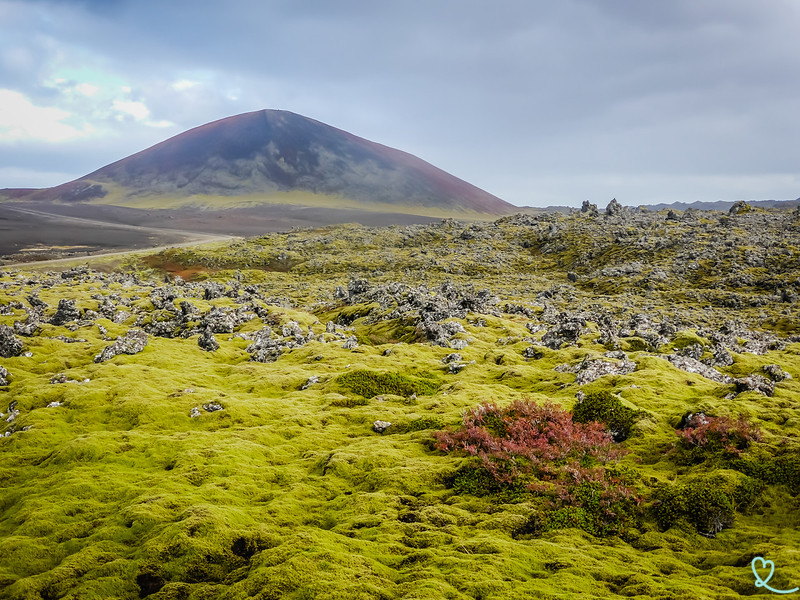
The road winds through intensely green moss-covered lava formations, framed by singular mountains and fjords. We particularly appreciated the tranquility of the place: very few passing vehicles, a rare feeling of immensity and solitude. The contrast between the black of the rock, the bright green of the moss and the changing hues of the sky left a lasting impression on us.
It’s one of the most beautiful lava fields in Iceland and one of the most beautiful places on the peninsula.

Our favorite moments
This journey through the lava fields offered us some memorable moments. We loved it:
- The pyramid-shaped mountains that rise up behind the lava field, giving the landscape an almost unreal allure.
- Color contrasts between the bright green of the moss, the black of the lava and touches of red on certain rocks.
- The tranquility of the road: driving alone through this volcanic landscape, with hardly anyone in sight, gives you a real sense of freedom.
- Lake Hraunsfjardarvatn at the start of the route, whose waters reflect the surrounding lava formations.

WHERE TO STAY IN Snaefellsnes
In Grundarfjordur, near Kirkjufell
See top-rated accommodations
In Stykkisholmur, surrounded by water and islands
See top-rated accommodations
In Borganes, at the junction of Route 1 and Snaefellsnes
See top-rated accommodations

How to get to Berserkjahraun: access and map
Where is Berserkjahraun?
- North of the Snaefellsnes peninsula, west of Iceland.
- Driving time from Reykjavik: 2h15
- Driving time from Grundarfjordur: 15min
- Driving time from Stykkisholmur: 15min
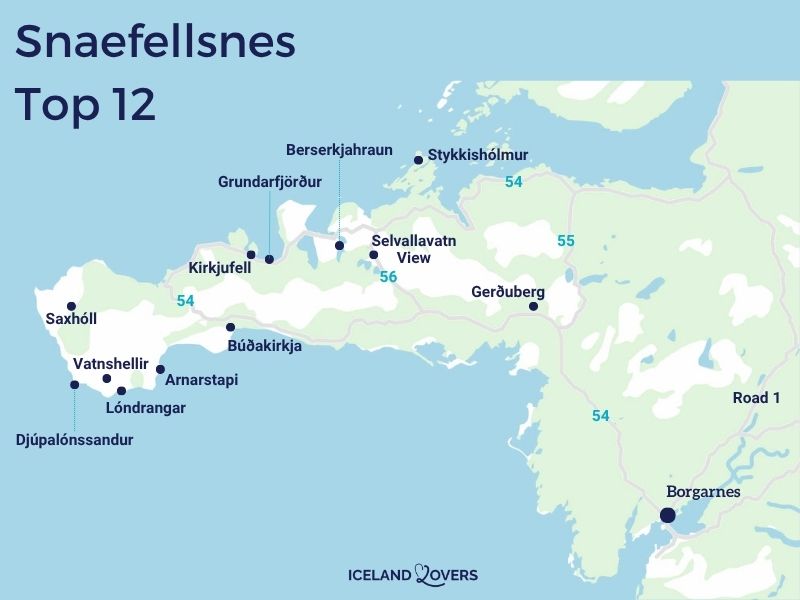
- Here is a map to help you find your way:
How to get there? Access road
The lava field can be explored along Route 558.
Arriving from the west on Route 54 from Grundarfjordur, cross the first bridge and turn right onto Route 558, also known as Berserkjahraun. After a small bridge, continue to a crossroads and turn right.
If you’re coming from the east, just after the junction between roads 56 (Vatnaleid) and 54 (Snaefellsnesvegur), turn left towards Berserkjahraun.
We found access easy and easy to spot once on Route 54.

Parking
There are no parking facilities to speak of. You can park on the sides of Route 558 where the terrain permits. As the road is not very busy, we had no trouble parking during our stops.

RENTING A CAR IN Iceland
Discover the best offers on Discovercars, our preferred platform!
On Route 1, no 4WD required, off Route 1, it depends on your plans.

Useful tips: duration, schedules, difficulties…
Best time to visit, opening hours and prices
We recommend early morning to enjoy the reflections on the water around the bridge and the soft light on the lava formations.
Access to the lava field is free, with no time restrictions.
Bear in mind that the light changes considerably depending on the weather: in fact, we drove the route twice in two days, once under overcast skies and a second time in better sunshine, to appreciate the variations in color. If you have a few clouds, you’ll be able to observe the rock’s hues oscillating between pink, grey, orange and brown.

Length of visit and main difficulties
We drove for around 2h30, stopping very, very often to observe and photograph the lava formations. You can, however, cover the route more quickly if you have less time.
Route 558 is not asphalted, but is still passable without major difficulties. Just drive slowly. Some sections are bumpier than others, and weather conditions can change the state of the ground. We covered it in 4WD, which proved comfortable.
An important point: don’t step on the lava! The moss that covers the rocks is extremely fragile and takes many years to regenerate. Volcanic rock is also sharp. Stay on the road and watch the scenery from the roadside.

Advice on how to visit
Route 558 runs in both directions. If you’re coming from the west from Grundarfjordur, you’ll first come across Lake Hraunsfjardarvatn and the bridge, a good starting point.
Continuing eastwards, you cross the heart of the lava field. We suggest you take your time and stop whenever a panorama catches your eye: each bend reveals a different perspective on the surrounding volcanic formations and mountains.
But think of the others, don’t stop in the middle!
Catering, Toilets and Facilities
You won’t find any facilities on the Berserkjahraun lava field: no toilets, no catering, no water. The towns of Grundarfjordur and Stykkisholmur, both a 15-minute drive away, offer shops and restaurants.

Lake Hraunsfjardarvatn
Arriving from the west, the first sight you see is Lake Hraunsfjardarvatn, located at the start of the lava field. This body of water is actually connected to the sea, giving it a special atmosphere.
We recommend stopping off near the bridge to admire the reflections on the water’s surface, especially in the early morning. On one side of the road, the landscape remains relatively clear. On the other, towering blocks of lava frame the bodies of water, creating a striking contrast. We were surprised by the diversity of views this one stop offers.

OUR GUIDE TO PLANNING A Dream trip
- 8 maps that make planning easier
- + 100 pre-selected locations
- Practical advice
- + 130 photos to help you choose
Fascinating landscapes
The whole journey through the lava field is a treat for photographers. You don’t need any special instructions: you just ride and stop as the scenery inspires you. We paused again and again, unable to resist the panoramic views around every bend.

The pyramid-shaped mountains that rise up behind the lava formations create remarkable pictures. The almost unreal green moss covers the black boulders, and in places, the lava takes on frankly red hues. Depending on the cloud cover, the colors change: from pink to gray when the sun is hidden, then from orange to brown when it reappears.
You’ll want to stop again and again. Especially if the sheep make an appearance!

The Icelandic Saga of the Lava Field
Berserkjahraun is named after an episode in the Eyrbyggja Saga, one of Iceland’s best-known medieval sagas. This 10th-century tale tells how a farmer brought two Swedish berserker warriors back to Iceland.
Unable to control them, he entrusted them to his brother Víga-Styr, nicknamed “the Killer”, who lived on the other side of the lava field. One of the berserkers fell in love with Styr’s daughter and asked her to marry him. Styr agreed, on one condition: the two Swedes had to clear a path through the lava field to link his farm to the nearby settlement. A task deemed impossible. But the berserkers quickly accomplished it. Instead of keeping his promise, Styr had the two men killed and buried along the path.

Four remains linked to this saga can still be identified on the site: Berserkjagata, the trail itself; Berserkjadys, the supposed burial site; Landamerkjagarður, a boundary fence; and Fjárrétt, a sheep pen. If you’re curious about Nordic culture, this place adds a narrative dimension to the journey that goes beyond simply contemplating the landscape.

Geology of the lava field
The Berserkjahraun lava field was formed around 4,000 years ago by the successive eruption of four slag craters. The lava flowed from the slopes of the Bjarnarhafnarfjall to the sea at Hraunsfjörður and Hraunsvík.
The four craters line up from west to east from the Kerlingarskarð pass. Rauðkúla, the largest (379m diameter), erupted first, followed by Kothraunskúla, then Smáhraunskúla and finally Grákúla (211m diameter). The Grákúla eruption gave rise to Lake Selvallavatn, south of the crater, while Lake Kothraunsvatn was also formed during this volcanic period.

The names of the craters reveal their characteristics: Rauðkúla means “red crater” and Grákúla “grey crater”. In reality, both are red, but Grákúla appears grey because of the moss that covers it. We found these geological details enlightening in understanding the landscape we’re passing through. You’ll notice the differences in texture and color between the lava zones as you go along.

What does Berserkjahraun mean?
Berserkjahraun literally translates as “berserker’s lava field”. The term berserker refers to a Viking warrior-falcon known for fighting in a state of uncontrolled fury. The region takes its name from the saga mentioned above, which anchors this place in the Nordic imagination.
Please note: whenever you come across the word “hraun” in an Icelandic place name, it means “lava”. This detail will help you decipher the place names throughout your trip to Iceland. We appreciated these insights, which gave meaning to the landscapes we passed through.
Other nearby attractions
You can combine your visit to Berserkjahraun with these nearby attractions:
- Grundarfjordur and Kirkjufell Mountain, one of Iceland’s most photographed mountains (15min drive)
- Stykkisholmur, a waterside fishing village on the peninsula’s north coast (15min drive)
- Other sites on the Snaefellsnes peninsula, accessible from Route 54
- View of the lava field from Route 54

Frequently asked questions
What type of car do I need to drive around Berserkjahraun?
Route 558 is unpaved but accessible. A 4WD is recommended for greater comfort, especially on the bumpier sections. We drove it in a compact 4WD and it was perfect. However, weather conditions can change road conditions, so please take care and adapt your speed.

Can you walk on the Berserkjahraun lava field?
No, we strongly advise against walking on lava. The moss that covers the rocks is very fragile and takes many years to grow back. What’s more, volcanic rock is particularly sharp. Stay on the road and along the path to observe the landscape in complete safety and preserve this ecosystem.
PLAN YOUR SUMMER TRIP TO iceland
- Best of
What to do in Iceland
The most beautiful waterfalls
The most beautiful black sand beaches
Volcanic craters to climb
Lava caves to visit
Best excursions from Reykjavik

- Practical advice
Summer travel tips
How to rent a car in Iceland
Driving tips
Where to stay in Iceland
Itineraries: 3 days – 4 days – 5 days – 1 week – 10 days

- The must-dos
What to do in Reykjavik
Best attractions in the Golden Circle
South Coast attractions
Snaefellsnes Peninsula
Silver Circle
Lake Myvatn attractions