
The Silver Circle is a route in western Iceland that is less touristy than the Golden Circle.
In winter, this tour takes on a special charm: steaming hot springs in the cold, waterfalls partially frozen over, and a tour through a tunnel carved right out of a glacier.
In this article, we’ll share our winter itinerary for the Silver Circle, following the logical order of the route, along with our practical tips for traveling in this region during the cold season.
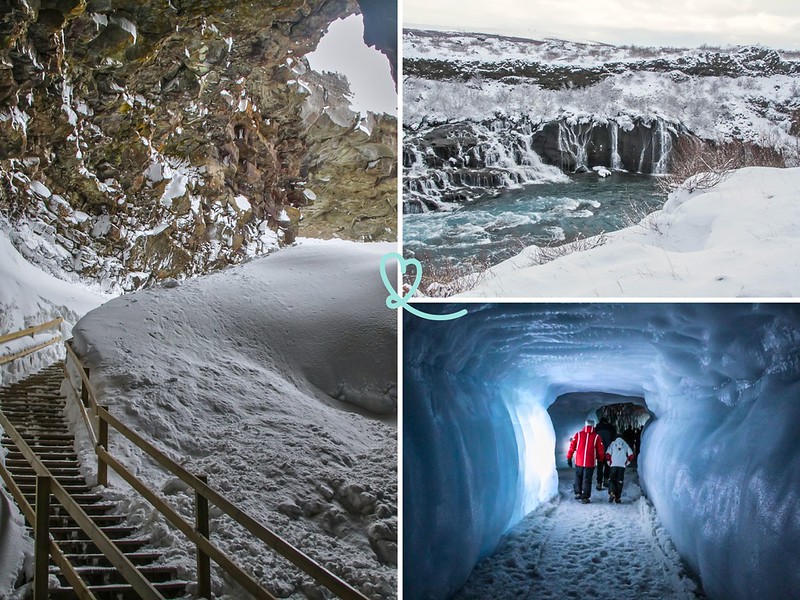
The Silver Circle in Winter: Itinerary and Map
The stages in the order of the route
A brief geographical note: The Silver Circle does not correspond to any specific administrative boundary, unlike the Golden Circle, which has a more official name.
Rather, it refers to a logical sequence of sites in Borgarfjörður, which most visitors follow in the same direction, as detailed below:
- Deildartunguhver
- Reykholt: Church and Viking Baths
- Hraunfossar
- Barnafoss
- Húsafell
- Víðgelmir
- Into the Glacier (ice tunnel)
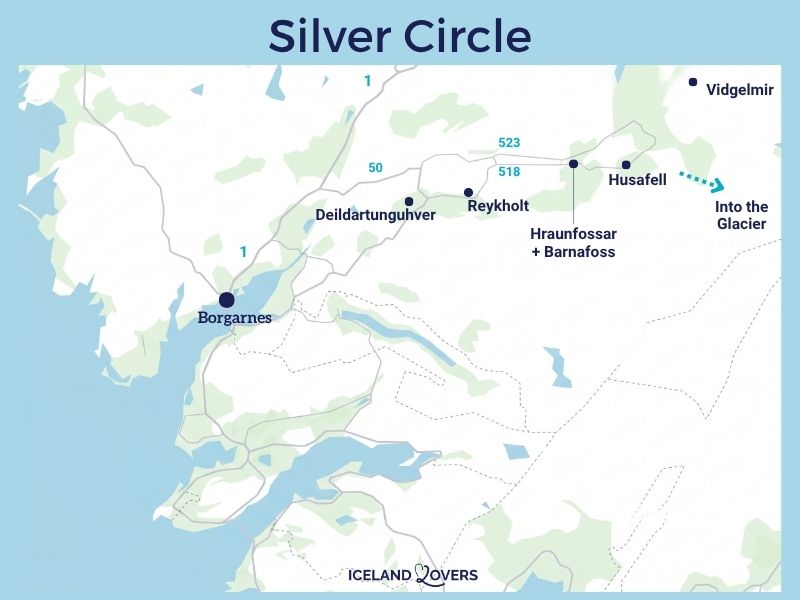
Allow a full day to complete these seven stages in winter, due to the shorter daylight hours. We provide a detailed breakdown of the logistics for this itinerary below, in our practical tips section.
If you don’t want to drive, this destination has far fewer guided tours than the Golden Circle, but you can still find some. View options and availability.
RENTING A CAR IN Iceland
Discover the best offers on Discovercars, our preferred platform!
On Route 1, no 4WD required, off Route 1, it depends on your plans.

1. Deildartunguhver

Iceland’s underground heat continuously heats the water, giving rise to springs that are distinguished by their flow rate rather than by their temperature alone. We were surprised by the contrast between the snow all around us and the clouds of steam rising from the boiling water.
In winter, this contrast makes the site particularly photogenic, as the steam seems to freeze in the cold air. A walkway allows visitors to approach the emergence points safely. We still recommend keeping a reasonable distance: the heat and splashes can take an inattentive visitor by surprise.

- Deildartunguhver, the most powerful hot spring in continental Europe, with a flow rate of about 180 liters per second and water temperatures approaching 100°C
- Free access year-round via a walkway built along the water intake points,
- Allow 10 to 30 minutes at the site
- Right next door, the Krauma Baths—fed by the same spring and cooled by water from a nearby river—are open year-round, including in winter
- Free parking right on site
- In winter, be sure to wear non-slip shoes: the walkway can freeze even though it’s close to warm water
2. Reykholt

Some villages owe their reputation to a single resident, whose name has lived on through the centuries thanks to his writings. This is true of Reykholt, the village where Snorri Sturluson—a 13th-century historian and poet, and the presumed author of several royal sagas—lived.
We always find it interesting to stop at places that combine literary history with older historical sites, such as these stone pools fed by a hot spring, where people used to come to bathe.

A cultural center offers a deeper look into the historical context of the site, which is helpful for those who are not yet familiar with the Icelandic sagas. We recommend spending a little time there before hitting the road again, if only to understand Reykholt’s significance in the country’s history.

- The Reykholt Church, built in the 20th century, which houses Snorrastofa, a cultural center dedicated to Snorri Sturluson and the sagas
- Snorralaug, a stone pool likely dating from the Viking Age and one of the country’s oldest thermal bath sites, visible from an outdoor trail
- Plan on spending 20 to 30 minutes there; a little longer if you visit the cultural center.
- Free parking in the village center
WHERE TO STAY IN Iceland
Our independent picks for the accommodation of your dreams:

3. Hraunfossar

A river can sometimes spring directly from the ground, with no visible channel upstream, when it flows through a field of porous lava. We were impressed by this phenomenon, which gives the impression that water is springing from the rock itself over a distance of several hundred meters.
In winter, part of the flow freezes into ice, creating white patches among the streams of water that remain liquid. A specially designed observation deck offers a panoramic view without having to get close to the edge. We especially love the low winter light in Iceland, which accentuates the contrasts between the ice, the black rock, and the turquoise water.

- Hraunfossar, literally “lava falls,” is a series of waterfalls that cascade nearly 900 meters down from a lava field formed by the Hallmundarhraun volcano
- Observation deck accessible from the parking lot in a 2- to 3-minute walk; the path is paved but slippery in winter
- Plan on spending 20 to 30 minutes there; there’s a pedestrian bridge that lets you see the falls from a different angle
- Free parking, shared with access to Barnafoss
- Crampons or shoes with treaded soles are recommended; the path and the bridge may be icy
- See more photos
4. Barnafoss

Just a few minutes from the previous site, a river can also narrow abruptly between two lava walls, forming rapids that are less conspicuous but just as pronounced. Passages like this often have names linked to local legends, which we’ll let you read for yourself when you get there.
The place is spectacular in a different way than the nearby waterfall, and it adds a sonic dimension that we really enjoyed. The water rushes powerfully here, whereas just a few steps away it flowed gently.

- Barnafoss, or “Children’s Falls,” named after a local legend about two children who fell into the river while crossing a natural stone bridge that no longer exists
- Rapids enclosed between two lava walls, about a 5-minute walk from Hraunfossar along a shared trail
- Allow 10 to 15 minutes at the site
- Same parking lot as for Hraunfossar
- See more photos

5. Húsafell

A little further down the road, an area of planted forest stands in contrast to the more rocky landscapes we’ve passed through so far. We love this stop to take a breather, between a geothermal bath set in a natural gorge and a network of marked trails that turn into cross-country ski trails as soon as the first snow falls.
This is also the starting point for several hikes to the nearby glacier, making it a logical base for the rest of the day. There are a few shops and a hotel where you can take a break or extend your stay.

6. Vidgelmir

Beneath the surface of some lava fields lie tunnels carved out by the flow itself, formed when the rock on the surface cools while the magma continues to flow beneath it.
Vídgelmir, one of Iceland’s largest lava tubes, is about 1.6 km long and up to 15.8 m high in places. We found the guided tour to be particularly well designed, with lighting that highlights the mineral colors of the rock without detracting from the setting.
And in winter, ice stalagmites form inside the lava tube, creating a striking contrast.

- Tours are available only as guided group tours; advance reservations are required; duration: approximately 1 hour and 30 minutes
- Helmet, headlamp, and crampons are provided on site and included in the price
- Open year-round, including in winter, unlike other caves that are harder to access during this season— check availability and make a reservation
UNFORGETTABLE ACTIVITIES IN winter
- Visit an ice cave
- Glacier hiking
- Whale watching (from Reykjavik, Husavik or Akureyri)

7. Into the Glacier (inside the glacier)

Into the Glacier is a network of artificial tunnels and passages carved into the Langjökull glacier, Iceland’s second-largest ice cap.
We were struck by the shades of blue, which vary depending on the thickness of the ice through which the light passes—a gradient that cannot be seen anywhere else in the region.
Access is possible only in specially modified vehicles, which are the only ones capable of driving on the ice cap without sinking into it. Which means that the trip is already an adventure even before you reach the tunnel!

- Access is only possible in a modified vehicle (monster truck) from the meeting point in Klaki, near Húsafell; private cars are not permitted.
- Total duration of the excursion: about 3 to 4 hours, including a 45-minute to 1-hour truck ride to the glacier
- Advance reservations are required; space is limited, especially during the peak winter season (Christmas break, February)
- In the event of a storm, the tour may be canceled or rescheduled by the organizer for safety reasons; please allow for flexibility in your itinerary
- Warm, waterproof clothing is essential; the temperature inside the tunnel stays below 0°C all year round— check availability and make a reservation

It’s time to book!
Compare everything: companies, prices, schedules and availability.
Visiting the Silver Circle in Winter: Practical Tips
Where is the Silver Circle located?
The Silver Circle is located in Vesturland, in the Borgarfjörður region, north of Reykjavik. Húsafell, the last stop before the glacier, is located about 130 km from the capital.
- From Reykjavik: about 1.5 to 2 hours by car to Húsafell, via the Hvalfjörður Tunnel (Hvalfjarðargöng, toll) and then Route 50 toward Reykholt
- From Borgarnes: about 45 minutes to 1 hour to Húsafell
- Classic linear route: Route 1 to Borgarnes, then Route 50 (Borgarfjarðarbraut) via Reykholt, then Route 518 to Húsafell
Getting Around and Driving in Winter

A car is essential for this itinerary, as public transportation does not serve the various stops. Route 518 toward Húsafell may become slippery or even temporarily closed after a heavy snowfall. See our article on winter driving.
Always check road.is (Vegagerðin) for road conditions and safetravel.is for weather alerts before you leave and regularly throughout the day. Headlights must remain on at all times, as is the case throughout Iceland, and it is best to maintain a greater safety distance than usual on snow-covered roads.
- No Type F roads (mountain trails) are used on this route; access to the glacier is provided exclusively by vehicles operated by Into the Glacier.
- Fill up on gas in Borgarnes, the last gas station before Húsafell
How much time should I set aside for the Silver Circle in winter?
Excluding the glacier tour, allow half a day for the first six stages. For the “Into the Glacier” tour, plan on spending a full day, keeping in mind the shorter daylight hours: in December and January, the sun often doesn’t rise until after 11 a.m. and sets as early as 4 p.m. We recommend staying overnight in Borgarnes so you can enjoy the sites in daylight.

We recommend the Hamar Hotel (formerly Icelandair)
A peaceful setting with modern, minimalist rooms, private patios and breathtaking views of the Borgarfjördur fjord. Outdoor saunas and jacuzzis (summer and winter).
See photos and availability
What to Pack
- Several layers of warm clothing, including a waterproof and windproof layer
- Waterproof hiking boots with lugged soles, useful for Hraunfossar, Barnafoss, and Deildartunguhver
- Lightweight crampons (Microspikes-style), in addition to those provided in the lava tube, for the other sites
- A hat, gloves, and sunglasses—since the glare off the snow remains strong even on overcast days
- Swimsuit and towel, for the Krauma Baths or the Canyon Baths in Húsafell
Frequently asked questions
Is the Silver Circle open in the winter?
Yes, the entire route remains accessible in winter, including the “Into the Glacier” tour, which operates year-round thanks to specially adapted vehicles. Only extreme weather conditions (storms, heavy snowfall) may result in the temporary closure of Route 518 or the occasional cancellation of the glacier tour.
Silver Circle or Golden Circle in winter: which one should you choose?
Both routes remain accessible in winter and are not mutually exclusive: the Golden Circle is more popular and closer to Reykjavik, while the Silver Circle attracts fewer visitors and offers a glacier tour that is unique to the region. If your itinerary allows, the two go well together on different days.
PLAN YOUR TRIP TO iceland IN WINTER
- Best of
Iceland’s winter landscapes
Best things to do in Iceland in winter
The most beautiful waterfalls
Ice caves
Best excursions from Reykjavik

- Practical advice
How to rent a car in Iceland
Winter driving tips
Where to stay in Iceland in winter
Itineraries: 3 days – 4 days – 5 days – 1 week – 10 days