
Want to go to Iceland in August?
Find out if the region is right for you at this time of year, with our comprehensive guide to climate, travel conditions, crowds, prices, attractions and events.
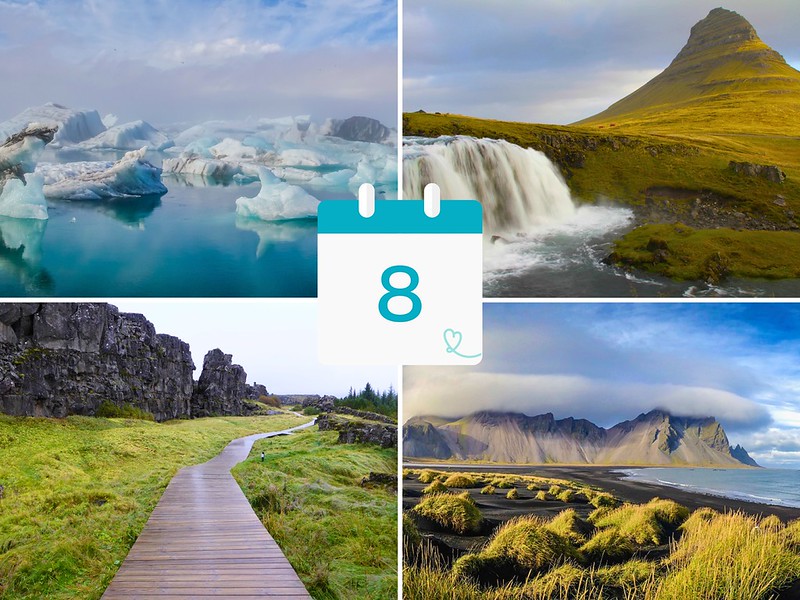
This opinion is completely independent, based on our experiences. We visited the region anonymously, making our own choices and paying our bills in full.
Content
Travelling to Iceland in August: quick answers
Is the weather nice in Iceland in August? Is this a good time to visit?
August is an excellent month to discover Iceland. Temperatures remain among the mildest of the year, the days are long and all the roads are open, including the tracks in the Highlands. We appreciate this period for the relatively mild climate and the gradual return of dark nights at the end of the month, which gives us a glimpse of the first aurora borealis.
It’s still high season: visitors are numerous, especially in the first fortnight, and prices remain high.


It’s time to book!
Compare everything: companies, prices, schedules and availability.
Travelling to Iceland in August: summary of conditions
Temperatures
Temperatures in August were comparable to those in July, with a slight drop towards the end of the month. In Reykjavik and on the south coast, the thermometer reads between 9°C (48°F) and 14°C (57°F) during the day. In the north, the Akureyri region has similar averages. Nights become progressively cooler, especially from the third week onwards;
Crowds and prizes
The first two weeks of August are as busy as July. Visitor numbers then gradually decline as the European summer vacations draw to a close. We advise you to book accommodation and rental cars in advance.

Opening conditions
All roads are open in August, including the F trails in the Highlands. Museums, restaurants, campsites and activity providers are in full swing.
The waterfalls are flowing!
Length of day
In August, the days get progressively shorter. In early August, the sun rises at around 4.30am and sets at around 10pm, giving us around 17.5 hours of daylight. At the end of August, sunrise is around 5:45 a.m. and sunset around 8:30 p.m., i.e. around 15 hours of light. The nights become dark enough at the end of the month to hope for a glimpse of the first aurora borealis of the season.

WHERE TO STAY IN Iceland
Our independent picks for the accommodation of your dreams:

Best attractions in Iceland in August
August offers the same possibilities as July, with an added advantage: vegetation is at its peak and landscape colors are intense. We liked it:
- Hiking in the rhyolite mountains of Landmannalaugar and its hot springs
- Watching puffins before they head out to sea (last weeks of the season)
- Touring the Golden Circle: Thingvellir, Geysir and Gullfoss
- Discover the emblematic waterfalls: Seljalandsfoss, Skógafoss, Dettifoss
- Exploring the Central Lands (4WD)
- Admire the Snæfellsnes Peninsula, Iceland in miniature
- Drive Route 1 (circular route) for a complete tour of the island
- Sailing between the icebergs of the Jökulsárlón glacial lagoon
- Visit the Askja caldera and its Víti crater lake in the Highlands
- …

OUR GUIDE TO PLANNING A Dream trip
- 8 maps that make planning easier
- + 100 pre-selected locations
- Practical advice
- + 130 photos to help you choose
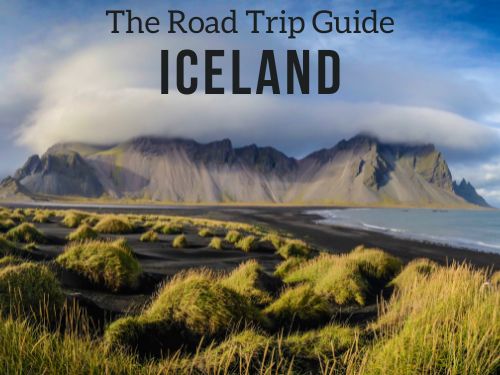
Climate in Iceland in August – weather forecast
The weather in August remains mild for Iceland, comparable to July. The weather remains changeable: a day can start with clear skies and turn into light showers a few hours later. Towards the end of the month, the first autumn chill is felt, especially in the evening. We’ve often noticed that the days of August offer beautiful sunny spells, sometimes more stable than those of June or July.
On the coasts and in the south
The southern coast retains pleasant daytime temperatures, between 10°C and 14°C. Showers remain frequent, especially in the area between Vik and Höfn, the country’s wettest. The wind blows steadily across the black sand beaches and coastal headlands. Nevertheless, there is plenty of sunshine and periods of fine weather can last for several hours.

In the north
North Iceland enjoys drier conditions than the south, protected by the central mountains. Around Lake Mývatn, midges are always present in August, although their numbers are lower than in July: a head mosquito net is still useful. The more secluded eastern fjords offer a calm setting where sunny spells alternate with cloudy passages.

In the Highlands
The Highlands are fully accessible in August. Daytime temperatures range from 3°C (37°F) to 12°C (54°F), depending on altitude and wind exposure. Nights can be cold. Rivers fed by glacial melt sometimes reach high levels early in the month, making some fords difficult to cross. We recommend crossing the rivers early in the morning, when meltwaters are at their lowest. A sturdy 4WD vehicle is a must.

UNFORGETTABLE ACTIVITIES IN Iceland
- Swimming in the Silfra fissure
- Horseback riding
- Hiking on a glacier
- Whale watching (from Reykjavik, Husavik or Akureyri)

August temperatures in Iceland
Temperatures in August were close to those in July, with a downward trend towards the end of the month. Here are the averages for three representative cities.
Temperature in Reykjavik
- Average daytime temperature: 13°C (55°F)
- Average night-time temperature: 8°C (46°F)
Temperature in Akureyri
- Average daytime temperature: 13°C (55°F)
- Average night-time temperature: 7°C (45°F)
Temperature in Vik
- Average daytime temperature: 12°C (54°F)
- Average night-time temperature: 7°C (45°F)
In any case, all year round, you’ll need warmth, windproof and rainproof layers. From T-shirt to full-coverage in no time.

RENTING A CAR IN Iceland
Discover the best offers on Discovercars, our preferred platform!
On Route 1, no 4WD required, off Route 1, it depends on your plans.

Rain and Wind
August is slightly wetter than July in Iceland. Precipitation gradually increases as the month progresses, heralding the transition to autumn. The south remains the wettest area, while the north remains comparatively drier. Showers are often short and localized: it’s not unusual to see the sun breaking through between two showers. We recommend that you always keep a waterproof jacket close at hand, whatever the weather at the start.
- Rainfall in Reykjavik: 50 to 65mm
(averaging 11 to 13 days) - Rainfall in Akureyri: 30 to 45mm
(8 to 10 days on average) - Rainfall in Vik: 90 to 130mm
(15 to 17 days on average)
There is no snow on the plains in August. Glaciers and the highest peaks retain their permanent snow cover. Vatnajökull, Europe’s largest ice cap, covers some 8,000km² and remains imposing even in the height of summer.

Winds average between 15 and 25km/h, with stronger gusts on exposed coasts and at higher altitudes. Towards the end of the month, the first autumn storms may appear. Car doors remain vulnerable: open them carefully. Check vedur.is for wind forecasts before each excursion, especially if you plan to hike in the mountains or take the ferry to the Vestmann Islands.
Sunshine and northern lights
In August, daylight hours decrease significantly. In early August, the sun rises around 4.30am and sets around 10pm. In late August, sunrise is around 5.45am and sunset around 8.30pm. The nights gradually become dark again.
Actual sunshine depends on cloud cover, which increases slightly in August. Count on an average of 4 to 6 hours of direct sunshine a day. The north tends to have clearer skies than the south.

The return of night-time darkness at the end of the month opens up the possibility of observing the first aurora borealis of the season. It’s not guaranteed, as auroral activity depends on solar factors, but conditions are right from the last week of August. Night masks become less necessary as the weeks go by.
Crowds and other conditions
The first fortnight of August extends the July peak. The major sites of the Golden Circle, the south coast and the Blue Lagoon remain very popular. The parking lots fill up in the middle of the day, and the popular hiking trails welcome a constant stream of walkers.
From mid-August onwards, visitor numbers gradually decline. European families are returning from their vacations, freeing up space in accommodation and on the roads.

In practical terms, all F roads are open. River levels in 4WD can be high after hot days, as glacial melt accelerates. Cross fords preferably early in the morning.
In August, sheep graze freely along roadsides all over the country. They can appear on the road without warning. We recommend that you drive carefully, especially in rural areas where visibility is reduced by terrain.
Wildlife in August
August marks the end of the puffin nesting season. These emblematic birds gradually leave the cliffs to return to the open sea, where they spend the winter. In early August, you can still see them in the colonies on Látrabjarg, the Vestmann islands and Borgarfjörður Eystri. From mid-August onwards, their numbers drop significantly. We advise you to visit the colonies as early as possible in the month to maximize your chances of seeing them.
On the Vestmann Islands, a singular event occurs in August: young puffins, disoriented by the artificial lights of the city, land in the streets instead of in the sea. Locals and children collect them and release them at the ocean’s edge in the early hours of the morning. This local tradition, known as “puffling patrol”, illustrates the close bond between Icelanders and their wildlife.

Whale watching remains favorable in August. Humpback whales, minke whales and white-beaked dolphins are regularly spotted from Húsavík, Akureyri and Reykjavik. Seals can be seen on the beaches of the Vatnsnes peninsula and around Jökulsárlón.
August events in Iceland
August is a festive month in Iceland. Several major events are taking place across the country:
- Þjóðhátíð (Vestmann Islands National Festival): on the first weekend in August, thousands of Icelanders gather on the island of Heimaey for the country’s biggest open-air festival. Concerts, giant bonfires, fireworks and collective celebrations punctuate this not-to-be-missed event in Icelandic culture.
- Reykjavik Culture Night (Menningarnótt): on a Saturday in mid-August, the capital is transformed into an open-air stage. Free museums, street concerts, dance performances and a final fireworks display keep the city lively until the early hours of the morning.
- Reykjavik Gay Pride: held in early August, this annual pride march attracts over 100,000 participants and spectators, representing around a third of the country’s population. The streets of the city center fill up with color and music.
Subscribe to our Newsletter
- Get away from it all with Region Lovers’ beautiful destinations!
- Once a month
- Advertising-free
August prices
August remains an expensive month in which to travel to Iceland, even if fares are slightly lower than in July at the end of the month. Iceland’s cost of living is among the highest in Europe. As everywhere, prices depend on what you’re looking for: from campsites to top-of-the-range hotels, the options are varied.
Other months
When to go to Iceland, other months…
- Iceland in January
- Iceland in February
- Iceland in March
- Iceland in April
- Iceland in May
- Iceland in June
- Iceland in July
- Iceland in September
- Iceland in October
- Iceland in November
- Iceland in December
Or read our article on when to go to Iceland (coming soon).
PLAN YOUR SUMMER TRIP TO iceland
- Best of
What to do in Iceland
The most beautiful waterfalls
The most beautiful black sand beaches
Volcanic craters to climb
Lava caves to visit
Best excursions from Reykjavik

- Practical advice
Summer travel tips
How to rent a car in Iceland
Driving tips
Where to stay in Iceland
Itineraries: 3 days – 4 days – 5 days – 1 week – 10 days

- The must-dos
What to do in Reykjavik
Best attractions in the Golden Circle
South Coast attractions
Snaefellsnes Peninsula
Silver Circle
Lake Myvatn attractions