
Here’s our complete guide to planning your trip to Iceland in winter, with all our advice in one place for making choices and getting ready:
- Where to go and how
- Where to sleep
- Map and directions
- What to bring
- What to look out for
- …
This opinion is completely independent, based on our experiences. We visited the region anonymously, making our own choices and paying our bills in full.
Content
Successful winter travel in Iceland: the essentials
If you don’t want to read the whole article, here’s a summary of our answers. But you’ll find more detailed information in each section below.
When to go
Winter in Iceland lasts from November to March. For a good balance between daylight and Northern Lights nights, we recommend late February and early March, with 10-13h of daylight.
December-January are the darkest months, with only 4-5 hours of daylight.
Temperatures
Temperatures in Reykjavik range from 0.6°C to 4.9°C in winter. The north of the country and the highlands experience lower temperatures, down to -10°C.

Where to go
Our favourite regions for a winter break are :
- The easily accessible south coast, a world of waterfalls, icebergs and ice caves
- The Snaefellsnes peninsula for a wide variety of experiences
- Lake Myvatn for an intriguing black-and-white world
How to get around
There are three main options:
- Rent a winter-equipped car (recommended if you’re comfortable)
- Joining organized excursions (safest option)
- Use public transport (limited to major cities)
Our top 3 winter activities
- Watching the northern lights
- Explore the ice caves
- Bathing in geothermal hot springs

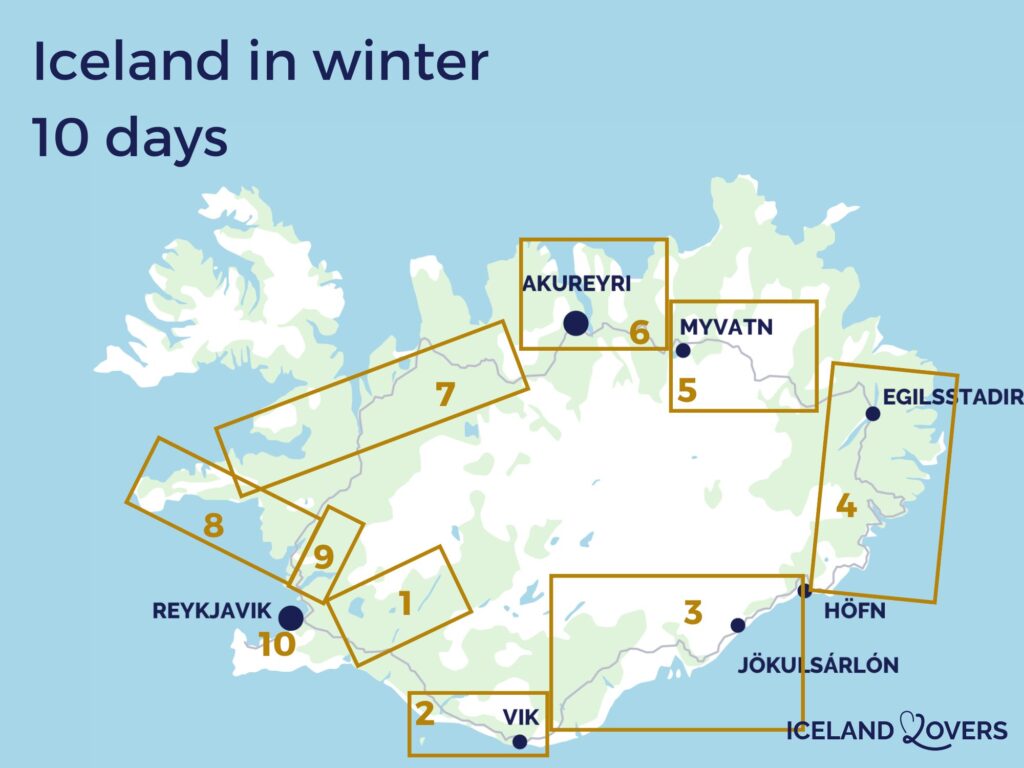
Map – How long will you be gone?
To fully enjoy Iceland in winter, a stay of 7 to 10 days is ideal.
This allows you to explore the Golden Circle, follow part of the south coast to the glaciers and black sand beaches, and keep a few evenings free to watch for the Northern Lights.
If time is more limited, 4 to 5 days are enough to discover the must-sees around Reykjavik and the south-west, but you’ll have to make some choices.
In winter, the days are very short – just 4 to 5 hours of daylight in December – which slows down travel considerably, and weather conditions make distances longer to cover than in summer.
Note also that changing weather conditions can also upset plans: a closed road or a snowstorm can mean staying an extra day in the same place. It’s better to leave a margin in your itinerary rather than overload the program, and keep in mind that the Icelandic winter rhythm is more conducive to contemplation than racing.
When to go to Iceland in winter
The Icelandic winter lasts from November to March, but each month offers a unique experience:
- November: 5-8h daylight hours, start of Northern Lights season
- December: 4h30-5h daylight hours, time of Icelandic festivals and traditions
- January: 4h30-7h daylight hours, coldest temperatures
- February: 7-10h daylight, ideal conditions for ice caves
- March: 10-13:30 daylight hours, good balance between light and dark for auroras

How to get to Iceland in winter
The only practical way to reach Iceland in winter is by plane. Keflavik International Airport (KEF) is the main point of entry, around 45 minutes from Reykjavik.
- Direct flights – Available from many European cities: Paris, London, Amsterdam, Frankfurt, etc.
- Transfer to Reykjavik – Regular shuttle service from the airport to the city center
- Visa – Iceland is part of the Schengen area, check your visa requirements according to your nationality

It’s time to book!
Compare everything: companies, prices, schedules and availability.
Getting around Iceland in winter
Car rental
Renting a car offers you great freedom, but requires adequate preparation:
- Choose a 4WD vehicle equipped with winter tires
- Check daily weather and road conditions on road.is
- Stay on main roads (Ring Road) and avoid mountain roads
- Always carry a full tank of fuel and provisions
- Expect longer journey times than in summer
- See all our tips for renting a car in Iceland.

Our first instinct is to check out the offers on DiscoverCars.
This platform allows us to easily compare offers from different rental companies: prices and conditions. And every time, we find good deals. What’s more, the insurance is attractively priced.
See the latest car rental offers
And then check out our article on winter driving.

Organized excursions
Organized excursions are an excellent alternative, particularly recommended for :
- Northern lights viewing – see options
- Visits to the ice caves (at least 2 days from Reykjavik)
- Golden Circle tours like this one
- Glacier hiking
- Blue Lagoon like this one
Day trips are available from Reykjavik.
Or multi-day tours, or even guided tours around Iceland.
See our article on our favorite excursions from Reykjavik.

Public transport
We don’t recommend trying to get around by public transport. They only go to cities with low frequencies, while almost all attractions are outside cities.
OUR GUIDE TO PLANNING A Dream trip
- 6 maps that make planning easier
- + 75 pre-selected locations
- Practical advice
- + 115 photos to help you choose
Winter itinerary in Iceland
Our site contains lots of information and photos to help you plan a trip that suits you. But the amount of choices to be made can seem like a mountain.
In that case, start with our itinerary suggestions:
Best things to do in Iceland in winter
In addition to admiring the magnificent landscapes under the snow, winter offers unique experiences impossible to enjoy in summer:
- Aurora borealis – Best viewing opportunities from September to March
- Ice caves – Accessible only in winter, especially on the Vatnajökull glacier – see our article
- Hot springs – Even more magical in the cold of winter (Blue Lagoon, Sky Lagoon, etc.).

- Winter activities:
- Glacier hiking
- Snowmobile
- Skiing in Akureyri
- Whale watching (available all year round)
- Cultural events:
- Christmas festivities (13 Icelandic Santas)
- Spectacular New Year in Reykjavik
- Winter Lights Festival in February
See our full article on Iceland’s winter attractions.

UNFORGETTABLE ACTIVITIES IN winter
- Visit an ice cave
- Glacier hiking
- Whale watching (from Reykjavik, Husavik or Akureyri)

Which region to visit and where to sleep?
Your choice of location will depend on your travel objectives.
Take a look at our full article, or read the summary of our recommendations by region below:
Reykjavik
The capital Reykjavik is an excellent winter base:
- Numerous accommodation options to suit all budgets
- Restaurants and lively nightlife
- Ideal starting point for excursions
- Easy access to the Blue Lagoon and the Golden Circle
- Surprising and historic museums

A wide choice of accommodation, including hotels, aparthotels and rentals.
Please note that tour buses do not enter the center, but there are pick-up points all around.
Our favorite hotels:
Reykjavik Konsulat Hotel – Check photos and availability.
Black Pearl Apartment Hotel – Check photos and availability
See the top-rated accommodations in Reykjavik.

South coast of Iceland
The south coast region is the most accessible in winter with :
- The mangiferous Seljalandsfoss and Skógafoss waterfalls, which don’t freeze over completely
- The glacial lagoons of Jökulsárlón and Fjallsarlon
- The black sand beaches of Vík and Diamond Beach with its iecbergs
- Ice caves
- Glacier hiking
- Numerous opportunities to observe the northern lights

On the south coast, you will find accommodation in the towns of
- Selfoss, between the Golden Circle and the coast
- Vik, in the middle of the coast
- Höfn in the east, between the southern coast and the eastern fjords
Our favorite hotels:
Kria Hotel – Check photos and availability.
Fosshotel Glacier Lagoon – Check photos and availability
And you’ll also find hotels and guest farms between towns, surrounded by nature.
See the best rated accommodations around Vik.
See the best rated accommodations around Höfn.

The golden circle
The Golden Circle, one of Iceland’s most famous itineraries, offers a unique winter experience. We were amazed by the beauty of the snow-covered landscapes and the magic of the geysers in the winter light. A stay in this region allows you to take full advantage of iconic sites such as Thingvellir, Geysir and Gullfoss.

The accommodations, often surrounded by nature, offer total immersion in the Icelandic landscape.
You can find a small-town spirit in Fludir, or head to Selfoss for many more options, the town between the Golden Circle and the south coast.
Our favourite hotel: The Hill Hotel at Fludir – Check photos and availability
See the top-rated accommodations on the Golden Circle.

The Snaefellsnes Peninsula
The Snaefellsnes Peninsula is one of our favorite regions in Iceland, even in winter.
The scenery is less impressive than on the south coast or in the Golden Circle, but the atmosphere is, in our opinion, more magical, with beaches, fjords, volcanoes and lava fields.
Among the must-haves:
- Kirfkjufell mountain and its waterfalls
- Arnarstapi and Londrangar lava cliffs
- The black church of Budakirkja is even more surprising, surrounded by white snow.
- Saxholl crater

Whether in summer or winter, the places to stay are similar, even if not all B&Bs and guesthouses are open.
The two main options are:
- Borgarnes, inland at the junction between Route 1 and the access road to Snaefellsnes
- Grundarfjordur to be right next to Kirkjufell and admire the northern lights with a bit of luck.
Our favorite: Hotel Hamar in Borganes – Check photos and availability
See the best rated accommodations on Snaefellsnes Peninsula
See our article on where to stay on the Snaefellsnes peninsula.

Eastern Fjords
Iceland’s eastern fjords are more of a transit region. It’s an easy 1-day drive from fjord to fjord.
This is where you’ll have the best chance of spotting reindeer, and enjoying traditional fishing villages.

Egilsstadir, the main town in eastern Iceland, is a strategic stopover if you’re touring Iceland via Route 1. It’s an ideal place to end the day after exploring the eastern fjords. In winter, the town offers a comfortable, well-equipped retreat, with its many services and amenities. Egilsstadir is surrounded by a variety of landscapes, from forests (rare in Iceland) to frozen lakes.
Our favorite: Gistihusid – Lake Hotel Egilsstadir – Check photos and availability
See the top-rated accommodations in Egilsstadir.

Lake Myvatn
The Lake Myvatn region offers a unique black-and-white interlude during the Icelandic winter. We were captivated by the lunar landscapes and volcanic formations surrounding this shallow lake. In winter, the Hverir geothermal zone, with its fumaroles and pools of bubbling mud, creates a striking contrast with the surrounding snow. Staying near Lake Myvatn means you can explore the pseudo-craters of Skutustadagir, the lava formations of Dimmuborgir, and relax in the natural baths.

The main town is Reykjalid, but there are accommodations all around the lake (not all open in winter).
Our favorite: Fosshotel Myvatn – Check photos and availability
See top rated accommodations around Lake Myvatn.

Akureyri, capital of the North :
Northern Iceland offers a unique and authentic winter experience, although conditions are more extreme than in the south:
- Largest city in the north (approx. 20,000 inhabitants)
- Ideal starting point for exploring the region
- Hlíðarfjall ski resort renowned for excellent conditions
- Direct flight from Reykjavik to avoid winter driving
Specific activities :
- Skiing and snowboarding in Hlíðarfjall
- Mývatn geothermal baths
- Whale watching from Húsavík (possible even in winter)
- Snowshoe hikes
- Snowmobile tours

In Akureyri, you’ll find a wide choice of accommodation including hotels, aparthotels and rentals. As the city lies on a fjord, accommodations outside the center can offer unforgettable panoramas.
Our favorite: Akureyri Berjaya – Check photos and availability
See the top-rated accommodations in Akureyri.

The Westfjords and Highlands in winter
These spectacular regions become largely inaccessible in winter. Roads are often closed due to extreme weather conditions and heavy snowfalls.
How to dress in Iceland in winter
In Iceland in winter, the choice of clothing is crucial to making the most of your stay. The three-layer principle is essential:
- First layer (against the skin) :
- Thermal underwear in merino wool or synthetic materials
- Avoid cotton, which retains moisture
- Intermediate layer (insulation) :
- Wool or fleece sweater
- Warm ski pants
- Outer layer (protection) :
- Waterproof and windproof jacket with hood
- Waterproof ski or hiking pants

Essential accessories :
- Warm hat
- Scarf or choker
- Waterproof gloves
- Thermal socks
- Waterproof and non-slip boots
- Crampons to attach to shoes
See our full article on what to bring to Iceland in winter.

Winter safety in Iceland
Weather conditions
The weather can change rapidly in Iceland. Here are the essential precautions:
- Check the weather forecast daily on vedur.is
- The biggest danger is not necessarily the snow, but the wind!
- Follow Iceland’s weather warning system:
- Yellow: difficult conditions
- Orange: potential danger
- Red: extreme danger
- Download the 112 Iceland emergency application
- In case of emergency, dial 112

Winter driving
- Always carry with you in the car:
- Covers
- Food and water
- Flashlight
- First aid kit
- Charged cell phone
- Never stop on the road to photograph
- Respect road closures
And read our article on winter driving!
Water
Iceland’s tap water is one of the purest in the world, and perfectly drinkable. It comes directly from glacial springs and natural aquifers. A slight sulfur odor may be present in hot water due to its geothermal origin, but it is totally harmless.

How to see the aurora borealis
To admire the northern lights, winter is the best time to visit Iceland. The long, dark nights offer ideal conditions for observing this unique celestial spectacle. But nothing is guaranteed!
For the best chances, you need clear skies and high solar activity 18 hours beforehand.
You also need to keep as far away from light sources as possible.
Many hotels offer wake-up calls in the event of visible dawn, so you don’t miss a thing.
See the different tower options

Icelandic wildlife in winter
The Icelandic winter offers unique opportunities to observe wildlife adapted to extreme conditions:
Arctic foxes
The only land mammal native to Iceland, the Arctic fox changes color in winter to a white coat that allows it to blend in with the snow. Difficult to spot but fascinating to observe. We spotted one crossing the road, but didn’t have time to take a photo. It quickly disappeared into the white of the snow!
Reindeer
Mainly seen in eastern Iceland, they come down from the highlands in winter in search of food. Introduced in the 18th century, they have adapted perfectly to the Icelandic climate. We were lucky enough to see quite a few on the roadside!

Whales and marine life
Winter is ideal for spotting white-beaked dolphins and porpoises. If you’re lucky, you may even catch a glimpse of the humpback whales that remain in Icelandic waters.
See excursion options
The Icelandic horse
This unique breed develops a thick winter coat that allows it to stay outdoors all year round. You can watch them in the snow-covered fields and even go horseback riding in winter.
Whether you’re watching them or riding them, Icelandic horses offer an authentic and memorable experience. – View options and book

Puffin
You won’t see any puffins in winter. During this season, they stay mainly at sea. They return to the shore only in spring to breed.
Christmas festivities
Christmas in Iceland
Icelandic Christmas traditions are unique and extend over several weeks. It’s a cultural experience we recommend.
The 13 “Yule Lads” are folkloric characters who visit children for 13 nights before Christmas, leaving small gifts in shoes placed on windowsills. Their mother, Gryla, is a frightening troll who… Legend has it that she eats disobedient children.
New Year’s Eve
Icelandic New Year’s Eve is very festive.
Unlike in other countries, individuals can buy and shoot off their own fireworks, creating a nationwide pyrotechnic spectacle.
The evening traditionally begins with community “brennur” (bonfires), and at midnight the sky lights up with fireworks all over the country.
Practical aspects
Iceland is an expensive destination, especially in winter when certain equipment is essential. Here’s what you need to know:
- Currency: Icelandic krona (ISK), but credit cards accepted everywhere
- Electricity: European 230V sockets (type C and F)
- Internet: Wifi widely available, but remember to take a local option to access the Internet between towns.
- Language: English is widely spoken
- Opening hours:
- Supermarkets: generally 10 a.m.-7 p.m.
- Restaurants: 11:30 a.m.-10 p.m.
- Reduced opening hours over the holidays

Frequently asked questions about Iceland in winter
Is Iceland completely dark in winter?
No, even at the shortest time of the year (December 21), Reykjavik enjoys around 4 hours of daylight. In November and March, you’ll have between 8 and 10 hours of daylight.
Is it possible to camp in winter?
Although possible, camping is not recommended in winter. Most campsites are closed and weather conditions can be extreme. Choose solid accommodation.
Can you see the northern lights every night?
No, aurora viewing depends on several factors: solar activity, cloud cover and darkness. The best conditions are on a clear, cold night, away from the city lights.
Are all attractions in Iceland accessible in winter?
Some attractions may be temporarily inaccessible due to adverse weather conditions or closed for the season. However, many popular sites, such as the Golden Circle, remain open. This is particularly true of locations along Iceland’s southern coast, where the weather is generally milder.
Base yourself in Reykjavik or go on a road trip?
Our recommendation is to go on a road trip to really enjoy this exceptional country. But we understand that the stress of driving in winter is real, and in this case, making excursions from Reykjavik means you can already see a lot of sumptuous places.
PLAN YOUR TRIP TO iceland IN WINTER
- Best of
Iceland’s winter landscapes
Best things to do in Iceland in winter
The most beautiful waterfalls
Ice caves
Best excursions from Reykjavik

- Practical advice
Getting around (coming soon)
How to rent a car in Iceland
Winter driving tips
Where to stay in Iceland in winter
Itineraries: 3 days – 4 days – 5 days – 1 week – 10 days (to come)

- The must-dos
Reykjavik in winter
Golden Circle in winter
South coast in winter
Snaefellsnes in winter
Silver Circle in winter (coming soon)
Lake Myvatn in winter
Eastern Fjords in winter
Seljalandsfoss in winter
Jokulsarlon in winter